The standard mileage rate and the actual expense method solve the same problem in two very different ways. One prices the trip with a federal per-mile rate. The other prices the business-use share of your real vehicle costs.
That choice matters before you file because the record burden changes with it. The current federal rate and the method rules live in the IRS mileage-rate announcement, the standard mileage rates page, and Publication 463.
If you want mileage tracking to stay clean while you compare the methods, MyCarTracks automatic mileage tracking can help you keep business trips, total mileage, and export-ready reports organized across the year.
This article is educational and is not tax, legal, payroll, employment, or financial advice. Mileage rules change by federal tax treatment, state law, employer policy, vehicle program, and tax year. Check the official source and a qualified professional before relying on a calculation.
Quick answer
The standard mileage method is usually easier because it multiplies qualifying business miles by the federal rate. The actual expense method is more detailed because it uses the business-use share of real vehicle costs. The better option depends on eligibility, driving patterns, vehicle costs, and the quality of your records.
Eligibility rules that can block the standard mileage method
Actual expenses are broadly available. The standard mileage method has more gatekeeping.
Publication 463 explains that you generally cannot use the standard mileage method for a vehicle if you:
- use five or more cars at the same time in business
- claimed depreciation on the car using a method other than straight line
- claimed a Section 179 deduction on the car
- claimed the special depreciation allowance on the car
- claimed actual expenses after 1997 for a leased car
The first-year choice also matters. For a vehicle you own, you generally need to choose the standard mileage method in the first year the vehicle is available for business use if you want that method to remain available later. For a leased vehicle, using the standard mileage method usually commits you to that method for the full lease period, including renewals.
Standard mileage method
The standard mileage method uses a fixed federal rate for qualifying business miles. For 2026, the IRS business rate is 72.5 cents per mile for business use of a car, van, pickup, or panel truck, including gasoline, diesel, hybrid, and fully electric vehicles.
This method is popular because the math is simple once the miles have been classified correctly. It also works well when your main challenge is consistent mileage tracking rather than receipt management.
What the standard mileage rate covers
The per-mile amount is meant to reflect the cost of operating the vehicle for business. That is why you usually do not add the same vehicle operating costs again under the same method.
Parking and tolls for qualifying business trips are different. They can still matter, but they stay outside the mileage line. If that distinction is easy to lose in your records, Business Travel Tax Deduction is the right companion article.
Why people choose the standard mileage method
- simpler calculations once the mileage log is clean
- fewer receipts to manage than the actual expense method
- easier year-end review when one vehicle has moderate operating costs
- a cleaner fit for people who want a repeatable routine rather than a full vehicle-cost ledger
Where the standard mileage method can disappoint
- it can understate costs for expensive or high-maintenance vehicles
- it is not available for every vehicle
- it still requires a mileage log, even though the math is simpler
- using it on a leased vehicle can limit later flexibility
Actual expense method
The actual expense method uses the business-use percentage of the real costs of owning and operating the vehicle.
Publication 463 lists deductible categories that can include lease payments, depreciation, registration fees, licenses, insurance, repairs, gas, oil, tires, parking fees, and tolls when the facts support the deduction.
How the actual expense method works
Start with the full annual vehicle cost. Then calculate the business-use percentage by comparing business miles with total miles for the year. Apply that percentage to the deductible cost pool.
That is the main reason mileage still matters under the actual expense method. Even when the deduction is based on real costs, you still need mileage tracking to defend the business-use percentage.
Why people choose actual expenses
- it can produce a larger deduction when the vehicle is expensive to buy, maintain, insure, or repair
- it reflects the real operating cost of the specific vehicle instead of a national average
- it gives a more precise answer when business use is high and records are strong
Where actual expenses can become painful
- every deductible cost needs documentation
- mixed-use vehicles require total annual mileage, not only business miles
- depreciation choices can lock you out of standard mileage later
- year-end review takes longer because the file is larger and easier to misclassify
Mileage tracking records each method needs
Both methods need mileage tracking. The difference is what gets layered on top.
| Record question | Standard mileage method | Actual expense method |
|---|---|---|
| Business trip log | yes | yes |
| Business purpose for each trip | yes | yes |
| Total annual vehicle miles | strongly recommended | required in practice |
| Parking and toll support | yes, kept separate | yes |
| Fuel, insurance, repair, and registration receipts | no, not for the mileage line itself | yes |
| Depreciation or lease support | no | yes where relevant |
That is why What Is a Mileage Log?, IRS Mileage Log Requirements, and How to Track Mileage for Tax Deductions belong in the same workflow as this method decision.
How the methods compare
| Question | Standard mileage rate | Actual expenses |
|---|---|---|
| Main formula | business miles x federal rate | deductible vehicle costs x business-use percentage |
| Best fit | cleaner routine, lower admin burden | higher vehicle costs, stronger documentation |
| Biggest record risk | missing or misclassified miles | missing receipts or weak business-use percentage |
| Flexibility concern | first-year and lease rules matter | depreciation choices can narrow later options |
| Route costs | parking and tolls stay separate | parking and tolls can be part of the documented cost set |
When standard mileage is usually the better fit
Standard mileage is often the cleaner choice when you want the deduction process to stay predictable.
It is commonly a good fit when:
- your vehicle costs are fairly ordinary
- you want a lighter record burden
- your business use is easy to document with a mileage log
- you value speed and repeatability more than squeezing every possible dollar from the calculation
If that sounds like your situation, How to Claim Mileage on Taxes shows how the method fits into the filing flow.
When actual expenses can be worth the extra work
Actual expenses can be worth the trouble when the vehicle is costly to operate and the records are already disciplined.
That often means:
- a newer or more expensive vehicle
- high insurance, repair, or maintenance costs
- heavy business use that makes the percentage meaningful
- a taxpayer who will actually keep the receipts and year-end totals organized
If you are self-employed, Self-Employed Mileage Deduction Rules goes deeper on choosing and defending that method.
Mileage that still does not qualify
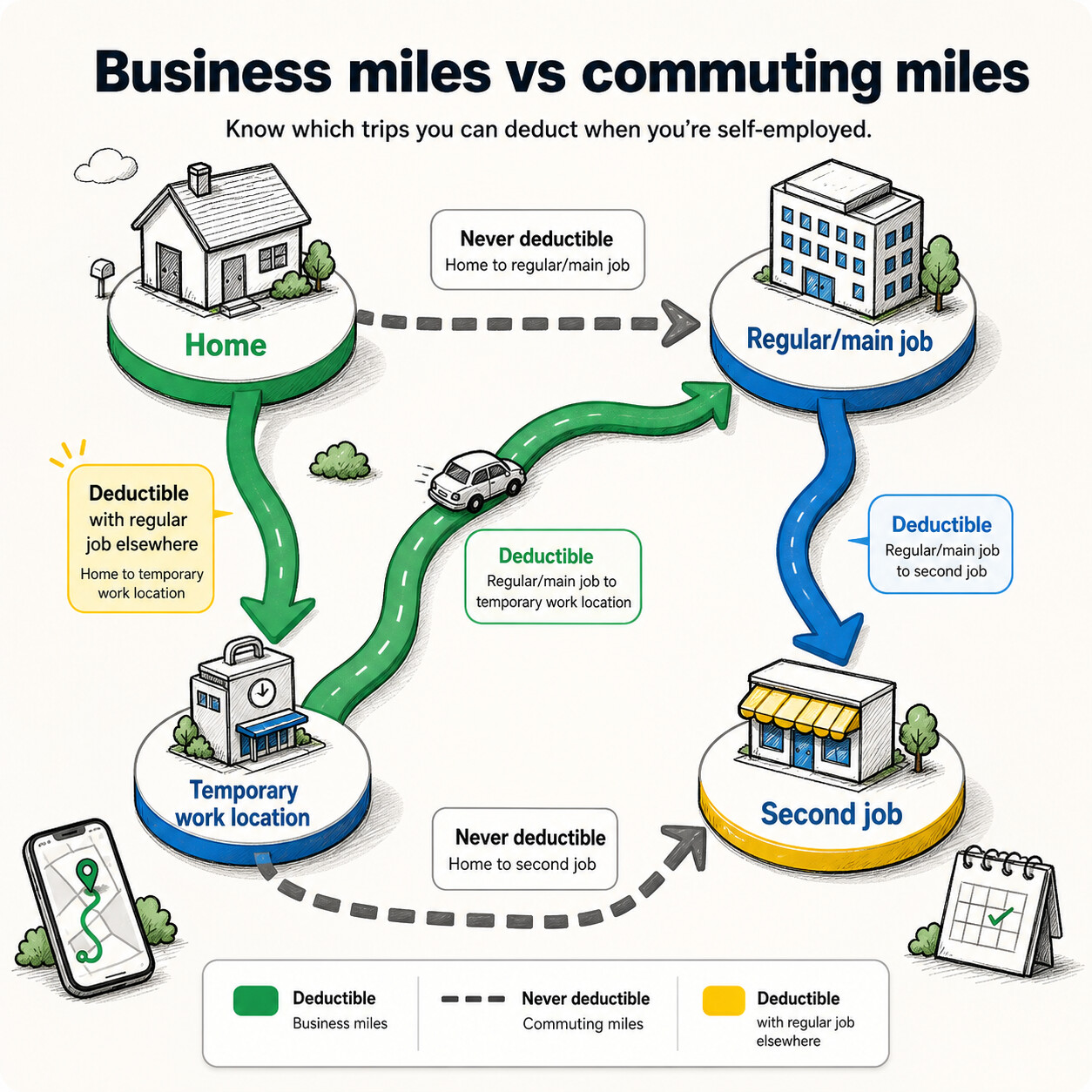
Changing the calculation method does not turn a nondeductible trip into a deductible one.
Ordinary commuting remains the big trap. Personal errands also stay personal even when they happen between work tasks. Temporary workplace rules and qualifying home-office situations can change the analysis, but they do not erase the need to classify each trip correctly. Use Business Miles vs Commuting Miles before you price the trip.
Other deductible travel costs to keep separate
Mileage is only one part of some business travel files.
Parking, tolls, airfare, lodging, and other qualifying travel costs may belong in the tax file too, but they do not all belong inside the same mileage number. If you need the broader travel-cost workflow, use Business Travel Tax Deduction. If you need the broader tax file around vehicle and nonvehicle write-offs, Self-Employed Tax Deductions is the better support article.
Common mistakes
- assuming standard mileage means no log is needed
- using actual expenses without keeping total annual miles
- adding fuel again after already using the standard mileage rate
- choosing a depreciation path without understanding the later method lock-in
- treating commuting like business mileage
- applying the current year’s rate to older miles
FAQ
Is standard mileage the same thing as cents-per-mile?
In most tax discussions, yes. People often use cents-per-mile, standard mileage rate, and standard mileage method to describe the same federal per-mile calculation.
Can actual expenses produce a bigger deduction?
Yes. That is one reason people compare the methods. But the bigger number only helps if the records are complete enough to support it.
Do I still need mileage tracking if I use actual expenses?
Yes. Actual expenses still depend on the business-use percentage, and that percentage depends on mileage records.
Can I change methods every year?
Sometimes, but not always. The first-year choice, depreciation decisions, and lease rules can all restrict later changes.
MyCarTracks workflow
Use MyCarTracks to build the record first, then compare the methods with cleaner data.
- Capture business trips throughout the year instead of recreating them from memory.
- Review questionable trips early so commuting and personal use do not contaminate the annual totals.
- Export mileage logs by vehicle and tax year before you compare standard mileage with actual expenses.
- Keep the mileage report with the receipts and depreciation documents if actual expenses are still in the running.
If you need the broader product view behind reporting, exports, and team visibility, see MyCarTracks and the reporting sections on the features page.
What to read next
- How to Claim Mileage on Taxes
- Self-Employed Mileage Deduction Rules
- Business Miles vs Commuting Miles
- Business Travel Tax Deduction