California mileage tracking and reimbursement questions start with one point if you want to review employee driving claims correctly: if an employee has to use a personal vehicle for work, California Labor Code section 2802 is the starting point because it requires employers to cover necessary expenditures or losses tied to the job.
That does not mean every employer has to use the same formula. The real California question is whether the reimbursement method fairly covers required business driving and whether the trip record can hold up later. Many employers use the 2026 IRS business mileage rate of 72.5 cents per mile as a practical benchmark, but California law focuses on adequate reimbursement, not one mandatory statewide mileage rate.
If you want the mileage record cleaned up before payroll review starts, MyCarTracks automatic mileage tracking can help you capture routes, classify business drives, and export approval-ready reports while the details are still easy to verify.
This article is educational and is not tax, legal, payroll, employment, or financial advice. Mileage rules change by federal tax treatment, state law, employer policy, vehicle program, and tax year. Check the official source and a qualified professional before relying on a calculation.
Quick answer
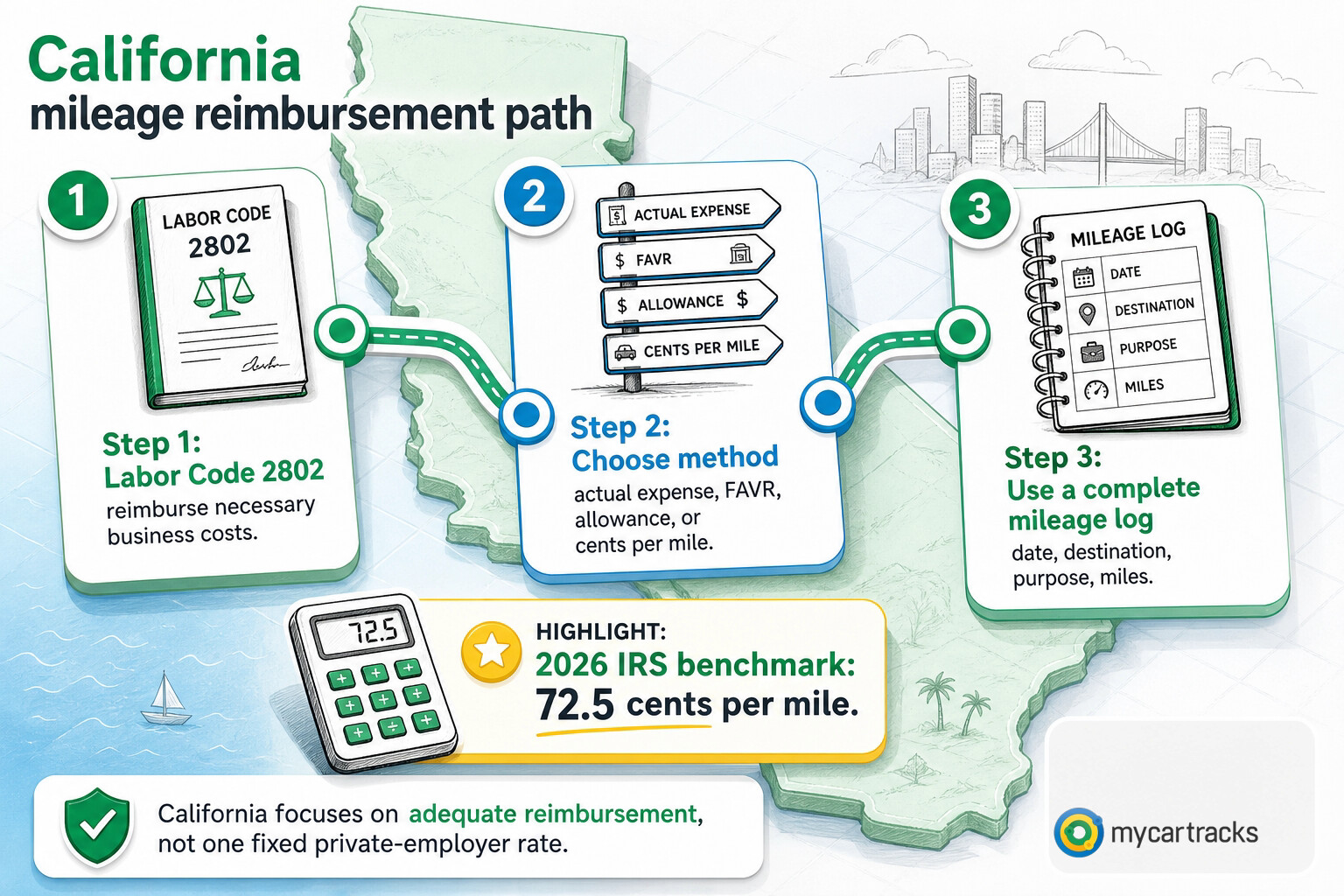
California employers generally need to reimburse employees for necessary vehicle costs incurred while doing their jobs. The law does not force one reimbursement method, but the method chosen still needs to reasonably cover required business driving in a personal vehicle. That is why the practical California workflow is law first, method second, and mileage log third.
California reimbursement rule
The core California rule is broad on purpose. Under Labor Code section 2802, an employer must indemnify an employee for necessary expenditures or losses incurred in direct consequence of job duties or the employer’s directions. Section 2802(c) also says necessary expenditures include all reasonable costs, which matters because personal-vehicle reimbursement is about more than just gasoline.
For mileage, that usually means an employer should not shift ordinary business-driving costs onto the employee. Daily commuting is still a separate category, so it helps to sort that question first with Business Miles vs Commuting Miles before anyone starts pricing trips.
California law is flexible on method but not on outcome. A company can choose the program design that fits its workforce, yet it still needs a result that reasonably covers required business use of a personal vehicle. If you need the broader policy layer behind that decision, Mileage Reimbursement Rules for Employers and How to Create a Mileage Reimbursement Policy are the next local guides.
Methods of mileage reimbursement in California
California employers usually pick one of four reimbursement approaches:
- actual expense reimbursement
- FAVR reimbursement
- lump-sum allowance
- cents-per-mile reimbursement
Each method can work in the right setting, but each one creates a different recordkeeping burden and a different risk of overpaying or underpaying employees.
Actual expense method
The actual expense method is the most detailed option. Employees track business mileage, keep receipts, and document vehicle costs such as fuel, maintenance, insurance, repairs, registration, and similar operating expenses. Then the reimbursement is tied to the business-use portion of those costs rather than a flat rate per mile.
This method can be highly accurate, especially when driving patterns vary sharply across employees. It also creates more room for disagreement over what is reasonable, necessary, and sufficiently documented. If your team is comparing this approach with the simpler mileage-rate model, Standard Mileage Rate vs Actual Expenses gives the federal method background that usually shapes the employer discussion.
FAVR reimbursement method
FAVR stands for fixed and variable rate reimbursement. It separates ownership-style costs such as insurance, depreciation, taxes, and registration from operating costs such as fuel, oil, tires, and maintenance. That makes it more precise than a simple cents-per-mile plan for teams with recurring business driving and meaningful cost variation by location.
The tradeoff is administration. FAVR works best when the company is willing to maintain stronger program rules, mileage tracking, and payroll coordination. If California employees drive often enough to justify that structure, FAVR Reimbursement Plans Explained and Car Allowance vs Mileage Reimbursement are the right follow-up reads.
Lump-sum method
A lump-sum method pays a fixed amount, often monthly, to help cover business vehicle use. Employers like it because it is easy to budget and easy to explain. Employees often like it only when the allowance actually keeps pace with the real cost of the work driving they are expected to do.
That is the California risk. A flat payment can be simple but still fail if it consistently leaves employees short of the necessary costs created by their job duties. It can also create avoidable disputes when one employee drives a few hundred business miles and another drives several times more under the same allowance.
Cents-per-mile method
The cents-per-mile method is the most common California reimbursement approach because it is easy to administer and easy to audit later. Employees log their qualifying business miles, and the employer applies a set reimbursement rate to those miles.
Many companies use the IRS business mileage rate as the working benchmark because it gives them a current, recognizable figure and usually fits accountable reimbursement workflows. The method is still only as good as the mileage log behind it, which is why What Is a Mileage Log?, IRS Mileage Log Requirements, and How to Calculate Mileage Reimbursement belong in the same process.
California mileage rate 2026
California does not publish one general private-employer mileage reimbursement rate for all business driving. In practice, many employers use the current IRS business mileage rate as the cents-per-mile benchmark because it is updated annually and already reflects a national vehicle-cost study.
For 2026, the IRS business rate is 72.5 cents per mile. Recent business rates were:
- 2025: 70 cents per mile
- 2024: 67 cents per mile
- 2023: 65.5 cents per mile
- July 1, 2022 through December 31, 2022: 62.5 cents per mile
- January 1, 2022 through June 30, 2022: 58.5 cents per mile
Using the IRS benchmark can make administration easier, but California compliance still depends on whether the reimbursement method reasonably covers necessary business-driving costs. If you are pricing older claims, use the rate that matched the trip date rather than the rate in effect today.
What cents-per-mile reimbursement usually covers
When an employer uses a cents-per-mile reimbursement approach, the rate is meant to approximate the cost of owning and operating a vehicle for business use. That usually includes items such as:
- fuel
- maintenance
- insurance
- depreciation
- registration and licensing costs
- tires and routine wear
Parking and tolls are often handled separately, so the policy should say that explicitly. If the employer uses the actual expense method instead, the employee usually needs receipts and a business-use percentage calculation rather than a single flat rate.
Mileage tracking records for reimbursement
California reimbursement is much easier to defend when the mileage file is complete before the claim is submitted. For a cents-per-mile plan, the mileage tracking record should usually show:
- trip date
- starting point and destination
- business purpose
- miles driven
- employee or driver name
- vehicle used
- parking and toll support when those are reimbursed separately
For an actual-expense plan, the record stack needs more than a log. Employees also need receipts or other support for vehicle costs, plus enough mileage history to calculate the business-use share. That is why automatic trip capture can save time long before a dispute exists. If you want a cleaner reporting workflow, MyCarTracks mileage reports can help turn trip history into reimbursement-period exports, and the broader MyCarTracks homepage shows how the reporting layer fits into fleet, driver, and admin workflows.
California teams should also save the written policy version used for the claim period. Without that, a company may know how many miles were driven but still struggle to explain why a specific method, rate, or exception was applied.
Common mistakes
- treating the IRS rate as the only California rule instead of a common benchmark
- reimbursing a flat amount without checking whether it actually covers required business driving
- mixing commuting with qualifying business mileage
- keeping the reimbursement total but not the mileage log behind it
- forgetting to preserve parking, toll, and policy-version support
MyCarTracks workflow
Use MyCarTracks when you want California claims to be reviewed from trip data instead of from memory.
- Capture drives automatically instead of rebuilding them later.
- Classify business mileage and commuting before the route details go stale.
- Export reports by employee, vehicle, client, or reimbursement period.
- Save the trip report with the policy version and payment approval.
For automatic trip capture, use MyCarTracks automatic mileage tracking. If you need reimbursement-period exports, MyCarTracks mileage reports can help, and the broader MyCarTracks homepage shows how the reporting layer fits into driver and admin workflows.
FAQ
How much is mileage reimbursement in California?
There is no one California private-employer mileage rate that automatically applies to every company. Many employers use the 2026 IRS business rate of 72.5 cents per mile as the working cents-per-mile benchmark, but California law still asks whether the method reasonably reimburses necessary business-driving costs.
How do you calculate mileage reimbursement in California?
Under a cents-per-mile plan, multiply the employee’s qualifying business miles by the employer’s approved reimbursement rate. If an employee drove 500 approved business miles at 72.5 cents per mile, the reimbursement would be $362.50. If the company uses actual expenses instead, it needs the vehicle-cost records and the business-use percentage rather than that simple formula.
Does California mileage reimbursement include gas?
Usually yes, when the employer is using a cents-per-mile rate. That method is intended to cover a bundle of vehicle operating and ownership costs rather than fuel alone. If the company uses actual expenses, gas is typically one documented cost among several rather than the whole reimbursement.
What to read next
- Which States Require Mileage Reimbursement?
- What Is Mileage Reimbursement?
- Mileage Reimbursement Rules for Employers
- How to Create a Mileage Reimbursement Policy
- Business Miles vs Commuting Miles
- What Is a Mileage Log?