For 2026, the prescribed tax-exempt employee allowance limit in Canada is 73 cents per kilometre for the first 5,000 kilometres in the provinces and 67 cents after that. In the territories, the 2026 limit is 77 cents for the first 5,000 kilometres and 71 cents after that. Those numbers come from the Department of Finance Canada 2026 announcement and sit inside the CRA rules for automobile and motor vehicle allowances.
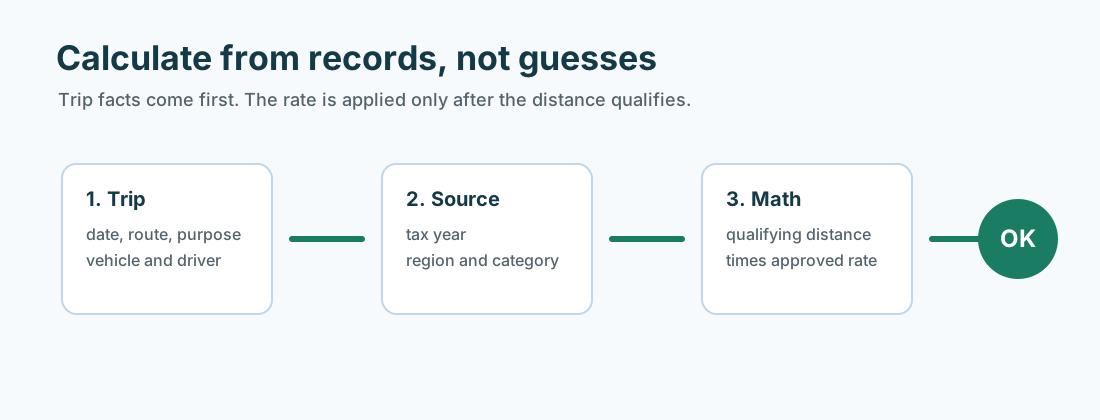
If you want mileage tracking in place before you build the allowance or deduction file, a mileage tracker app such as MyCarTracks automatic mileage tracking can help you keep kilometres, business purpose, and vehicle details together while the trip is still fresh. That matters because the rate alone is not enough. CRA still expects a logbook and supporting records when the vehicle is used for business mileage.
This article is educational and is not tax, legal, payroll, employment, or financial advice. Mileage rules change by country, employer policy, vehicle type, and tax year. Check the official source and a qualified professional before relying on a calculation.
Quick answer
Use the 2026 prescribed rates only for the employee allowance question they are meant to answer. They are not a self-employed deduction table, and they do not replace the logbook. If you are reimbursing employees, start with the 73/67 or 77/71 rates and the CRA reasonableness rules. If you are self-employed, start with total vehicle kilometres, business kilometres, and actual supported motor vehicle expenses.
2026 prescribed allowance rates
| 2026 prescribed employee allowance rate | Provinces | Territories |
|---|---|---|
| First 5,000 kilometres | 73 cents/km | 77 cents/km |
| Additional kilometres | 67 cents/km | 71 cents/km |
When employee mileage reimbursement can stay non-taxable
CRA treats an allowance as non-taxable when it is based only on business kilometres, uses a reasonable per-kilometre rate, and does not double-pay the same vehicle use through another expense reimbursement for that same driving. That is why a rough monthly estimate is a weak foundation for a Canada mileage policy. The employer still needs the underlying trip record.
If your question is really about the recordkeeping side, move next to Mileage Tracking Guide for the US, Canada, and Europe and What Is Mileage Reimbursement?.
Company-owned or leased vehicle limits for 2026
The 2026 Finance Canada announcement also matters when the business owns or leases the vehicle instead of paying a personal-vehicle allowance.
- The capital cost allowance ceiling for Class 10.1 passenger vehicles is CAD 39,000 before tax for new and used vehicles acquired on or after January 1, 2026.
- The Class 54 zero-emission passenger vehicle ceiling remains CAD 61,000 before tax.
- Deductible leasing costs remain capped at CAD 1,100 per month before tax for new leases entered into on or after January 1, 2026.
- The maximum allowable interest deduction remains CAD 350 per month for new automobile loans entered into on or after January 1, 2026.
Those limits answer a different question from the per-kilometre employee allowance, but readers often need both on the same page because they are choosing between a personal-vehicle reimbursement workflow and a company-vehicle cost workflow.
Self-employed vehicle expense records
Self-employed readers do not plug their kilometres into the prescribed employee allowance table and stop there. CRA’s motor vehicle expense guidance asks you to keep total vehicle kilometres, kilometres driven to earn income, and the receipts that support the deductible costs. If the vehicle is mixed-use, only the business portion is relevant.
That is the handoff point to How to Track Mileage for Tax Deductions and Standard Mileage Rate vs Actual Expenses. The labels are US-facing, but the practical lesson is the same: the logbook and the expense file have to agree with each other.
Canada mileage tracking logbook fields
CRA’s full-logbook guidance is specific. For each business trip, keep:
- date
- destination
- purpose
- number of kilometres driven
Also record the odometer reading of each vehicle at the start and end of the fiscal period. If you change vehicles during the period, record the dates of the change and the odometer reading when the vehicle was bought, sold, or traded.
Sample calculation for a mixed-use vehicle
Suppose you drove 25,000 total kilometres in the year and 15,000 of those kilometres were to earn business income. Your business-use percentage is 60 percent.
Now suppose your supported annual motor vehicle costs were:
- registration fees: CAD 100
- interest paid: CAD 1,000
- insurance: CAD 2,000
- fuel: CAD 3,000
- maintenance and repairs: CAD 250
That gives you CAD 6,350 in total supported costs. At a 60 percent business-use percentage, the business portion is CAD 3,810. If you also have separately deductible business parking costs, those may be added based on the applicable rule and support.
The point of the example is not the arithmetic by itself. It is the workflow: total kilometres, business kilometres, supported costs, then the percentage calculation.
Common Canada mileage mistakes
- treating the prescribed employee allowance rate as a self-employed deduction rate
- keeping only the reimbursement total without the logbook behind it
- forgetting start-of-year and end-of-year odometer readings
- mixing one vehicle’s business record with another vehicle’s totals
- using an employee allowance method and also reimbursing the same driving costs without checking the CRA rules
- pricing an older year with the 2026 rate
FAQ
Are the 2026 Canada rates the same in every province?
The provinces share the same 73 cents and 67 cents thresholds for 2026. The territories use the higher 77 cents and 71 cents thresholds.
Can I use these rates if I am self-employed?
Not as a shortcut deduction table. Self-employed readers still need the CRA motor vehicle expense and logbook workflow.
Do I need a logbook if my employer already pays a per-kilometre allowance?
Yes. The allowance still needs a business-kilometre record behind it.
What if the company owns the vehicle instead?
Then the per-kilometre allowance is usually not the main question. The 2026 deduction limits, lease caps, interest caps, and taxable-benefit rules become more important.
MyCarTracks workflow
Use MyCarTracks to collect the kilometre record first, then build the allowance or deduction file from that record.
- Capture trips automatically.
- Review destination and business purpose weekly.
- Keep separate tags for vehicle, employee, or work role.
- Export annual and period-based kilometre reports before tax or payroll deadlines.
- Save the official rate or policy source with the final report.
What to read next
- Mileage Tracking Guide for the US, Canada, and Europe
- Mileage Rates by Region: US, Canada, and Europe
- What Is a Mileage Log?
- How to Track Mileage for Tax Deductions
- What Is Mileage Reimbursement?
- Standard Mileage Rate vs Actual Expenses