If you are wondering whether moving mileage is still deductible in 2026, the short answer is that most taxpayers cannot claim it, and mileage tracking only helps after you confirm you are inside the narrow federal exception. IRS Topic no. 455 and the 2026 IRS mileage guidance in Internal Revenue Bulletin 2026-04 limit the deduction to qualifying active-duty Armed Forces moves and, beginning with moves after December 31, 2025, certain qualifying intelligence community moves.
For the people who still qualify, mileage is only one part of the moving-expense file. Deductible costs can also include household goods, storage, travel, lodging, parking, and tolls, while meals and many other relocation costs still stay out. This article explains who may still qualify, which costs can count, and how the deduction is reported on Form 3903 and Schedule 1.
If you want the mileage-tracking side captured while the move is happening, MyCarTracks automatic mileage tracking can help you keep the trip record, dates, and distance ready before the filing decision is made.
This article is educational and is not tax, legal, payroll, employment, or financial advice. Mileage rules change by federal tax treatment, state law, employer policy, vehicle program, and tax year. Check the official source and a qualified professional before relying on a calculation.
Quick answer
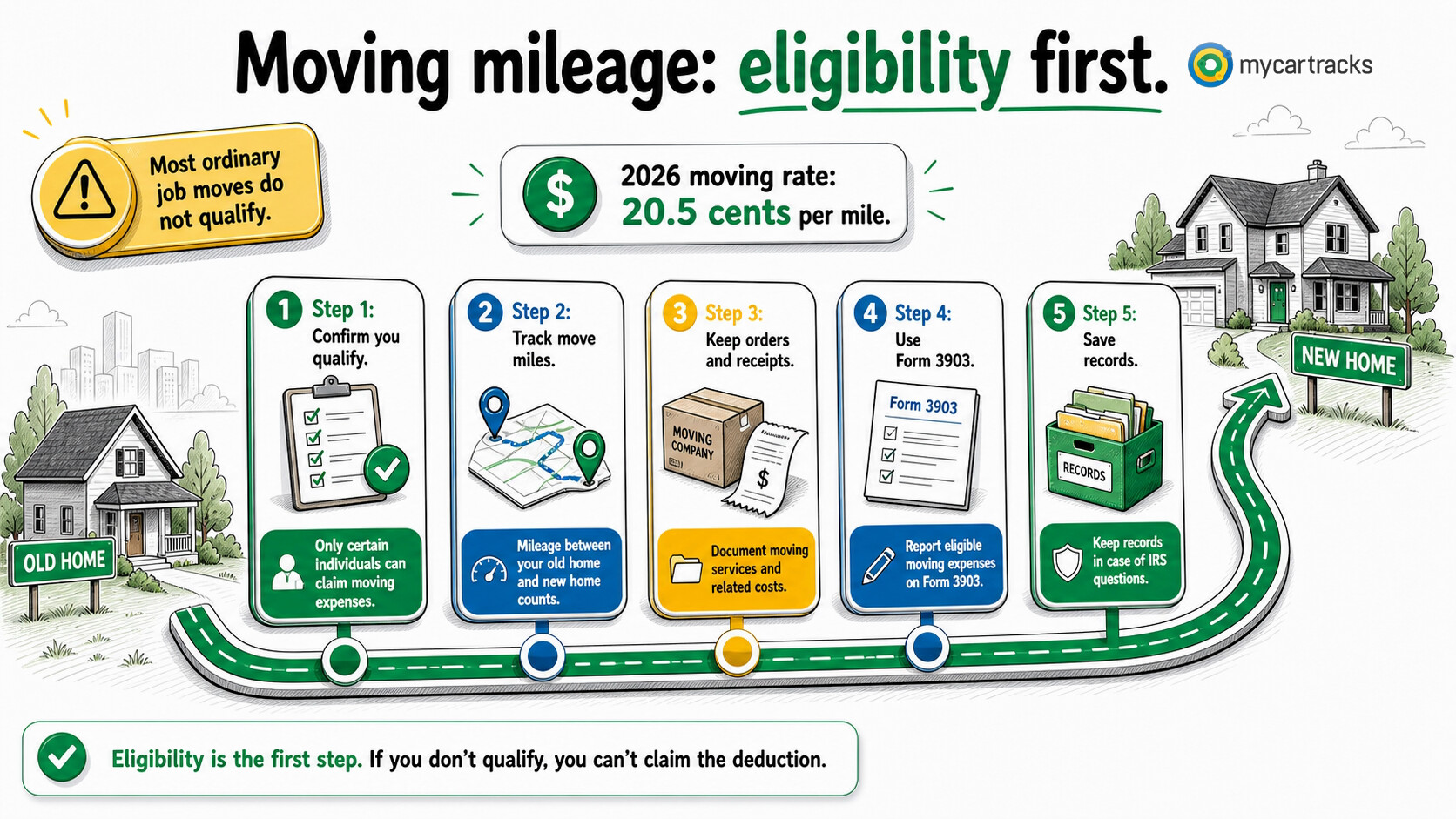
For 2026, the IRS moving mileage rate is 20.5 cents per mile, but that rate is not a general relocation deduction. Under current federal guidance, it applies only to qualifying active-duty Armed Forces moves and certain intelligence community moves beginning in 2026. Most ordinary job changes, office transfers, voluntary relocations, and remote-work moves should not be treated as deductible moving mileage.
What moving mileage means
Moving mileage is the standard cents-per-mile rate allowed for a qualifying move when you use your own vehicle to travel from your old home to your new home. For 2026, that rate is 20.5 cents per mile.
The rate is only for a narrow category of moves. It is not the same as the business mileage rate, and it does not turn a personal relocation into a deduction just because a job change is involved. If you are comparing the moving rate with the other IRS categories, Current IRS Mileage Rates for 2026 and Medical and Charitable Mileage Rates keep those categories separated.
Who may still claim moving mileage
The federal deduction is now limited enough that eligibility comes before arithmetic.
Under Topic no. 455 and Publication 3, active-duty Armed Forces members may qualify when the move is due to a military order and incident to a permanent change of station. That includes moves to a first post of duty, between permanent posts, and certain moves from the last post of duty back to a home or nearer point in the United States within the allowed time period.
The 2026 IRS mileage guidance adds another narrow category: certain intelligence community employees or new appointees moving after December 31, 2025, pursuant to a qualifying change of assignment requiring relocation. The federal rule is still narrow even after that expansion. It does not reopen the deduction for the general public.
If you are not clearly inside one of those categories, stop there and verify eligibility before you track or claim any moving mileage.
Which moving expenses can still qualify
For people who do qualify, the deductible costs are broader than mileage alone.
Topic no. 455, Publication 3, and the Form 3903 instructions support these categories when they are reasonable, unreimbursed, and tied to a qualifying move:
- moving household goods and personal effects
- packing, crating, hauling, and in-transit storage
- limited storage and insurance for household goods
- travel from the old home to the new home
- lodging during the move
- mileage at the moving rate when you use your own vehicle
- parking fees and tolls related to the move
If you use your own vehicle, the IRS allows either actual out-of-pocket gas and oil costs or the moving mileage rate. That choice is much narrower than the normal business-vehicle deduction discussion, so keep the moving file separate from Standard Mileage Rate vs Actual Expenses and other business-use articles.
Which moving costs do not qualify
This is where many readers overclaim by accident.
Current IRS guidance says you cannot deduct:
- meals during the move
- unnecessary side trips
- lavish or extravagant lodging
- general repairs, maintenance, insurance, or depreciation for the vehicle when you use the moving mileage rate
- house-hunting trips
- costs of buying or selling a home
- lease-break costs, security deposits, car tags, driver’s licenses, and similar personal relocation costs
- moving or storage services provided directly by the government
- expenses already covered by excluded government reimbursements or allowances
That is why the moving-mileage rate should stay in its own lane. If the relocation question is really about a new job, remote work, or a standard business trip, Business Travel Tax Deduction and How to Claim Mileage on Taxes are better follow-ups.
How to claim the deduction
The reporting path is straightforward once the move qualifies.
Use Form 3903 to figure the deduction, then carry the result to Schedule 1 with the federal return. The Form 3903 instructions and Topic no. 455 both explain that you should not deduct expenses already covered by excluded government reimbursements.
If you qualify for more than one move, the IRS instructions say to use a separate Form 3903 for each move. If your issue is only storage fees from an earlier qualifying foreign move, Topic 455 explains that there is a narrow exception where Form 3903 may not be required.
State tax treatment can differ
The federal rule is not always the end of the story for a state return. Some states can decouple from current federal treatment or handle moving expenses differently in their own instructions.
This article does not use a fixed state list because that question is time-sensitive and can change with current state conformity rules, forms, and administrative guidance. If your state return matters, check the current instructions from your state tax department rather than assuming the federal disallowance or the federal exception automatically controls the state result.
Mileage tracking records to keep for moving mileage
The file should show why the move qualified, not only how far you drove.
Keep these items together:
- military orders or qualifying assignment documents
- old and new duty locations or residences
- move dates
- mileage logs or odometer support for vehicle travel
- lodging, parking, toll, storage, and transportation receipts
- household goods and storage invoices
- reimbursement or allowance records
- the Form 3903 support used for the calculation
- the official source used for the tax year
If you need a cleaner trip record before the filing step, What Is a Mileage Log? and IRS Mileage Log Requirements help you build the proof first.
Common mistakes
- using the moving rate for an ordinary job relocation
- treating the 20.5-cent rate like a business mileage rule
- forgetting that meals do not qualify
- mixing reimbursed government costs with unreimbursed deductible costs
- keeping the mileage total without keeping the eligibility documents
- claiming side trips or personal relocation costs in the same file
- using one combined form or spreadsheet for multiple qualifying moves
- assuming the federal result automatically answers the state return
Practical example
Suppose an active-duty service member receives permanent-change-of-station orders and drives a personal vehicle from the old home to the new duty station. The move includes lodging on the way, paid tolls, paid parking, shipping household goods, and a short storage period before delivery. That file can support a moving deduction if the expenses were unreimbursed and otherwise meet the current federal rules.
Now change one fact: the person is a civilian employee moving to start a regular new job, with no qualifying military order or covered intelligence community assignment. The miles may be real, the hotel may be real, and the moving truck bill may be real, but the federal moving deduction is usually gone. Eligibility is the whole question before the rate even matters.
MyCarTracks workflow
Use MyCarTracks to keep the moving trip record clean first, then let the tax file follow the qualifying facts.
- Capture the vehicle travel during the move instead of rebuilding it later.
- Keep the moving trip separate from ordinary business, commuting, medical, and personal driving.
- Export the mileage report with the move dates and attach the orders, receipts, and reimbursement records.
- Save the report with the official tax-year source before the Form 3903 calculation is finalized.
For the broader product view behind logging, reports, and exports, see MyCarTracks and the recordkeeping tools on the MyCarTracks features page.
What to read next
- Current IRS Mileage Rates for 2026
- Medical and Charitable Mileage Rates
- How to Claim Mileage on Taxes
- IRS Mileage Log Requirements