The point of a CRA mileage log is simple: show how each vehicle was used for business, with enough detail to support the claim or allowance. CRA’s motor vehicle records guidance treats a full logbook as the best evidence for business vehicle use and expects date, destination, purpose, and kilometres for each business trip.
For employee allowances and reimbursements, your employer may set its own submission format, but the record still needs to prove employment-related business kilometres. CRA’s automobile and motor vehicle allowance guidance points employers to records such as expense claims, receipts, logs, and other support before deciding whether an allowance or reimbursement is taxable.
This article is educational and is not tax, legal, payroll, employment, or financial advice. CRA treatment can change by tax year, vehicle type, employment agreement, province or territory, GST/HST position, and business structure. Check the official source and a qualified professional before relying on a claim.
Quick answer
For a CRA mileage log in Canada, record each business trip’s date, destination, purpose, and kilometres driven. Keep total kilometres, business kilometres, and odometer readings at the start and end of the year or fiscal period. If you are claiming motor vehicle expenses, keep the receipts and invoices too.
If you use the vehicle for both business and personal driving, the logbook has to support the business-use percentage. If you use more than one vehicle, keep a separate logbook and expense file for each vehicle.
What to include in a CRA mileage log
Your logbook should make the trip understandable without a follow-up explanation months later. For each business trip, record:
- date
- destination
- business purpose
- kilometres driven
- vehicle used, when more than one vehicle is in the file
Your annual vehicle record should also include:
- odometer reading at the start and end of the year or fiscal period
- total kilometres driven by the vehicle
- business kilometres driven by the vehicle
- personal kilometres or enough total-kilometre support to calculate personal use
- dates and odometer readings when you buy, sell, trade, or change vehicles
- receipts and invoices for vehicle expenses when you are deducting or reimbursing actual costs
CRA does not require an odometer reading for every single trip in its business motor vehicle records page. The start and end readings matter because they anchor the total annual kilometres. Your employer can still ask for more detail, including trip-by-trip odometer readings, time of day, customer names, job numbers, or approval notes.
Employee mileage logs, allowance rates, and records
Employees usually keep a mileage log for an employer, not directly for a self-employed T2125 claim. The employer uses the record to decide whether a payment is a reimbursement, an accountable advance, a reasonable per-kilometre allowance, or a taxable benefit.
The 2026 prescribed employee automobile allowance benchmark is 73 cents per kilometre for the first 5,000 business kilometres in the provinces and 67 cents per kilometre after that. For the territories, the 2026 figures are 77 cents and 71 cents. Those rates come from the Department of Finance Canada 2026 automobile limits announcement. They do not remove the need for a logbook.
For employee allowance and reimbursement records, keep:
- each employment-related business trip
- kilometres driven for employment duties
- date, destination, and purpose of each work trip
- receipts when the employer reimburses actual costs, parking, tolls, or other travel costs
- a copy of submitted expense reports or mileage reports
- employer approval records, if your workplace uses approvals
- any taxable allowance, non-taxable allowance, reimbursement, or advance details
Ordinary commuting is usually personal driving in CRA employment motor vehicle expense guidance. If your work arrangement is more complicated, such as multiple regular work locations or a home office, record the facts while the trip is fresh and ask the employer or a tax professional how the policy treats it.
If you are claiming unreimbursed employment motor vehicle expenses on your tax return, the record needs to support the Form T777 calculation. Keep total kilometres, employment kilometres, start and end odometer readings, receipts, employer reimbursement or allowance details, and Form T2200 support where required.
Self-employed and T2125 logbook requirements
Self-employed people, sole proprietors, partners, and business owners generally use a logbook to support the business-use percentage for actual motor vehicle expenses. The prescribed employee allowance rate is not the self-employed deduction method.
For business or professional income, the vehicle expense calculation usually connects to Form T2125. Your logbook supports the kilometres. Your receipts support the costs. The deductible amount is usually the business portion of supported motor vehicle expenses.
The basic calculation is:
business kilometres / total kilometres x supported motor vehicle expenses = deductible business portion
Example: your logbook shows 11,000 business kilometres and 20,000 total kilometres for the fiscal period. Your business-use percentage is 55 percent. If your supported mixed-use motor vehicle expenses are CAD 6,400, the deductible business portion is:
11,000 / 20,000 x CAD 6,400 = CAD 3,520
Keep business parking and supplementary business insurance separate when they relate directly to business activities. CRA’s calculating motor vehicle expenses guidance treats those costs differently from mixed-use vehicle expenses in its example.
When to keep a full-year logbook
A full logbook records business driving for the entire year or fiscal period. Use it when you are starting a vehicle claim, adding a vehicle, changing your business or work pattern, or rebuilding a weak record.
For each vehicle, the full logbook should support:
- total kilometres for the period
- business kilometres for the period
- trip-level date, destination, purpose, and kilometres
- start and end odometer readings
- vehicle-change dates and odometer readings, if applicable
- receipts and invoices for the expenses being claimed
A full-year record takes more work, but it is cleaner when the vehicle is used for both business and personal driving. It also avoids leaning on a three-month sample before you have a valid base year.
When a simplified logbook can work
The simplified logbook method is not a shortcut for the first year. CRA allows it only after you keep a full 12-month base-year logbook that represents normal business use of the vehicle.
After that base year, you may use a continuous three-month sample period in a later year if it remains representative. CRA’s formula is:
sample-year period % / base-year period % x base-year annual % = calculated annual business use
The result must stay within CRA’s allowed range compared with the base year. If the calculated annual business use rises or falls by more than 10 percentage points, the base year is no longer a good annual indicator for that later year. The three-month sample may support only the sample period, and you may need a new full-year logbook for the rest of the year.
Keep the full 12-month base-year logbook for six years from the end of the last tax year that uses it to establish business use. That is longer than simply keeping it for six years from the base year if you keep relying on it later.
Records to keep with the logbook
The logbook proves vehicle use. It does not prove what you paid.
For a motor vehicle expense claim, keep receipts, invoices, and account records for costs such as:
- licence and registration fees
- fuel and oil
- electricity for zero-emission vehicles
- insurance
- maintenance and repairs
- eligible interest on money borrowed to buy the motor vehicle
- leasing costs
- parking and supplementary business insurance when relevant
If you use more than one vehicle for business, keep the kilometres and costs separate. Each vehicle has its own business-use percentage and expense support.
For employment records, keep the mileage report you sent to the employer, receipts where required, reimbursement statements, allowance records, and any Form T2200 or Form T777 records if you are claiming unreimbursed employment motor vehicle expenses.
CRA’s income tax record retention page says to keep tax documents and records for at least six years. Business record rules can also require supporting records to be kept for six years from the end of the last tax year they relate to.
Accepted mileage log formats
CRA’s motor vehicle records guidance focuses on content, not one required file format. A logbook can be paper, spreadsheet-based, exported from an app, or held in accounting records. The record still has to be complete, readable, and backed by supporting documents.
Common formats include:
- paper logbook or diary
- spreadsheet, including XLSX
- CSV export
- PDF report
- accounting-system attachment
- mileage tracker app export
Choose the format you can keep current. A perfect template filled in months late is weaker than a plain record kept during the year with clear trip purposes and matching odometer readings.
Common mistakes
- recording business kilometres but not total kilometres
- missing start or end odometer readings
- using one combined logbook for two vehicles
- treating the employee allowance rate as a self-employed deduction rate
- relying on a simplified logbook before creating a 12-month base year
- keeping receipts but no trip log
- using vague purposes such as “work” instead of the business reason for the trip
- rebuilding the log from memory at tax time
- mixing employee reimbursement kilometres with self-employed business kilometres
- forgetting to keep the base-year logbook after using it in later years
MyCarTracks workflow for CRA mileage logs
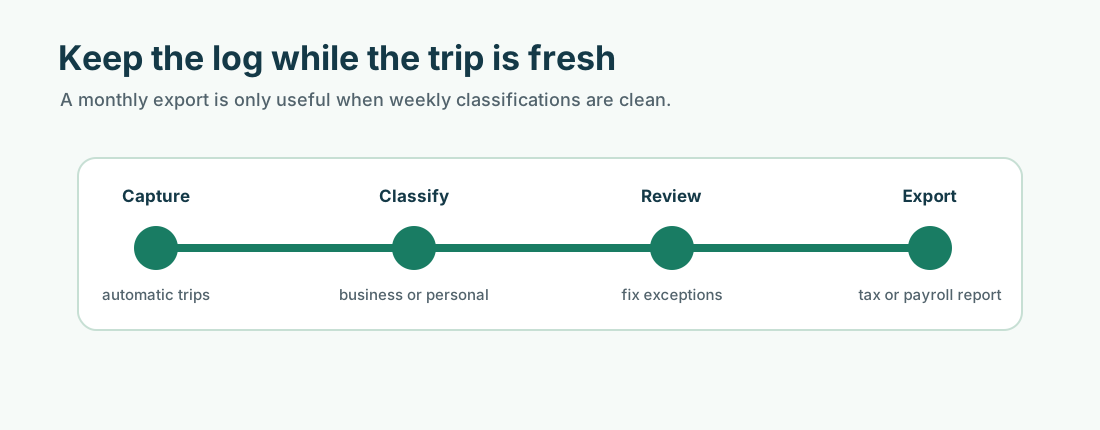
Build the kilometre record during the year. MyCarTracks automatic mileage tracking can help capture trips, classify business and personal kilometres, keep vehicle records separate, and export reports for reimbursement, payroll, or tax review.
Use a simple weekly routine:
- Review new trips while the purpose is still clear.
- Confirm business or personal classification.
- Add the customer, job, destination, or reason your policy requires.
- Save receipts for the same period.
- Compare total kilometres with odometer readings.
- Export reports by vehicle, driver, period, or business activity.
Automatic tracking does not decide tax treatment. It gives you the trip file before the allowance, reimbursement, or motor vehicle expense calculation starts.
FAQ
Are trip-by-trip odometer readings mandatory?
CRA’s business motor vehicle records page expects odometer readings at the start and end of the fiscal period. It does not say every trip needs an odometer reading. Your employer may still require trip-by-trip odometer readings for its own reimbursement or allowance policy.
Do personal kilometres need to be in the record?
If the vehicle is used for both business and personal driving, you need enough total-kilometre support to calculate the business-use percentage. That usually means your record must distinguish business kilometres from personal kilometres, even if the business trips get the most detail.
Can a three-month sample replace a full logbook?
Only after you have a full 12-month base-year logbook. A later continuous three-month sample can estimate annual business use only when it remains representative and stays within CRA’s allowed range compared with the base year.
How long should I keep CRA mileage logs?
Keep tax records for at least six years. If you use a simplified logbook, keep the full 12-month base-year logbook for six years from the end of the last tax year that relies on that base year.
Is a mileage tracker app accepted by CRA?
CRA does not require one specific format. An app export can be useful if it contains the required trip details, vehicle totals, odometer support, and records you can produce if asked. Keep receipts and tax working papers with it.
Do employees and self-employed people need the same logbook?
The trip fields are similar, but the purpose is different. Employees usually support an employer allowance, reimbursement, taxable-benefit review, or employment expense claim. Self-employed people usually support the business-use percentage for actual motor vehicle expenses. Keep the files separate if both roles apply.
What to read next
- CRA Mileage Guide (Canada)
- Claim Motor Vehicle Expenses From the CRA (Canada)
- Self-Employed Vehicle Expense Deductions (Canada)
- How to Calculate Mileage Reimbursement (Canada)
- Mileage Reimbursement for Employees (Canada)
- Mileage Reimbursement Rules for Employers (Canada)
- Is Mileage Reimbursement Taxable Income? (Canada)
- Current CRA Automobile Allowance Rates (Canada)
Sources
- CRA motor vehicle records
- CRA automobile and motor vehicle allowances
- Department of Finance Canada 2026 automobile deduction limits and expense benefit rates
- CRA calculating motor vehicle expenses
- CRA employment motor vehicle expenses
- CRA T777 Statement of Employment Expenses
- CRA T2200 Declaration of Conditions of Employment
- CRA income tax record retention guidance