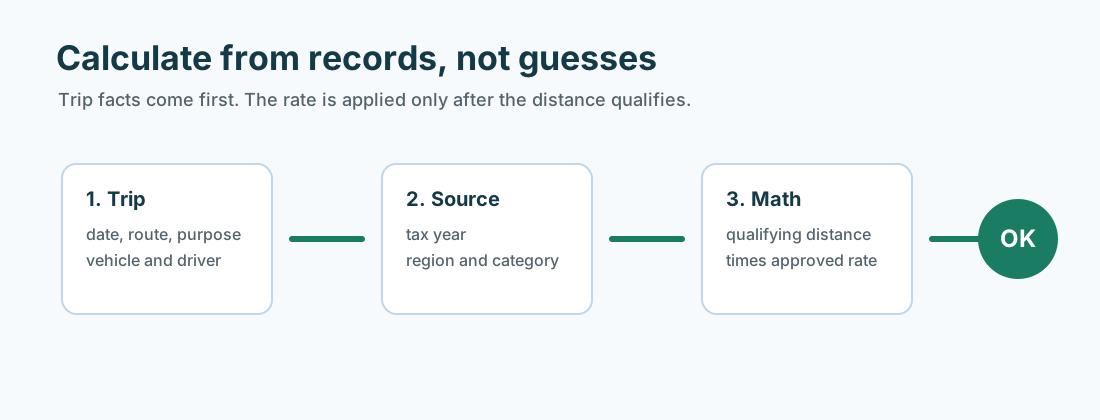
To calculate mileage reimbursement Canada amounts for a tax return, payroll file, or employer claim, start with the payment type. For an employee per-kilometre automobile allowance, multiply business kilometres by the cents per kilometre rate. For actual-cost reimbursement, self-employed motor vehicle expenses, or employment expenses, use receipts and the business-use percentage instead.
For 2026, the prescribed employee automobile allowance benchmark is 73 cents per kilometre for the first 5,000 business kilometres in the provinces and 67 cents after that. Yukon, the Northwest Territories, and Nunavut use 77 cents and 71 cents, as confirmed by the Department of Finance Canada 2026 automobile limits announcement and CRA’s automobile and motor vehicle allowance guidance.
Do not use that prescribed allowance rate for every vehicle question. CRA’s calculating motor vehicle expenses guidance uses total kilometres, business kilometres, and supported expenses for business-use calculations. CRA’s motor vehicle records guidance also expects logbook support for business vehicle use.
This article is educational and is not tax, legal, payroll, employment, or financial advice. CRA treatment can change by tax year, vehicle type, employment agreement, province or territory, payment method, and business structure. Check the official source and a qualified professional before relying on an allowance, reimbursement, taxable-benefit, or deduction calculation.
Quick answer
Use the formula that matches your situation:
| Situation | Basic calculation | Use it for |
|---|---|---|
| Employee per-kilometre allowance | business kilometres x rate |
A personal vehicle used for employment duties |
| Employee allowance above 5,000 km | (5,000 km x first rate) + (additional km x second rate) |
CRA prescribed-rate allowance calculations |
| Actual expense reimbursement | approved business costs supported by receipts |
Parking, tolls, ferry charges, supplementary business insurance, fuel, or other costs your employer reimburses |
| Self-employed or employment motor vehicle expense claim | business kilometres / total kilometres x supported vehicle expenses |
T2125 or employment-expense calculations where the rules allow |
| Simplified logbook business-use estimate | sample-year period % / base-year period % x base-year annual % |
Later-year business-use percentage after a full 12-month base-year logbook |
If the payment is an employee allowance, calculate business kilometres and the applicable per-kilometre rate. If the file is a vehicle expense deduction, calculate the business-use percentage and apply it to supported costs.
Mileage reimbursement Canada calculation formulas
There is no single formula for every driver. Use the allowance formula for employee per-kilometre payments. Use the actual-expense formula when the question is reimbursement of receipts, Form T2125, or Form T777.
Calculate an employee per-kilometre allowance
For a straightforward employee allowance, multiply supported employment-related kilometres by the employer’s per-kilometre rate.
business kilometres x per-kilometre rate = allowance
Example: you drive 850 supported business kilometres in Ontario in 2026 and your employer uses the prescribed province rate for the first 5,000 kilometres.
850 km x $0.73 = $620.50
That calculation only works when the kilometres are employment-related business kilometres. Ordinary travel between home and a regular workplace is usually personal driving. For employee reimbursement details, see Mileage Reimbursement for Employees (Canada).
Calculate the first 5,000 kilometres and the amount after that
The CRA prescribed allowance rate changes after the first 5,000 business kilometres in the year.
| 2026 business kilometres | Provinces | Yukon, Northwest Territories, and Nunavut |
|---|---|---|
| First 5,000 kilometres | 73 cents/km | 77 cents/km |
| Each additional kilometre | 67 cents/km | 71 cents/km |
For 2026 province driving, use:
(first 5,000 km x $0.73) + (additional business km x $0.67)
Example: an employee in a province drives 6,200 supported business kilometres in 2026.
5,000 km x $0.73 = $3,650
1,200 km x $0.67 = $804
$3,650 + $804 = $4,454
For the same 6,200 supported business kilometres in Yukon, the Northwest Territories, or Nunavut:
5,000 km x $0.77 = $3,850
1,200 km x $0.71 = $852
$3,850 + $852 = $4,702
For a full rate table and older years, use Current CRA Automobile Allowance Rates (Canada) and Historical CRA Automobile Allowance Rates (Canada).
If your employer uses a custom rate
Your employer can use a rate other than the prescribed CRA benchmark. The calculation is still:
business kilometres x employer rate = allowance
The tax question is separate. A per-kilometre allowance may be non-taxable when it is based only on employment-related business kilometres, the rate is reasonable, and the employer does not reimburse the same vehicle use twice. A higher or lower rate is not automatically wrong, but the employer needs a reason for the rate if the payment is meant to stay out of taxable income.
A flat monthly vehicle allowance is different. Because it is not based only on business kilometres, it can be taxable. A combined flat allowance and per-kilometre allowance for the same vehicle use can create the same problem. Employers should document the policy, trip records, rate, approvals, and payroll treatment. For employer controls, see Mileage Reimbursement Rules for Employers (Canada).
Calculate actual expense reimbursement
An actual reimbursement pays back amounts spent for employment-related costs. It is not a cents per kilometre formula unless the employer’s policy says so.
Start with the approved costs and the proof behind them:
- receipt or invoice
- trip or business purpose
- date
- employee claim or expense report
- employer approval
- repayment record if an accountable advance was more than the final approved cost
Example: your employer reimburses approved parking and tolls for a client visit. You paid CAD 18 for parking and CAD 7 in tolls, and the trip was employment-related.
CAD 18 + CAD 7 = CAD 25 reimbursed
A reimbursement can be non-taxable when it is for reasonable expenses connected with employment duties and supported by records such as receipts, expense reports, vouchers, logbooks, or other documentation. Reimbursement for personal expenses can be taxable.
Calculate self-employed motor vehicle expenses
Self-employed people and business owners generally do not multiply business kilometres by the CRA employee allowance rate. The usual calculation is:
business kilometres / total kilometres x supported motor vehicle expenses = deductible business portion
Example: your logbook shows 9,600 business kilometres and 16,000 total kilometres for the fiscal period. Your supported mixed-use motor vehicle expenses are CAD 7,200.
9,600 / 16,000 = 60% business use
60% x CAD 7,200 = CAD 4,320
The same method applies separately to each vehicle. If you use two vehicles for business, keep separate kilometres, odometer readings, receipts, and expense totals for each one.
CRA’s motor vehicle expense categories can include licence and registration fees, fuel and oil, electricity for zero-emission vehicles, insurance, eligible interest, maintenance and repairs, and leasing costs. Capital cost allowance is handled separately from ordinary motor vehicle expenses and can be subject to vehicle limits. For the claim workflow, see Claim Motor Vehicle Expenses From the CRA (Canada) and Self-Employed Vehicle Expense Deductions (Canada).
Calculate employment motor vehicle expenses
Employees who are not reimbursed, or who receive a taxable allowance and meet the employment-expense conditions, may need the employment-expense calculation instead of a reimbursement calculation.
The working formula is still based on employment-use percentage:
employment kilometres / total kilometres x supported vehicle expenses = employment-use portion
Employees generally use Form T777 for employment expenses and keep Form T2200 support where required. Do not claim costs already covered by a non-taxable allowance or reimbursement for the same vehicle use. If you are both an employee and self-employed, keep the records separate.
Records you need before calculating
The business-use percentage depends on the logbook behind it. For each business trip, keep:
- date
- destination
- purpose
- kilometres driven
Also keep opening and closing odometer readings for the year or fiscal period. If you buy, sell, trade, or change vehicles during the period, record the date and odometer reading for that change.
The logbook should let you calculate:
- total kilometres for the vehicle
- business or employment kilometres
- personal kilometres or the non-business portion
- business-use percentage
- vehicle-specific totals when more than one vehicle is used
For a detailed record checklist, use CRA Mileage Log Requirements (Canada).
Use the simplified logbook formula only after a base year
The simplified logbook method is not a first-year shortcut. You first need a full 12-month base-year logbook that represents normal business use of the vehicle.
In a later year, you may use a continuous three-month sample when the sample remains representative. CRA’s formula is:
sample-year period % / base-year period % x base-year annual % = calculated annual business use
Example: your base-year annual business use was 50 percent. In April to June of the base year, business use was 40 percent. In April to June of the later year, business use is 44 percent.
44% / 40% x 50% = 55% calculated annual business use
That result can support the later-year business-use percentage only if it stays within CRA’s allowed range compared with the base year and there is no contradictory evidence. If your driving pattern changes too much, the sample may support only the sample period, and you may need a full logbook for the rest of the year or a new base year.
Keep the base-year logbook for six years from the end of the last tax year that uses it, not just six years from the base year itself.
Calculate mileage reimbursement in a spreadsheet
A spreadsheet can work if it keeps the required fields and does the threshold math correctly. For an employee allowance sheet, include:
- trip date
- destination
- business purpose
- province or territory
- vehicle
- business kilometres
- year-to-date business kilometres
- rate used
- allowance amount
- approval status
For a vehicle expense deduction sheet, add total kilometres, odometer readings, expense categories, receipts, and business-use percentage. Keep the official rate source or policy source with the spreadsheet so an old claim does not accidentally use the wrong tax-year rate.
Common mistakes when calculating mileage reimbursement
- using the 2026 rate for an older claim year
- using the province rate for Yukon, the Northwest Territories, or Nunavut
- multiplying self-employed kilometres by the employee allowance rate
- calculating reimbursement from total kilometres instead of business kilometres
- missing the lower rate after the first 5,000 business kilometres
- treating a flat vehicle allowance as non-taxable without a kilometre-based calculation
- claiming expenses already reimbursed by an employer
- using one combined business-use percentage for multiple vehicles
- keeping receipts without a logbook
- rebuilding trip purposes months later from calendar notes
MyCarTracks workflow for reimbursement calculations
Use MyCarTracks automatic mileage tracking to build the kilometre record before calculating the allowance, reimbursement, or vehicle expense amount.
A practical workflow is:
- Capture trips during the year.
- Classify business, employment, commuting, and personal driving.
- Add purpose and destination while the trip is still fresh.
- Review totals by vehicle, driver, period, province, or territory.
- Export the report for payroll, reimbursement approval, T777, or T2125 review.
- Save receipts and the official rate source with the final calculation.
Automatic tracking does not decide tax treatment. It gives you the trip record before the calculation starts.
FAQ
What is the formula for mileage reimbursement in Canada?
For an employee per-kilometre allowance, use business kilometres x rate. If the claim goes past the first 5,000 business kilometres, calculate the first 5,000 kilometres at the first rate and the remaining kilometres at the lower additional-kilometre rate.
What is the 2026 CRA mileage reimbursement rate?
For employees using their own vehicle for business in the provinces, the 2026 prescribed allowance benchmark is 73 cents per kilometre for the first 5,000 business kilometres and 67 cents after that. Yukon, the Northwest Territories, and Nunavut use 77 cents and 71 cents.
How do I calculate mileage reimbursement for 2024?
Use the 2024 rate for 2024 business kilometres, not the current 2026 rate. The CRA prescribed 2024 province rates were 70 cents per kilometre for the first 5,000 business kilometres and 64 cents after that. The 2024 territorial rates were 74 cents and 68 cents.
Do employers have to pay mileage in Ontario?
CRA guidance explains tax treatment for allowances, reimbursements, and taxable benefits. It does not create a general rule that every Ontario employer must reimburse every employee for business driving. Your employment agreement, workplace policy, collective agreement, and Ontario employment rules may matter.
Can self-employed people use the CRA mileage rate?
Not as a general deduction method. Self-employed vehicle expenses usually use actual supported costs and the business-use percentage for the vehicle. Keep total kilometres, business kilometres, receipts, and odometer readings.
What does mileage reimbursement cover?
It depends on the payment method. A per-kilometre allowance is meant to cover employee use of a personal vehicle for employment duties. Actual reimbursements pay back approved expenses such as parking, tolls, ferry charges, supplementary business insurance, or other costs allowed by the employer policy.
Do I need receipts for mileage reimbursement?
For a per-kilometre allowance, the kilometre log is usually the main record. For actual expense reimbursement, receipts, expense reports, vouchers, or similar records are needed. For tax deductions, receipts and logbook records both matter.
What to read next
- Current CRA Automobile Allowance Rates (Canada)
- Mileage Reimbursement for Employees (Canada)
- Mileage Reimbursement Rules for Employers (Canada)
- Is Mileage Reimbursement Taxable Income? (Canada)
- CRA Mileage Log Requirements (Canada)
- Claim Motor Vehicle Expenses From the CRA (Canada)
- Self-Employed Vehicle Expense Deductions (Canada)
Sources
- Department of Finance Canada 2026 automobile deduction limits and expense benefit rates
- CRA automobile and motor vehicle allowances
- CRA calculating motor vehicle expenses
- CRA motor vehicle records
- CRA motor vehicle expenses for self-employed individuals
- CRA motor vehicle expenses for employees
- CRA T777 Statement of Employment Expenses
- CRA T2200 Declaration of Conditions of Employment