Use the CRA mileage rate for the year the business driving happened, not the year you are rebuilding the file. The current CRA automobile and motor vehicle allowance guidance lists prescribed per-kilometre rates for 2015 through 2026. Older Department of Finance Canada announcements support the 2010 to 2014 rows, so you can review old allowance files against the right year.
For 2026, the prescribed employee allowance rate is 73 cents per kilometre for the first 5,000 business kilometres in the provinces and 67 cents after that. Yukon, the Northwest Territories, and Nunavut are 4 cents higher, which makes the 2026 territorial rates 77 and 71 cents per kilometre, as confirmed by the Department of Finance Canada 2026 announcement.
These rates are employee automobile allowance benchmarks. They are not a self-employed deduction rate, and they do not replace a logbook, odometer readings, receipts, or a business-use percentage calculation.
This article is educational and is not tax, legal, payroll, employment, or financial advice. Check the current official source and a qualified professional before relying on an allowance, reimbursement, payroll, or deduction decision.
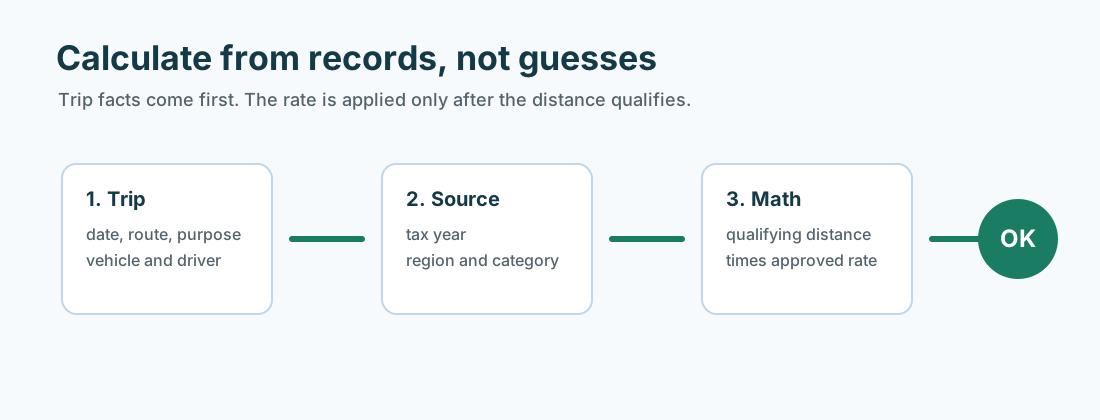
Quick answer
The historical CRA mileage rate table for prescribed automobile allowances from 2010 to 2026 is:
| Year | First 5,000 km in provinces | Additional km in provinces | First 5,000 km in territories | Additional km in territories |
|---|---|---|---|---|
| 2026 | 73 cents | 67 cents | 77 cents | 71 cents |
| 2025 | 72 cents | 66 cents | 76 cents | 70 cents |
| 2024 | 70 cents | 64 cents | 74 cents | 68 cents |
| 2023 | 68 cents | 62 cents | 72 cents | 66 cents |
| 2022 | 61 cents | 55 cents | 65 cents | 59 cents |
| 2021 | 59 cents | 53 cents | 63 cents | 57 cents |
| 2020 | 59 cents | 53 cents | 63 cents | 57 cents |
| 2019 | 58 cents | 52 cents | 62 cents | 56 cents |
| 2018 | 55 cents | 49 cents | 59 cents | 53 cents |
| 2017 | 54 cents | 48 cents | 58 cents | 52 cents |
| 2016 | 54 cents | 48 cents | 58 cents | 52 cents |
| 2015 | 55 cents | 49 cents | 59 cents | 53 cents |
| 2014 | 54 cents | 48 cents | 58 cents | 52 cents |
| 2013 | 54 cents | 48 cents | 58 cents | 52 cents |
| 2012 | 53 cents | 47 cents | 57 cents | 51 cents |
| 2011 | 52 cents | 46 cents | 56 cents | 50 cents |
| 2010 | 52 cents | 46 cents | 56 cents | 50 cents |
The first rate applies to the first 5,000 business kilometres in the year. The lower rate applies after that threshold. The territory columns apply only in Yukon, the Northwest Territories, and Nunavut.
Why historical rates matter
Old mileage files often get reviewed long after the driving happened. Payroll may be correcting an employee allowance. A manager may be checking whether a reimbursement was reasonable. An employee may be rebuilding records after a taxable-benefit question.
In those situations, the current CRA mileage rate is not enough. Check a 2021 employee allowance against the 2021 rate, not the 2026 rate. Keep the rate source, trip log, employee claim, approval record, and calculation together so the file shows which year you used.
The broader current-year rules are covered in Current CRA Automobile Allowance Rates (Canada). Use this page when the year-by-year table is the missing piece.
What the historical CRA mileage rates cover
The prescribed per-kilometre rates are used as a reasonable-rate benchmark for employee automobile allowances when an employee uses their own vehicle for employment duties. A non-taxable allowance still needs more than the right number. It generally needs to be based only on business or employment-related kilometres, use a reasonable per-kilometre rate, and avoid reimbursing the same vehicle use twice.
The rates are meant to reflect the main costs of owning and operating a vehicle for business use. Finance Canada announcements refer to depreciation, financing, insurance, maintenance, and fuel.
That does not make the table a universal vehicle-cost calculator. It is an employee allowance reference. Self-employed people and business owners usually work from actual motor vehicle expenses and business-use percentage records instead.
How to read the first 5,000 kilometre split
Each year has two province rates:
- one rate for the first 5,000 business kilometres
- a lower rate for business kilometres after 5,000
The 5,000 kilometre threshold is annual. If an employee drove 7,200 supported business kilometres in a province in 2024, the historical prescribed-rate calculation would use 5,000 kilometres at 70 cents and 2,200 kilometres at 64 cents.
If the same year of driving happened in Yukon, the Northwest Territories, or Nunavut, use the territorial rate for that year. The territory rate is 4 cents higher than the province rate at both thresholds in the table above.
Records to keep with an older allowance file
The rate table does not prove business driving by itself. Keep enough records to show why the allowance was paid and how it was calculated.
For an employee allowance or reimbursement file, keep:
- the year of driving
- business kilometres by trip or claim period
- the vehicle and driver
- date, destination, purpose, and kilometres for each work trip
- whether the driving happened in a province or territory
- the employer policy or rate used
- the calculation showing the first 5,000 kilometre threshold
- any separate reimbursements for tolls, ferry charges, or supplementary business insurance
- approval records and payroll treatment
If you are rebuilding records, do not average several years together. Split the file by calendar year first, then apply the rate for each year.
Self-employed motor vehicle expenses use a different method
Do not use this historical allowance table as a shortcut for self-employed motor vehicle expenses. CRA’s self-employed motor vehicle expense workflow is based on supported vehicle costs, total kilometres, business kilometres, and the business-use percentage.
For example, a self-employed person who drove 18,000 total kilometres and 9,000 business kilometres in a year would usually start from a 50 percent business-use percentage. The next step is applying that percentage to supported motor vehicle expenses where the CRA rules allow it. That is a different calculation from multiplying the 9,000 business kilometres by the employee allowance rate.
If you need the full routing between employee allowances, reimbursements, and self-employed deductions, start with the CRA Mileage Guide (Canada).
Common mistakes with historical CRA mileage rates
- using the newest CRA rate for an older year
- using only the province rate when the driving happened in Yukon, the Northwest Territories, or Nunavut
- treating the first 5,000 kilometre threshold as a monthly threshold
- calling the employee allowance rate a self-employed deduction rate
- paying a flat monthly vehicle allowance and assuming the historical per-kilometre table makes it non-taxable
- keeping a total allowance amount without the kilometres behind it
- mixing personal commuting with business kilometres
- leaving separate reimbursements out of the review
MyCarTracks mileage tracking workflow for future years
Historical files are hard to repair when the original trip record is thin. Capture kilometres during the year, then attach the rate source when payroll or tax review starts.
Use MyCarTracks automatic mileage tracking to keep the kilometre record tied to the date, vehicle, purpose, and driver. Then an old-rate lookup is a calculation check, not a reconstruction project.
FAQ
What was the CRA mileage rate in 2020?
For 2020, the prescribed province rates were 59 cents per kilometre for the first 5,000 business kilometres and 53 cents after that. The territorial rates were 63 cents and 57 cents.
What was the CRA mileage rate in 2021?
For 2021, the prescribed province rates were 59 cents per kilometre for the first 5,000 business kilometres and 53 cents after that. The territorial rates were 63 cents and 57 cents.
What was the CRA mileage rate in Ontario in 2021?
Ontario uses the province rate. For 2021, that was 59 cents per kilometre for the first 5,000 business kilometres and 53 cents after that.
What was the CRA mileage rate in 2019?
For 2019, the prescribed province rates were 58 cents per kilometre for the first 5,000 business kilometres and 52 cents after that. The territorial rates were 62 cents and 56 cents.
Are historical CRA mileage rates mandatory for employers?
No. An employer can use another rate or reimbursement method. If the payment is meant to be a non-taxable per-kilometre allowance, the rate and the rest of the file still need to be reasonable for the employee’s facts.
Can I use the historical CRA rate to claim self-employed vehicle expenses?
Not as a general deduction method. Self-employed vehicle claims normally use actual motor vehicle expenses, total kilometres, business kilometres, and business-use percentage records.
What to read next
- Current CRA Automobile Allowance Rates (Canada)
- CRA Mileage Guide (Canada)
- How to Calculate Mileage Reimbursement (Canada)
- Mileage Reimbursement Rules for Employers (Canada)
- Mileage Reimbursement for Employees (Canada)
- CRA Mileage Log Requirements (Canada)
Sources
- CRA automobile and motor vehicle allowances
- Department of Finance Canada 2026 automobile deduction limits and expense benefit rates
- Department of Finance Canada 2014 automobile deduction limits and expense benefit rates
- Department of Finance Canada 2012 automobile deduction limits and expense benefit rates
- Department of Finance Canada 2010 automobile deduction limits and expense benefit rates
- CRA motor vehicle records
- CRA motor vehicle expenses for self-employed individuals