This CRA mileage guide helps Canadian drivers, employers, and self-employed people sort the rate, reimbursement, and recordkeeping questions before a claim is made.
If you drive your own vehicle for work in Canada, start by separating two questions: whether an employee allowance can stay non-taxable, and whether a self-employed or business claim is supported by actual motor vehicle expenses.
For 2026, the prescribed employee automobile allowance rates are 73 cents per kilometre for the first 5,000 kilometres in the provinces and 67 cents after that; the territorial rates are 77 cents and 71 cents. Those figures come from the Department of Finance Canada 2026 automobile rate announcement and the CRA’s automobile and motor vehicle allowance guidance.
The rate is not the whole file. A reasonable allowance still needs business kilometres behind it, and a motor vehicle expense claim needs total kilometres, business kilometres, receipts, and the right form workflow. If you want the kilometre record captured before payroll, tax, or reimbursement review begins, MyCarTracks automatic mileage tracking can help keep trips, purposes, vehicles, and exportable reports organized while the details are still fresh.
This article is educational and is not tax, legal, payroll, employment, or financial advice. CRA treatment can change by tax year, vehicle type, province or territory, employment agreement, and business structure. Check the official source and a qualified professional before relying on a calculation.
Quick answer
Use the CRA prescribed per-kilometre rates for employee automobile allowance questions, not as a shortcut deduction table for self-employed vehicle expenses. Employees and employers need business-kilometre records to support a reasonable allowance. Self-employed people and business owners generally calculate the deductible business portion of actual motor vehicle expenses from their logbook and receipts.
Who this CRA mileage guide is for
Use this guide if you are:
- an employee using your own automobile or motor vehicle for work duties
- an employer setting an automobile allowance or reimbursement policy
- self-employed, a sole proprietor, or a partner using a personal vehicle to earn business income
- a business owner deciding whether a per-kilometre allowance, actual expense reimbursement, or company-vehicle workflow fits the situation
The same drive can need a different record depending on the role. An employee may be submitting a reimbursement claim. An employer may be deciding whether to withhold CPP, EI, and income tax from an allowance. A self-employed person may be preparing Chart A on T2125. Keep those workflows separate before you apply a rate.
CRA mileage guide workflow
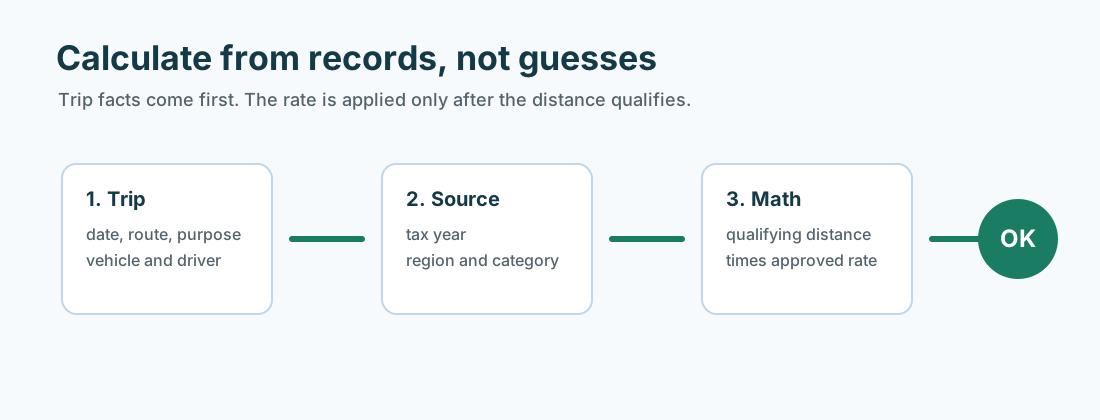
The practical order is role, trip purpose, record, rate or expense method, then filing or payroll treatment. Starting with the rate can hide the bigger question: whether the kilometres were business-related and whether the supporting records are strong enough.
Current CRA automobile allowance rates
The current prescribed rates for 2026 are:
| 2026 prescribed employee allowance rate | Provinces | Yukon, Northwest Territories, and Nunavut |
|---|---|---|
| First 5,000 kilometres | 73 cents/km | 77 cents/km |
| Additional kilometres | 67 cents/km | 71 cents/km |
These rates are commonly used as the benchmark for a reasonable per-kilometre employee allowance. They are also useful when you are reviewing an employer policy, but they do not replace the conditions that make an allowance non-taxable.
For a rate-focused page with the current table and company-vehicle limits, use Current CRA Automobile Allowance Rates (Canada).
When an employee allowance can stay non-taxable
An employee automobile allowance can be non-taxable when it is based only on business kilometres driven in the course of employment duties, the per-kilometre rate is reasonable, and the employer has not also reimbursed expenses for the same vehicle use. The CRA gives limited exceptions for items such as tolls, ferry charges, and supplementary business insurance when those amounts were not included in the allowance calculation.
That means a flat monthly car allowance, a payment not based on actual business kilometres, or a rate that is not reasonable for the situation may become taxable. When the allowance is taxable, payroll and employee deduction questions need separate review.
What counts as business driving
Business driving is driving that has a work or business purpose. Common examples include:
- travelling from one work location to another
- visiting a client, customer, supplier, job site, or temporary work location
- attending a work meeting, training, or conference away from the usual workplace
- picking up supplies or making a business errand
- delivering goods, equipment, or documents for the business
Ordinary travel between home and a regular workplace is usually personal commuting, not business driving. If your home is also a real business base or your work arrangement is unusual, document the facts before treating a home-based trip as business kilometres.
Employee reimbursement records
If you are an employee using your own vehicle, your employer should tell you what records they require before payment. A practical claim file usually includes:
- trip date
- destination or route
- business purpose
- number of kilometres driven
- vehicle used
- separately claimed parking, toll, ferry, or supplementary business insurance amounts, if allowed by the policy
If your employer pays a reasonable per-kilometre allowance, you usually do not need to submit every fuel or repair receipt for that allowance calculation. If the employer reimburses actual expenses instead, receipts and expense reports become much more important.
Employees who are not reimbursed, or who receive a taxable allowance, may need to review the employment-expense rules, Form T2200, and Form T777 before assuming they can deduct motor vehicle expenses on their own return.
Employer allowance and reimbursement controls
Employers should build the policy around proof, not just around a rate. A clean Canada mileage workflow normally answers:
- Which roles may claim business kilometres?
- Which trips qualify and which trips are commuting or personal?
- Which rate applies for the tax year and province or territory?
- What proof must the employee submit before approval?
- How are parking, tolls, ferry charges, supplementary business insurance, and actual expense claims handled?
- Who approves the report and when is it paid?
- How are taxable allowances reported when the allowance does not meet the reasonable-allowance conditions?
Do not double-pay the same vehicle use without reviewing the CRA treatment. A per-kilometre allowance and an actual-expense reimbursement for the same driving can change the payroll result.
Self-employed motor vehicle expenses
Self-employed readers do not use the prescribed employee allowance as a deduction rate. If you use a motor vehicle or passenger vehicle to earn business income, CRA’s motor vehicle expense guidance asks you to calculate the business portion of actual expenses.
Typical motor vehicle expenses include:
- licence and registration fees
- fuel and oil
- electricity for zero-emission vehicles
- insurance
- interest on money borrowed to buy the vehicle
- maintenance and repairs
- leasing costs
- capital cost allowance, when applicable and entered on the correct line
If the vehicle is used for both business and personal driving, only the business-use percentage applies to mixed-use vehicle costs. Business parking and supplementary business insurance may be handled separately under CRA’s motor vehicle expense guidance.
Business-use percentage example
Suppose your logbook shows 18,000 total kilometres for the year and 10,800 kilometres driven to earn business income. Your business-use percentage is 60 percent.
If your supported annual motor vehicle expenses are CAD 7,000, the business portion is:
10,800 business kilometres / 18,000 total kilometres x CAD 7,000 = CAD 4,200
That example shows why the logbook matters. The receipts prove the cost, but the kilometre record decides how much of the mixed-use vehicle cost belongs to business use.
CRA logbook requirements
For a full logbook, keep an accurate record of business travel for the year. For each business trip, record:
- date
- destination
- purpose
- number of kilometres driven
Also record total kilometres and business kilometres for the vehicle, plus odometer readings at the start and end of the fiscal period. If you buy, sell, trade, or change vehicles during the fiscal period, record the change dates and odometer readings.
If you use more than one vehicle, keep separate records for each vehicle. Combining two vehicles into one kilometre total makes the business-use percentage harder to defend.
Full logbook and simplified logbook
The full logbook method means keeping the business travel record for the entire year. It is the strongest evidence when you need to support a motor vehicle expense claim.
The simplified logbook method starts only after you have a full 12-month base-year logbook that reflects normal business use. In later years, you may use a continuous three-month sample period to estimate annual business use when the sample remains within CRA’s allowed tolerance compared with the base year. You still need receipts and vehicle expense records for the year.
If your business pattern changes sharply, a sample period may no longer represent the year. In that situation, rebuild the record with a full-year logbook instead of forcing the old percentage onto a new driving pattern.
Records to keep with your mileage file
A Canada mileage file is stronger when the trip log and expense file are stored together. Keep:
- logbook entries for business trips
- start-of-period and end-of-period odometer readings
- total kilometres and business kilometres for each vehicle
- fuel, electricity, repair, maintenance, insurance, interest, lease, licence, and registration records
- parking, toll, ferry, and supplementary business insurance support when claimed separately
- allowance or reimbursement reports submitted to an employer
- payroll treatment or taxable-benefit records when the allowance is taxable
- the official rate or policy source used for the calculation
CRA recordkeeping guidance generally requires records and supporting documents to be kept for six years from the end of the last tax year they relate to, with exceptions for some situations.
Forms and filing touchpoints
For self-employed business or professional income, motor vehicle expenses are calculated through the T2125 workflow, including Chart A for motor vehicle expenses and the relevant CCA, interest, or leasing sections when they apply.
For employees, the filing path is different. Employment expense claims can involve Form T2200 from the employer and Form T777 on the employee return. Do not mix the employee forms with the self-employed T2125 workflow unless the person truly has both roles and separate records for each activity.
Common Canada mileage mistakes
- using the prescribed employee allowance rate as a self-employed deduction rate
- using the right rate but keeping no business-kilometre support
- treating an ordinary commute as business driving without facts to support it
- reimbursing actual expenses and paying a per-kilometre allowance for the same vehicle use without reviewing taxability
- forgetting odometer readings at the start and end of the year or fiscal period
- combining multiple vehicles in one logbook
- applying a 2026 rate to an older year without checking the annual table
- keeping receipts but no total-kilometre record, which leaves the business-use percentage unsupported
MyCarTracks workflow for Canadian mileage records
Use the record first, then the rate or expense calculation.
- Capture each trip as it happens.
- Classify business and personal kilometres while the purpose is still clear.
- Review vehicle and driver details weekly.
- Save receipts and reimbursement records with the same period.
- Export reports by employee, vehicle, tax year, or reimbursement period.
- Attach the official rate, employer policy, or accountant instructions before the final calculation is approved.
Automatic tracking does not decide tax treatment for you, but it reduces the risk that the business-use percentage or employee allowance is built from memory.
FAQ
Is the CRA mileage rate a self-employed deduction rate?
No. The prescribed per-kilometre rates are used for employee allowance reasonableness. Self-employed people generally claim the business portion of actual motor vehicle expenses supported by a logbook and receipts.
Are Canada automobile allowances taxable?
They can be non-taxable when they are based only on business kilometres, use a reasonable per-kilometre rate, and do not duplicate another reimbursement for the same vehicle use. A flat allowance or an unreasonable per-kilometre allowance can be taxable.
Do I need odometer readings for every trip?
CRA’s motor vehicle records guidance expects odometer readings at the start and end of the fiscal period. For each business trip, keep the date, destination, purpose, and kilometres driven. Your employer may ask for more detail.
How long should I keep CRA mileage records?
A practical rule is to keep tax records and supporting documents for six years from the end of the last tax year they relate to, unless a specific exception applies.
Does the CRA rate include fuel?
The prescribed employee allowance rate is meant to cover the main costs of using a personal vehicle for employment duties. For self-employed motor vehicle expenses, fuel or electricity is handled as part of the supported actual expense calculation instead of being replaced by the prescribed allowance rate.
What to read next
- Current CRA Automobile Allowance Rates (Canada)
- Historical CRA Automobile Allowance Rates (Canada)
- Claim Motor Vehicle Expenses From the CRA (Canada)
- Self-Employed Vehicle Expense Deductions (Canada)
- CRA Mileage Log Requirements (Canada)
- Mileage Reimbursement for Employees (Canada)
- Mileage Reimbursement Rules for Employers (Canada)
- How to Calculate Mileage Reimbursement (Canada)
- Is Mileage Reimbursement Taxable Income? (Canada)