For mileage reimbursement taxable income treatment in Canada, the tax result depends on how your employer paid you and what records support the claim. A reasonable per-kilometre automobile allowance can stay out of taxable income when it is based only on employment-related business kilometres, uses a reasonable rate, and does not duplicate another payment for the same vehicle use. CRA’s automobile and motor vehicle allowance guidance is the starting point because it separates allowances, reimbursements, and accountable advances.
The same payment can become taxable if it is a flat car allowance, pays personal driving, uses an unreasonable rate, lacks kilometre support, or combines a fixed allowance with a per-kilometre amount for the same use. For 2026, the prescribed employee automobile allowance benchmark is 73 cents per kilometre for the first 5,000 business kilometres in the provinces and 67 cents after that. Yukon, the Northwest Territories, and Nunavut use 77 cents and 71 cents under the Department of Finance Canada 2026 automobile limits announcement.
This article is educational and is not tax, legal, payroll, employment, or financial advice. CRA treatment can change by tax year, vehicle type, province or territory, employer policy, and the exact payment method. Check the official source and a qualified professional before relying on a reimbursement, taxable-benefit, GST/HST, or employment-expense position.
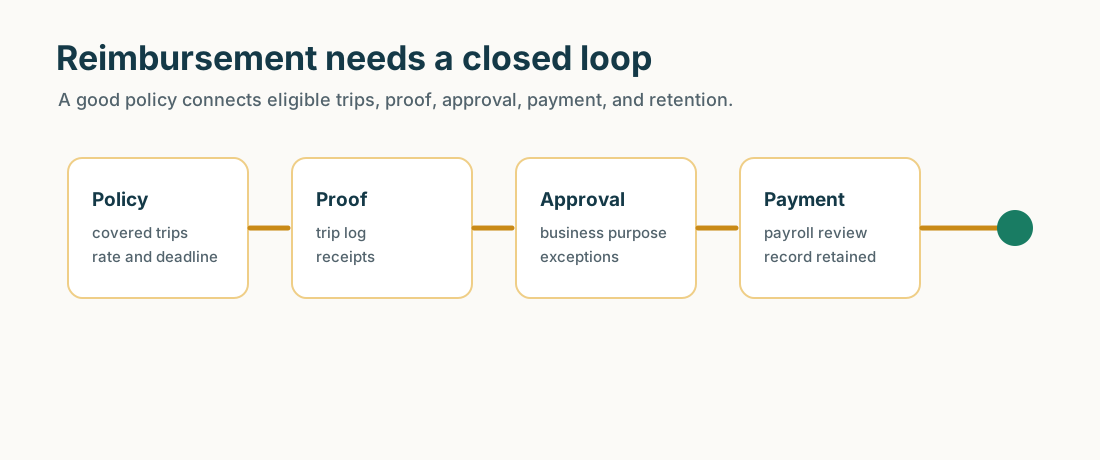
Quick answer
Mileage reimbursement in Canada is usually not taxable when your employer pays a reasonable per-kilometre allowance for your actual employment-related business kilometres and does not reimburse the same vehicle use another way. Actual expense reimbursements can also be non-taxable when they repay reasonable employment-related costs and you support them with records.
Mileage reimbursement can be taxable when the payment is not tied to business kilometres, covers personal driving, uses a rate that is not reasonable for your facts, lacks records, or is really a fixed vehicle benefit. If the amount is taxable, the employer may need to include it in income, withhold payroll deductions, and report it on your T4 slip.
| Payment situation | Usual CRA tax treatment |
|---|---|
| Reasonable per-kilometre allowance for actual employment-related business kilometres | Generally not taxable |
| Reimbursement of reasonable employment-related expenses with receipts and trip support | Generally not taxable |
| Accountable advance that is later supported and any excess is repaid | Generally not taxable when properly accounted for |
| Flat monthly car allowance | Taxable in most cases |
| Per-kilometre rate that is too high or too low without support | May be taxable |
| Payment for commuting, personal driving, or unsupported kilometres | Taxable risk |
| Employer-provided automobile available for personal use | Separate taxable-benefit rules may apply |
Allowance, reimbursement, and accountable advance
The payment label helps, but the facts decide the tax result.
An automobile allowance is usually a set amount, often cents per kilometre, paid to an employee for using their own vehicle for employment duties. The employee does not have to submit every fuel, insurance, repair, or maintenance receipt for the allowance itself.
A reimbursement pays an employee back for a specific cost they incurred for work. That can include parking, tolls, ferry charges, supplementary business insurance, or other approved expenses. The employer normally needs receipts, vouchers, an expense report, and a business reason.
An accountable advance is money paid before the employee spends it. The employee later accounts for the expense with records and returns any unused amount.
These categories matter because CRA treats a reasonable per-kilometre allowance differently from a flat allowance, an unsupported payment, or a company-car benefit.
When mileage reimbursement is not taxable
A per-kilometre automobile allowance can be non-taxable when all of these points are true:
- the vehicle is owned or leased by the employee
- the payment is based only on employment-related business kilometres
- the rate is reasonable for the vehicle and driving facts
- the employer does not reimburse the same vehicle use twice
- the employee keeps a kilometre log or other records that support the claim
The prescribed CRA allowance rates are commonly used as the private-sector benchmark for reasonableness. They are employee allowance rates. They are not a self-employed deduction rate, and they are not the quarterly CRA employee travel directive kilometric rates used for travel under that government directive.
Actual expense reimbursement can also be non-taxable when the employee incurred the cost for employment duties, the amount is reasonable, and the employee provides receipts or other records. A clean file usually shows the trip purpose, the claim period, the kilometres or expense, and approval under the employer’s policy.
When a vehicle payment becomes a taxable benefit
CRA can treat an employee vehicle payment as a taxable benefit when it does not meet the non-taxable allowance or reimbursement conditions. Common taxable situations include:
- a fixed monthly vehicle allowance that is not based only on business kilometres
- a per-kilometre allowance that is too high or too low for the facts and cannot be supported
- a combined flat allowance and per-kilometre allowance for the same vehicle use
- reimbursement for ordinary commuting or other personal driving
- payment for kilometres that were not logged or approved
- reimbursement of actual vehicle costs already covered by a per-kilometre allowance
- an advance that is not accounted for or has unused money that was not repaid
If an amount is taxable, CRA’s employer guidance can require the employer to include the value in employment income, withhold income tax, CPP contributions, and EI premiums where applicable, and report the benefit on the employee’s T4 slip. CRA also states that employers should not remit GST/HST on a taxable automobile allowance or reimbursement benefit.
Is a fixed car allowance taxable?
A fixed car allowance is usually taxable because it is paid regardless of the number of business kilometres driven. That is different from a per-kilometre allowance that changes with the employee’s actual business driving.
For example, a $500 monthly car allowance paid with no kilometre claim is more likely to be employment income than a non-taxable mileage reimbursement. Even if the employee drives for work, the payment is not based only on business kilometres.
If the employer wants a non-taxable allowance position, the file should show the rate, business kilometres, trip purpose, and approval. A flat amount without that support is hard to defend.
What if your rate is higher or lower than the CRA automobile allowance rate?
A higher or lower rate is not automatically wrong, but it needs a reason. CRA says a per-kilometre rate may be considered unreasonable if it is much higher or lower than the prescribed allowance rate, with all relevant facts considered.
For 2026, the prescribed employee allowance rates are:
| 2026 business kilometres | Provinces | Yukon, Northwest Territories, and Nunavut |
|---|---|---|
| First 5,000 kilometres | 73 cents/km | 77 cents/km |
| Each additional kilometre | 67 cents/km | 71 cents/km |
If an employer uses a custom rate, the record should explain why. Vehicle type, local costs, work location, driving conditions, and whether other costs are reimbursed separately may matter. The weaker the support, the more likely the allowance will be questioned as taxable.
For a deeper rate table, see Current CRA Automobile Allowance Rates (Canada). For prior years, see Historical CRA Automobile Allowance Rates (Canada).
How to tell if your employer treated it as taxable
Start with your pay records. A taxable vehicle allowance or taxable reimbursement usually appears in employment income, and payroll deductions may apply. Your pay stub may show withholding for income tax, CPP, and EI. Your T4 may include the taxable amount in employment income and may show the benefit through the employer’s reporting process.
If the payment does not appear as taxable income and no payroll deductions were withheld, the employer may have treated it as a non-taxable allowance, reimbursement, or accountable advance. Ask payroll how the amount was coded if the records are unclear. The name on the pay stub is less useful than the policy, records, rate, kilometre support, and T4 treatment.
Keep your submitted mileage reports, receipts, approvals, and year-end slips together. If CRA later asks about the payment, you will need more than a bank deposit or a monthly total.
Can you deduct vehicle expenses if the reimbursement was taxed?
Possibly, but do not assume every taxed allowance creates a deduction. Employees who deduct employment motor vehicle expenses usually need to meet the CRA employment-expense conditions, calculate the claim on Form T777, and have the employer complete Form T2200 where required.
If you received a non-taxable allowance or reimbursement for the same vehicle use, you generally should not deduct those same costs again. If the allowance was included in income and you otherwise meet the employee expense conditions, the employment-expense route may be available.
Employee motor vehicle expense claims are different from mileage reimbursement. They use actual expenses and an employment-use percentage. CRA’s employee motor vehicle expense guidance expects records such as total kilometres, employment kilometres, receipts, and odometer readings.
Employer-provided vehicles follow different rules
The prescribed per-kilometre allowance rate is for employees using their own vehicle. If your employer provides an automobile and makes it available for personal use, review the company-vehicle benefit rules instead.
An employer-provided automobile may create a standby charge benefit. If the employer pays operating costs for personal use, an operating expense benefit may also apply. CRA’s automobile provided by the employer guidance explains those calculations and the records needed to separate business and personal kilometres.
Do not treat a company vehicle as if it automatically qualifies for the personal-vehicle per-kilometre allowance. The tax question is different.
Records that support non-taxable treatment
Good records help both sides. Employees need them to support the claim. Employers need them before deciding whether the payment belongs in payroll income.
For each business trip, keep:
- date
- destination or route
- business purpose
- kilometres driven
- vehicle used, if more than one vehicle is involved
- parking, tolls, ferry charges, or other separately reimbursed costs
- receipts when the employer reimburses actual expenses
CRA’s motor vehicle records guidance treats a full logbook as the strongest support for business vehicle use. Odometer readings at the start and end of the year help prove total use when the same vehicle has both personal and business kilometres.
MyCarTracks mileage log workflow
Taxability problems often start when the kilometre record gets rebuilt after payroll has already paid the claim. Build the record as the trips happen.
A practical workflow is:
- Capture each trip.
- Mark commuting and personal driving separately from business driving.
- Add the destination and business purpose.
- Attach receipts for separately reimbursed costs.
- Review the claim before submitting it.
- Keep the report, approval, and pay record together.
With MyCarTracks automatic mileage tracking, you can capture trips, separate business and personal kilometres, keep vehicle records organized, and export reimbursement reports for payroll or tax review.
Automatic tracking does not decide whether a payment is taxable. It gives your employer, payroll team, or tax preparer the trip record they need before applying the CRA allowance, reimbursement, accountable advance, or taxable-benefit rules.
Common mistakes
- treating every payment called “reimbursement” as non-taxable
- paying a flat monthly vehicle allowance without including it in taxable income
- using the prescribed CRA rate without a kilometre log
- reimbursing commuting as if it were business driving
- paying both actual vehicle expenses and a per-kilometre allowance for the same use
- using a custom rate without support
- treating the employee allowance rate as a self-employed deduction rate
- mixing company-vehicle benefits with employee-owned vehicle allowance rules
- deducting expenses that were already covered by a non-taxable payment
- keeping only an annual kilometre total with no trip dates, destinations, or purposes
FAQ
Is mileage reimbursement taxable income in Canada?
It depends on how the payment works. A reasonable per-kilometre allowance for actual employment-related business kilometres is usually non-taxable. Flat allowances, personal driving payments, unsupported claims, and unreasonable rates can be taxable.
Is a car allowance taxable in Canada?
A fixed car allowance is usually taxable. A per-kilometre automobile allowance can be non-taxable when it is based only on employment-related business kilometres, uses a reasonable rate, and does not duplicate another reimbursement for the same vehicle use.
Is reimbursement taxable if my employer pays the CRA rate?
Using the prescribed CRA rate helps, but it is not the only test. The allowance also needs to be based on actual business kilometres, supported by records, and not combined with another payment for the same vehicle use.
What happens if my employer pays more than the CRA rate?
The allowance may be taxable if the higher rate is not reasonable for the facts. The employer should document why the rate is reasonable. Without that support, payroll may need to treat the allowance as taxable.
Can I claim vehicle expenses if my mileage reimbursement was taxed?
Possibly. If the amount was included in income and you meet the employee motor vehicle expense conditions, you may be able to use Form T777 with Form T2200 support. You still need receipts, kilometre records, and odometer readings. Do not deduct costs already covered by a non-taxable allowance or reimbursement.
Are parking and toll reimbursements taxable?
Parking, tolls, and ferry charges can be reimbursed separately when they are employment-related and properly supported. Keep receipts and trip notes. The tax treatment depends on the facts and the employer’s policy.
Is commuting mileage taxable if my employer pays it?
Ordinary travel between home and a regular workplace is usually personal driving. If an employer pays you for personal commuting, that payment has taxable-benefit risk unless a specific employment situation and CRA-supported treatment apply.
What to read next
- Mileage Reimbursement for Employees (Canada)
- Mileage Reimbursement Rules for Employers (Canada)
- How to Calculate Mileage Reimbursement (Canada)
- Current CRA Automobile Allowance Rates (Canada)
- Historical CRA Automobile Allowance Rates (Canada)
- CRA Mileage Log Requirements (Canada)
- Claim Motor Vehicle Expenses From the CRA (Canada)
Sources
- CRA automobile and motor vehicle allowances
- Department of Finance Canada 2026 automobile deduction limits and expense benefit rates
- CRA Employers’ Guide - Taxable Benefits and Allowances
- CRA motor vehicle expenses for employees
- CRA automobile provided by the employer
- CRA motor vehicle records
- CRA T777 Statement of Employment Expenses
- CRA T2200 Declaration of Conditions of Employment