For 2026, the CRA prescribed automobile allowance rate is 73 cents per kilometre for the first 5,000 business kilometres in the provinces. After 5,000 kilometres, the rate drops to 67 cents.
The territories get a higher rate. In Yukon, the Northwest Territories, and Nunavut, the 2026 rates are 77 cents for the first 5,000 business kilometres and 71 cents after that.
Those numbers come from Finance Canada’s 2026 automobile limits announcement and the CRA’s automobile allowance guidance. They answer one narrow question: what per-kilometre employee allowance is generally considered reasonable for tax purposes?
They do not give self-employed people a shortcut deduction. They also do not replace a kilometre log, odometer readings, receipts, or business-use records. Self-employed readers should use CRA’s motor vehicle expense rules instead.
This article is for general education only. It is not tax, legal, payroll, employment, or financial advice. Check the current CRA source and talk to a qualified professional before making a reimbursement, payroll, or tax decision.
Quick answer
The 2026 CRA prescribed automobile allowance rates are:
| 2026 business kilometres | Provinces | Yukon, Northwest Territories, and Nunavut |
|---|---|---|
| First 5,000 kilometres | 73 cents/km | 77 cents/km |
| Each additional kilometre | 67 cents/km | 71 cents/km |
An employer can choose a different rate. That does not automatically make the allowance taxable, but the employer needs to be able to explain why the rate is reasonable for that employee and that driving.
Flat vehicle allowances are a different story. If the payment is not tied to business kilometres, CRA may treat it as a taxable benefit. The same risk can come up when an employer pays both an allowance and a reimbursement for the same vehicle use.
What the CRA automobile allowance rate is for
The prescribed rate is mainly for employees who use their own vehicle for work. Employers use it as a benchmark when they pay a cents-per-kilometre allowance.
It does not mean every driver in Canada can multiply their kilometres by 73 or 67 cents and claim that amount on a return. The rule depends on who is driving and why.
- Employees may receive a per-kilometre allowance, an actual-expense reimbursement, an advance, or some other policy set by the employer.
- Employers need records that connect the payment to business kilometres.
- Self-employed people usually deduct the business share of actual vehicle expenses instead.
For the broader Canadian mileage rules, start with the CRA Mileage Guide (Canada).
Current CRA mileage rates for 2026
The 2026 rates are 1 cent higher than the 2025 rates. The territory rate is 4 cents higher than the province rate at both thresholds.
| Year | First 5,000 km in provinces | Additional km in provinces | First 5,000 km in territories | Additional km in territories |
|---|---|---|---|---|
| 2026 | 73 cents | 67 cents | 77 cents | 71 cents |
| 2025 | 72 cents | 66 cents | 76 cents | 70 cents |
| 2024 | 70 cents | 64 cents | 74 cents | 68 cents |
| 2023 | 68 cents | 62 cents | 72 cents | 66 cents |
| 2022 | 61 cents | 55 cents | 65 cents | 59 cents |
The first rate applies to the first 5,000 business kilometres in the year. The lower rate applies after that.
The higher territorial rate applies only in Yukon, the Northwest Territories, and Nunavut. It does not apply in Ontario, British Columbia, Alberta, Quebec, Manitoba, Saskatchewan, Nova Scotia, New Brunswick, Newfoundland and Labrador, or Prince Edward Island.
Use the rate for the year the driving happened
Do not use the newest rate just because you are reviewing the file now. Match the allowance rate to the year of the business driving.
That matters when payroll teams clean up old expense claims or when a reimbursement gets approved late. A 2025 trip uses the 2025 rate. A 2026 trip uses the 2026 rate.
Keep the official rate source with the claim, payroll file, or tax support. It saves a lot of backtracking later.
Finance Canada’s annual announcement also includes other automobile limits: passenger vehicle capital cost allowance ceilings, lease-cost limits, interest deduction limits, and taxable benefit rates for employer-paid automobile expenses. Those rules are related, but they are not the same as the employee-owned vehicle allowance rate.
When an employee allowance can be non-taxable
A cents-per-kilometre allowance may be non-taxable when:
- it is based only on business or employment-related kilometres
- the rate is reasonable
- the employer is not also reimbursing the same vehicle use, except for separately handled items such as supplementary business insurance, tolls, or ferry charges that were not included in the allowance
The records do the heavy lifting here. The rate by itself does not prove that the trips were for work.
An employer should be able to show the dates, destinations, purposes, and kilometres behind the payment. Without that, the allowance is harder to defend as non-taxable.
If the employer pays a higher or lower rate
A custom rate can be fine. It just needs support.
Vehicle type, driving conditions, location, and fuel costs can all affect what is reasonable. A higher rate for a remote or expensive operating area may be easier to explain than a higher rate with no notes at all.
The problem is an unsupported rate. CRA can treat the allowance as taxable if the rate does not fit the facts.
Flat monthly vehicle allowances are riskier because they are not based only on business kilometres. Mixing a flat allowance with a cents-per-kilometre allowance for the same driving can create the same taxable-benefit issue.
If an allowance becomes taxable and the employee qualifies to claim employment motor vehicle expenses, the employer may need to provide the right employment-expense paperwork. That is separate from paying the prescribed allowance rate.
Reimbursement is not the same as an allowance
An allowance is paid without asking the employee to account for each actual cost. A reimbursement pays the employee back for costs they already paid, usually after they submit receipts, an expense report, or other proof.
That distinction matters for tax.
A reimbursement can be non-taxable when it covers reasonable business expenses, the employee used their own vehicle for employment duties, and the employer has records to support the payment. If the employer reimburses personal driving or personal costs, the payment can become taxable.
Self-employed vehicle expenses use a different method
Self-employed people and business owners should not treat the CRA prescribed allowance rate as a deduction rate.
If one vehicle is used for both business and personal driving, CRA generally expects the business portion of actual motor vehicle expenses. That starts with:
- total kilometres driven by the vehicle
- business kilometres driven to earn income
- receipts and support for vehicle costs
- a business-use percentage
- separate records for each vehicle, if more than one vehicle is used
Example: you drive 20,000 kilometres in the year, and 12,000 of those kilometres are for business. Your business-use percentage is 60 percent. You would apply that percentage to supported vehicle expenses where the CRA rules allow it. You would not simply multiply 12,000 kilometres by the employee allowance rate.
Logbook records to keep
CRA says a full logbook is the best evidence for business vehicle use.
For each business trip, record:
- the date
- the destination
- the purpose
- the kilometres driven
Also keep the odometer reading for each vehicle at the start and end of the fiscal period. If you buy, sell, or trade a vehicle during the period, record the date and odometer reading when that happens.
A simplified logbook is possible only after you have kept a full 12-month base-year logbook. Even then, the sample period has to represent your normal driving. If your driving pattern changes, the shortcut may stop being useful.
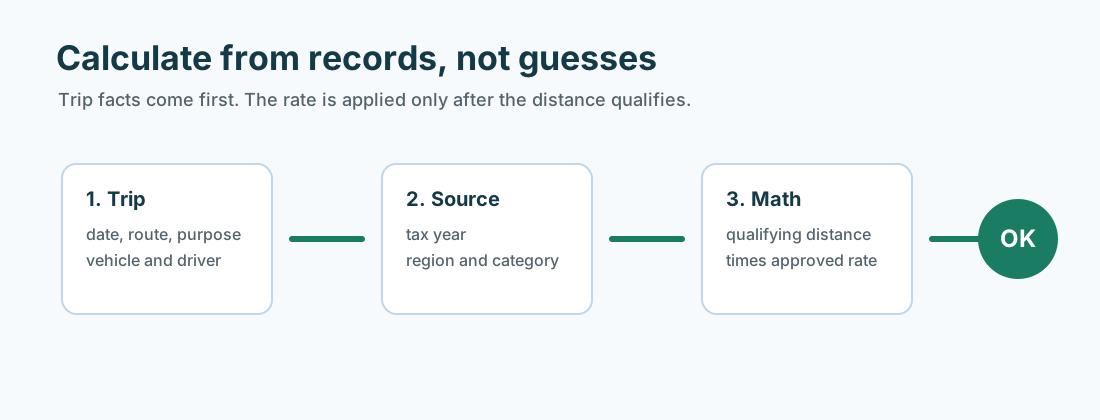
How to calculate an employee allowance
For an employee using a personal vehicle for work:
- Separate business kilometres from personal kilometres.
- Confirm whether the driving happened in a province or in Yukon, the Northwest Territories, or Nunavut.
- Apply the first-5,000-kilometre rate until the threshold is reached.
- Apply the additional-kilometre rate after 5,000 kilometres.
- Keep the trip log, employee claim, policy rate, and approval record together.
Example: an employee in a province drives 6,200 supported business kilometres in 2026.
- 5,000 km x $0.73 = $3,650
- 1,200 km x $0.67 = $804
- Total allowance = $4,454
Common CRA automobile allowance mistakes
- using the 2026 rate for driving that happened in an older year
- keeping only the reimbursement total and not the kilometre details
- treating a regular commute as business driving without checking the employment rules
- using the province rate for territorial driving
- treating the employee allowance rate as a self-employed deduction rate
- assuming a flat monthly allowance is automatically non-taxable
- paying twice for the same vehicle use without checking the exception rules
Mileage tracker app workflow
A mileage tracker helps most when it captures the record before payroll or tax time.
With MyCarTracks automatic mileage tracking, you can:
- Capture trips automatically.
- Review business purpose, destination, and vehicle each week.
- Separate employee, self-employed, and personal driving.
- Export kilometre reports for payroll, reimbursement, or tax review.
- Save the official CRA rate source with the final report.
FAQ
What is the 2026 CRA mileage rate in Canada?
For 2026, the CRA prescribed automobile allowance rate is 73 cents per kilometre for the first 5,000 business kilometres and 67 cents after that in the provinces. In Yukon, the Northwest Territories, and Nunavut, the rates are 77 cents and 71 cents.
What was the CRA mileage rate in 2025?
For 2025, the prescribed rates were 72 cents per kilometre for the first 5,000 business kilometres and 66 cents after that in the provinces. The territorial rates were 76 cents and 70 cents.
What was the CRA mileage rate in 2021?
For 2021, the prescribed rates were 59 cents per kilometre for the first 5,000 business kilometres and 53 cents after that in the provinces. The territorial rates were 63 cents and 57 cents.
What was the CRA mileage rate in 2020?
For 2020, the prescribed rates were 59 cents per kilometre for the first 5,000 business kilometres and 53 cents after that in the provinces. The territorial rates were 63 cents and 57 cents.
Is an employer required to use the CRA automobile allowance rate?
No. An employer may use a different rate or a reimbursement method. If the employer wants the allowance to stay non-taxable, the payment still needs to be based on business kilometres and reasonable for the facts.
Can self-employed people use the CRA allowance rate?
Not as a general deduction method. Self-employed vehicle deductions are based on supported motor vehicle expenses and the business-use percentage for the vehicle.
What to read next
- CRA Mileage Guide (Canada)
- Historical CRA Automobile Allowance Rates (Canada)
- How to Calculate Mileage Reimbursement (Canada)
- Mileage Reimbursement for Employees (Canada)
- Mileage Reimbursement Rules for Employers (Canada)
- Self-Employed Vehicle Expense Deductions (Canada)
- CRA Mileage Log Requirements (Canada)