Mileage reimbursement rules for employers in Canada come down to tax treatment, the vehicle, the trip, the payment method, and the records. A per-kilometre allowance for an employee’s own vehicle can be non-taxable, but only when the claim is tied to employment-related business kilometres and a reasonable rate. CRA’s automobile and motor vehicle allowance guidance separates allowances, reimbursements, and accountable advances because each one has different payroll treatment.
For 2026, the prescribed employee automobile allowance benchmark is 73 cents per kilometre for the first 5,000 business kilometres in the provinces and 67 cents per kilometre after that. Yukon, the Northwest Territories, and Nunavut use 77 cents and 71 cents. Those rates are confirmed in the Department of Finance Canada 2026 automobile limits announcement.
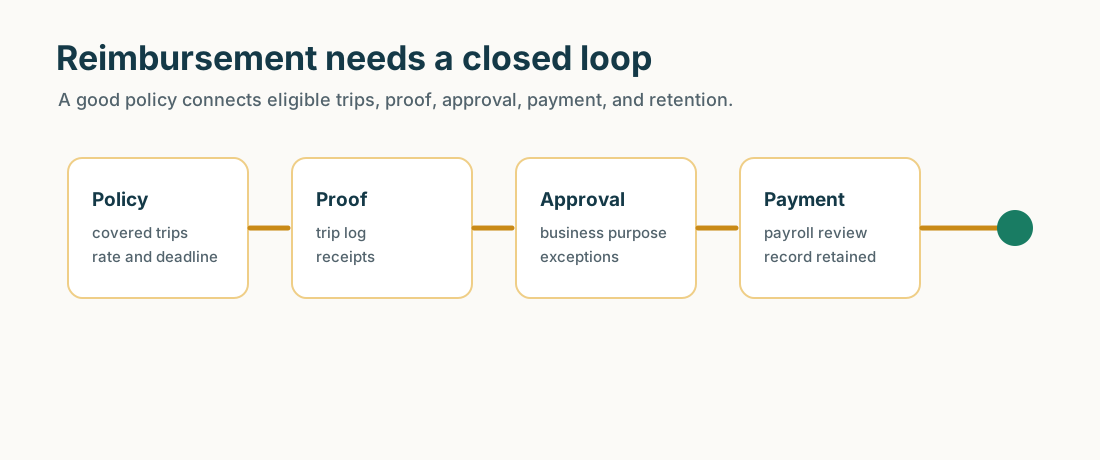
The rate alone does not make a vehicle payment non-taxable. You still need employment-related kilometres, a reasonable rate, no duplicate payment for the same vehicle use, and enough records to justify the treatment. If the payment is taxable, the payroll file changes: deductions, T4 reporting, and employee expense forms may come into play.
This article is educational and is not tax, legal, payroll, employment, or financial advice. CRA treatment can change by tax year, vehicle type, province or territory, employment contract, and payment method. Check the official source and a qualified professional before relying on a reimbursement, taxable-benefit, GST/HST, or payroll position.
Quick answer
Canadian employers can usually handle employee vehicle costs in one of these ways:
- pay a per-kilometre automobile allowance for supported employment-related kilometres
- reimburse actual expenses such as parking, tolls, ferry charges, supplementary business insurance, or other approved vehicle costs
- provide an accountable advance that the employee later supports with receipts or returns if unused
- provide a company automobile or motor vehicle, which follows separate taxable-benefit rules
A reasonable per-kilometre allowance can be non-taxable when it is based only on employment-related business kilometres, uses a reasonable rate, and does not duplicate reimbursement for the same vehicle use. Flat car allowances, unsupported kilometre claims, unreasonable per-kilometre rates, personal driving payments, and combined flat-plus-per-kilometre payments can become taxable benefits.
Mileage reimbursement rules for employers
An automobile allowance is a payment to an employee for using their own automobile or motor vehicle for employment duties. The employee does not have to account for every fuel, repair, insurance, or maintenance cost the way they would with actual expense reimbursement.
For the allowance to stay non-taxable, the employer file should show:
- the allowance was based only on business or employment-related kilometres
- the per-kilometre rate was reasonable for the employee’s facts
- the employer did not reimburse the employee for the same vehicle use twice
- any separately reimbursed supplementary business insurance, tolls, or ferry charges were outside the allowance calculation
- the employee submitted records that support the business kilometres
CRA generally treats the prescribed per-kilometre rates under the Income Tax Regulations as reasonable. A lower or higher rate is not automatically wrong, but it needs support. Vehicle type, driving conditions, and local fuel costs can matter.
2026 CRA automobile allowance rates
For employees using their own vehicle for employment duties, the 2026 prescribed allowance rates are:
| 2026 business kilometres | Provinces | Yukon, Northwest Territories, and Nunavut |
|---|---|---|
| First 5,000 kilometres | 73 cents/km | 77 cents/km |
| Each additional kilometre | 67 cents/km | 71 cents/km |
These are employee allowance rates. They are not a self-employed deduction rate, and they are not the quarterly CRA employee travel directive kilometric rates used for people travelling under that government directive.
Review the rate by tax year. If an employee submits a late claim for a prior year, use the rate and policy that apply to that claim period rather than copying the current-year amount into old payroll records.
For a deeper current-rate table, see Current CRA Automobile Allowance Rates (Canada). For prior years, see Historical CRA Automobile Allowance Rates (Canada).
What counts as business driving
Business driving for an employee generally means driving between work locations or to a point of call for employment duties. CRA’s allowance guidance treats a point of call as a place other than a regular place of employment where the employee goes to perform work.
Common employer-approved trips can include:
- travel from one regular work location to another during the workday
- client, customer, supplier, job site, or repair visits
- business errands such as bank, post office, supply, or delivery trips
- required meetings, conferences, training, or sales calls away from the regular workplace
- direct travel between home and a point of call when the employer needs or allows it and the timing is reasonable
Ordinary travel between home and a regular workplace is usually personal driving. When an employee visits several regular workplaces in one day, the trip from home to the first regular workplace and the trip from the final regular workplace home are usually personal; travel between the work locations during the day can be business driving.
Allowance, reimbursement, and accountable advance
The policy should name the payment type and the proof needed before payroll processes it.
| Payment type | How it works | Employer control |
|---|---|---|
| Per-kilometre allowance | You pay a cents per kilometre amount for employment-related use of the employee’s own vehicle. | Require a kilometre log, rate, claim period, vehicle, and approval. |
| Actual expense reimbursement | You repay amounts the employee spent for approved employment-related costs. | Require receipts, expense reports, trip support, and reasonableness review. |
| Accountable advance | You give money before the expense, then the employee accounts for it and returns any unused amount. | Require receipts or vouchers, final accounting, and repayment records. |
Do not use the label to decide tax treatment. A payment called a “reimbursement” can still be taxable if it pays personal expenses or lacks support. A per-kilometre payment can also be taxable when the rate is not reasonable or the claim is not based only on business kilometres.
If you advance allowance amounts during the year, document the pre-set rate and require employees to account for business kilometres by employment end or by December 31, whichever comes first. If the employee received too much, they have to repay the excess. CRA says you cannot fix an excess advance by simply reporting the difference on the employee’s T4 slip.
When vehicle payments become taxable
CRA lists several situations where an employee vehicle payment can become taxable. Employers should flag these before payroll closes:
- the employee receives a flat monthly or fixed vehicle allowance that is not based only on business kilometres
- the employer combines a flat amount and a per-kilometre amount for the same vehicle use
- the rate is too high or too low for the employee’s circumstances and cannot be justified
- the payment covers personal driving
- the employee does not provide detailed records
- the employer reimburses expenses that the per-kilometre allowance already covered
- an accountable advance is not supported or the employee does not return unused money
If the amount is taxable, CRA guidance says the taxable benefit is generally the amount paid to the employee in the year. The employer may need to include the amount in employment income, withhold income tax, CPP, and EI, and report it on the T4 slip. CRA’s allowance page also says not to remit GST/HST on that taxable allowance or reimbursement benefit.
Employer-provided vehicles are a separate file
The prescribed per-kilometre allowance rate is for employees using their own vehicle. If the employer owns or leases an automobile and makes it available to the employee, review the employer-provided automobile rules instead.
An employer-provided automobile can create a standby charge benefit when it is available for personal use. An operating expense benefit can also apply when the employer pays operating costs connected to personal use. CRA’s automobile provided by the employer guidance explains the calculation workflow and recordkeeping.
Keep business and personal kilometres separate for company vehicles too. The logbook affects taxable-benefit calculations, reduced standby charge questions, operating expense benefit review, and employer corrections.
Records to require from employees
The employer should get records before treating an allowance, reimbursement, or accountable advance as non-taxable. A practical submission should include:
- employee name or employee ID
- claim period
- vehicle used
- trip date
- destination or route
- business purpose
- kilometres driven
- rate used for per-kilometre claims
- receipts for actual expense reimbursement
- manager approval
- repayment record for unused accountable advances
For logbook support, CRA’s motor vehicle records guidance treats a full logbook as the strongest evidence of business vehicle use. For each business trip, the record should show date, destination, purpose, and kilometres driven. Odometer readings at the start and end of the year help support total use, especially when the same vehicle has both business and personal kilometres.
What to put in an employer reimbursement policy
Write the policy so payroll, managers, and employees use the same test each time. Include:
- who is eligible for reimbursement or an automobile allowance
- whether the policy covers employee-owned vehicles, leased vehicles, company vehicles, or all three
- the per-kilometre rate and when it changes after the first 5,000 business kilometres
- how Yukon, the Northwest Territories, and Nunavut rates are handled
- which trips count as employment-related driving
- how commuting and personal stops are handled
- whether parking, tolls, ferry charges, and supplementary business insurance are reimbursed separately
- the deadline for submitting claims
- required logbook fields and receipt rules
- manager approval steps
- payroll treatment for taxable and non-taxable amounts
- the correction process when a claim is wrong or unsupported
The policy should also explain what happens when an employee has a taxable allowance. If you include the allowance in income, the employee may need Form T2200 to review employment expense eligibility. The employee, not the employer, claims any qualifying employment expenses on their tax return.
MyCarTracks workflow for employer reimbursement
Mileage reimbursement gets messy when the kilometre record is rebuilt after the pay period. Build the record before payroll has to decide whether the amount is taxable.
A simple monthly workflow is:
- Employees capture trips during the month.
- Employees classify commuting, personal, and employment-related driving.
- Managers review trip purpose, distance, and policy fit.
- Payroll applies the approved rate or reimbursement treatment.
- The business keeps the report, approval, and receipts with payroll records.
With MyCarTracks automatic mileage tracking, teams can capture trips, separate business and personal kilometres, keep vehicle records organized, and export reports for payroll or reimbursement review.
Automatic tracking does not decide tax treatment. It gives the employer a clearer record before applying the CRA allowance, reimbursement, accountable advance, or taxable-benefit rules.
Common mistakes for employers
- using the prescribed rate without requiring a kilometre log
- treating a flat monthly vehicle allowance as non-taxable
- combining a fixed allowance and per-kilometre allowance for the same vehicle use
- reimbursing actual vehicle costs already covered by the allowance
- paying personal or commuting kilometres as if they were business kilometres
- using the wrong 2026 territorial rate
- treating the employee allowance rate as a self-employed deduction rate
- using CRA employee travel directive kilometric rates for a private-sector allowance policy
- missing payroll deductions and T4 reporting when the amount is taxable
- failing to document accountable advances and unused repayments
FAQ
Do employers in Canada have to reimburse mileage?
CRA guidance explains tax and payroll treatment. It does not create a general rule that every employer must reimburse every employee for business driving. Your employment agreements, workplace policy, collective agreement, and province or territory employment rules may matter.
Is a reasonable automobile allowance taxable?
A reasonable per-kilometre automobile allowance can be non-taxable when it is based only on employment-related business kilometres, the rate is reasonable, and the employer does not reimburse the same vehicle use twice.
Is a flat car allowance taxable in Canada?
A flat or fixed allowance is usually taxable because it is not based only on the number of kilometres driven for employment duties. If a flat amount is combined with a per-kilometre allowance for the same vehicle use, CRA can treat the combined amount as taxable.
Can an employer pay more than the CRA prescribed rate?
Possibly, but the employer needs support. CRA says a lower or higher rate may not be reasonable, and all relevant facts have to be considered. Keep the reason in the employee file if your policy uses a custom rate.
What should employers do when a vehicle allowance is taxable?
If the allowance, reimbursement, or accountable advance is taxable, the employer may need to include the amount in employment income, withhold income tax, CPP, and EI, and report the amount on the employee’s T4 slip.
Can employees claim vehicle expenses if the employer taxes the allowance?
They may be able to review the employee expense rules if the allowance has been included in income and they meet the conditions. The employer may need to complete Form T2200. The employee uses Form T777 and keeps the supporting records.
Do employees need receipts for a per-kilometre allowance?
Usually the per-kilometre allowance is built around supported business kilometres rather than receipts for every vehicle cost. Receipts are still needed for actual expense reimbursements and for separately reimbursed items such as tolls, ferry charges, parking, or supplementary business insurance.
What to read next
- Mileage Reimbursement for Employees (Canada)
- Is Mileage Reimbursement Taxable Income? (Canada)
- How to Calculate Mileage Reimbursement (Canada)
- Current CRA Automobile Allowance Rates (Canada)
- CRA Mileage Log Requirements (Canada)
- CRA Mileage Guide (Canada)
- Claim Motor Vehicle Expenses From the CRA (Canada)
Sources
- CRA automobile and motor vehicle allowances
- Department of Finance Canada 2026 automobile deduction limits and expense benefit rates
- CRA Employers’ Guide - Taxable Benefits and Allowances
- CRA automobile provided by the employer
- CRA motor vehicle records
- CRA T2200 Declaration of Conditions of Employment
- CRA T777 Statement of Employment Expenses