Grey fleet HMRC compliance tends to become visible when finance has to review a payment: why a trip was business, which vehicle was used, whether the rate was within the approved amount, and whether a car allowance or company-car rule changes the treatment. The problem is rarely just choosing a pence-per-mile rate.
A practical rule helps: every mileage payment needs a business reason, a driver, a vehicle, a distance, an approval, and a payment treatment. GOV.UK’s employee business travel mileage rules explain the approved mileage framework for employees using their own vehicles, while GOV.UK’s PAYE recordkeeping guidance and expenses and benefits recordkeeping guidance explain employer record expectations.
This guide is for UK employers, finance teams, payroll teams, HR teams, operations managers, and fleet administrators who need mileage claims to make sense before they reach payroll or review. It is educational only and is not tax, payroll, legal, employment, HSE, insurance, or financial advice.
Quick answer
Grey fleet HMRC compliance means keeping enough evidence to show which business journeys were paid, which vehicle model applied, whether the payment was a Mileage Allowance Payment (MAP), whether it stayed within HMRC’s approved amount, and whether payroll or reporting was needed for any excess, allowance, or company-car arrangement.
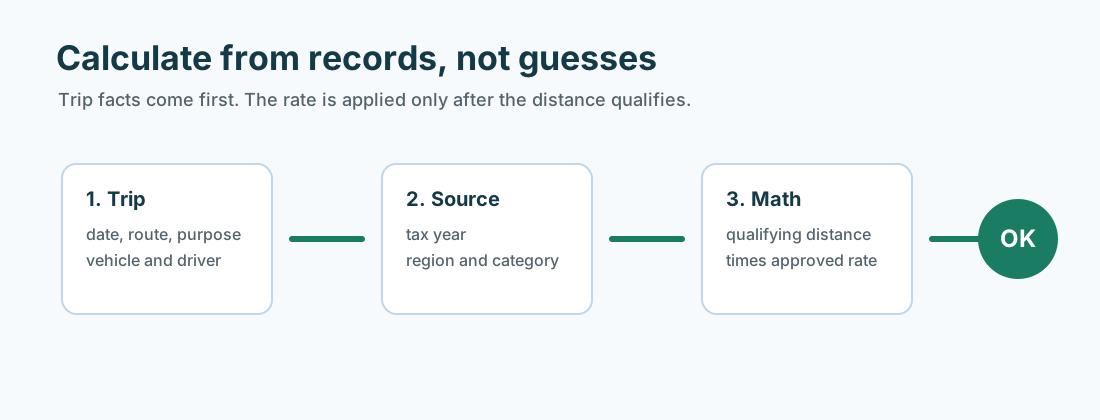
For employee-owned vehicles, the core record is a trip-level mileage log: date, business purpose, start and end location or route, miles, driver, vehicle, rate, approval status, and payment reference. For company cars, do not use employee-owned vehicle AMAP logic; company-car fuel and private use have different rules.
Grey fleet HMRC compliance terms
- HM Revenue and Customs (HMRC): the UK tax authority.
- Approved Mileage Allowance Payments (AMAPs): HMRC’s tax-free mileage payment benchmark for employees using their own vehicle for business trips.
- Mileage Allowance Payments (MAPs): payments an employer makes when an employee uses their own vehicle for business travel.
- Mileage Allowance Relief (MAR): tax relief an employee may claim if their employer pays less than HMRC’s approved amount.
- Benefit-in-Kind (BiK): tax on a non-cash employee benefit such as private use of a company car.
- Advisory Fuel Rates (AFRs): HMRC rates used for company-car fuel reimbursement or private-fuel repayment.
Mileage log requirements
If you reimburse employees for business miles in their own vehicles, the employer needs records that show the payment relates to qualifying business travel.
A practical grey-fleet mileage log should include:
- date of the journey
- business purpose
- start and end location or route
- total business miles
- driver name
- vehicle used
- business/private classification
- reimbursement rate
- manager approval
- payroll, expense, or finance reference
GOV.UK’s expenses and benefits recordkeeping guidance gives travel expenses as an example where employers should keep when and why the employee travelled and receipts where possible. A mileage log is the working file that explains the payment before finance exports it.
AMAP rates and approved amounts
For 2026/27, GOV.UK lists the approved rates for employees using their own vehicles as:
| Vehicle type | Approved mileage rate |
|---|---|
| Cars and vans, first 10,000 business miles in the tax year | 45p per mile |
| Cars and vans, each business mile after 10,000 | 25p per mile |
| Motorcycles | 24p per mile |
| Bicycles | 20p per mile |
The approved amount is the maximum tax-free benchmark for MAPs in that tax year. If the employer pays above the approved amount, the excess is treated as normal pay for income tax. If the employer pays below the approved amount, the employee may be able to claim MAR on the unused balance.
For a deeper calculation guide, use Current HMRC Mileage Rates (UK), Mileage Allowance for Employees (UK), and Mileage Allowance Relief (UK).
Mileage Allowance Relief handoff
Mileage Allowance Relief is usually an employee-side tax relief question. It can matter to employers because employees may ask why they were paid below the approved amount, what records they need, or whether the business will reimburse the shortfall.
Keep the employer policy clear:
- the employer’s mileage rate and payment rules
- whether the payment is a MAP, car allowance, exact reimbursement, or another payroll item
- which business journeys were approved
- what records employees can access for their own claim
- whether payroll or finance gives tax advice, or simply points employees to HMRC
For employee claim details, use Mileage Allowance Relief (UK) and How to Claim Mileage Allowance Relief From HMRC.
Self-employed drivers are a different topic
This grey fleet guide is for employers managing employees or workers who use private vehicles for work. It is not a self-employed mileage deduction article.
Self-employed sole traders and partners may use different rules, such as simplified vehicle expenses or actual vehicle costs, depending on their facts. Do not use a grey-fleet employee reimbursement policy as the authority for a sole trader’s Self Assessment claim. For that separate topic, use Self-Employed Mileage Allowance (UK).
Employer records and retention
The employer should be able to show:
- what mileage was claimed
- why the journey was business travel
- who approved it
- which rate or payment rule was used
- whether the payment was within the approved amount
- whether anything was reported or processed through payroll
- where supporting documents and export references are stored
GOV.UK says PAYE records generally need to be kept for three years after the relevant tax year ends. For expenses and benefits, GOV.UK says records should show the date and details of every expense or benefit, information needed for end-of-year forms, employee contributions, and HMRC correspondence.
Some businesses keep mileage support longer because tax, accounting, employment, or internal audit needs can differ. Set a retention rule with your accountant, payroll provider, or adviser instead of relying on a vague inbox archive.
Vehicle ownership changes the tax treatment
Do not mix employee-owned vehicles, personal leases, car allowances, company cars, and salary sacrifice cars into one rule.
| Vehicle or payment model | What to watch |
|---|---|
| Employee-owned grey-fleet vehicle | AMAP/MAP/MAR rules may apply if the employer pays business mileage; HSE, insurance, MOT, and approval checks still matter |
| Personal lease in employee’s name | Usually treated like an employee-owned vehicle for mileage-payment purposes; confirm business-use insurance because private lease policies can restrict use |
| Car allowance | Usually cash pay through payroll; it does not automatically become a MAP or prove the vehicle is suitable for work |
| Company car | Private availability can create BiK; business fuel reimbursement or private-fuel repayment may use AFRs where GOV.UK conditions are met |
| Salary sacrifice car | Contractual pay reduction, minimum-wage, OpRA, BiK, and company-car rules may be relevant |
For car allowance detail, use Car Allowance for Employees (UK). For salary sacrifice, use Salary Sacrifice Car Scheme (UK).
Company cars, AFRs, and BiK
Company cars are not grey-fleet vehicles in the HMRC mileage-payment sense. If an employee or their family can use a company car privately, GOV.UK says the employee pays tax on the value of that benefit, including commuting use.
AFRs are also company-car specific. GOV.UK says advisory fuel rates only apply to employees using a company car, either when the employer reimburses business travel in a company car or when employees repay private fuel. You must not use AFRs for employee-owned grey-fleet vehicles.
That distinction matters in mixed fleets. A finance team may be reviewing employee-owned mileage claims, company-car fuel records, and car allowance payments in the same month, but each needs its own tax treatment.
What can go wrong with weak records
Weak records can create several problems:
- mileage payments are treated as taxable pay because business purpose cannot be shown
- payroll needs to correct or reprocess payments
- managers approve rounded mileage without route or purpose evidence
- employees claim ordinary commuting as business travel
- finance cannot separate car allowance, MAPs, company-car fuel, and private expenses
- HMRC, auditors, or advisers ask for support and the business cannot produce a clear file
- employees lose the evidence they need for MAR
Do not describe every weak record as fraud. Often it is a process issue: drivers report late, managers approve incomplete claims, or nobody owns the field list.
Manual logging vs automatic tracking
Manual logs can work for small, low-mileage teams if the rules are clear and managers check the same fields every time. They fail when drivers reconstruct trips weeks later, estimate distances, or submit inconsistent spreadsheets.
Automatic tracking can reduce those gaps, but it still needs human review. The driver should be able to classify business and private journeys, correct trip details where needed, and submit only the records that belong in the claim. The manager should approve based on purpose, route, date, vehicle, and policy fit.
How MyCarTracks supports HMRC records
MyCarTracks does not replace HMRC advice, payroll review, or accountant judgement. It can help build the trip evidence that those reviews depend on.
MyCarTracks automatic mileage tracking can capture trips, let drivers classify business and private travel, and export reports by date, driver, vehicle, purpose, and distance. For teams, MyCarTracks fleet tracking can help administrators review team reports, vehicle activity, reimbursement records, and exportable mileage files from one workflow.
That matters when payroll needs a clean file rather than a monthly total with no trip detail.
Common mistakes
- Paying mileage without a trip purpose.
- Applying 45p per mile to every journey, including ordinary commuting.
- Using AFRs for employee-owned vehicles.
- Treating a car allowance as tax-free mileage reimbursement.
- Combining company-car, car allowance, and grey-fleet payments in one payroll code without review.
- Keeping licence, insurance, MOT, mileage, and payment records in separate places.
- Letting drivers submit rounded totals without route or location support.
- Forgetting that MAR is usually an employee claim, not an employer reimbursement of the whole shortfall.
FAQ
What records does HMRC expect for grey-fleet mileage?
Keep trip-level records showing the journey date, business purpose, start and end location or route, miles, driver, vehicle, rate, approval, and payment reference. The exact record design is your process, but it must explain what was paid and why.
Are AMAP rates mandatory reimbursement rates?
No. AMAP rates are HMRC tax benchmarks. They do not, by themselves, force every employer to pay 45p per mile. Your contract, policy, sector rules, or employment arrangement may matter separately.
What happens if an employer pays above the approved amount?
The excess above the approved amount is treated as normal pay for income tax. National Insurance can also need separate review under the relevant motoring expenditure rules.
Can employees claim MAR if paid less than AMAP rates?
They may be able to claim Mileage Allowance Relief on the unused approved amount if they used their own vehicle for qualifying business travel and were paid less than the approved amount.
Where to go next
- What Is a Grey Fleet? (UK)
- Grey Fleet Policy Guide (UK)
- Grey Fleet Risk Assessment (UK)
- Grey Fleet vs Company Cars (UK)
- Grey Fleet Mileage Tracking Software (UK)
- Current HMRC Mileage Rates (UK)
- Mileage Allowance for Employees (UK)
- Mileage Allowance Relief (UK)
- How to Claim Mileage Allowance Relief From HMRC
- Car Allowance for Employees (UK)
Sources
- GOV.UK: Expenses and benefits: business travel mileage for employees’ own vehicles
- GOV.UK: Travel - mileage and fuel rates and allowances
- HMRC Employment Income Manual EIM31230: approved amount for Mileage Allowance Payments
- HMRC Employment Income Manual EIM31240: statutory mileage rates
- HMRC Employment Income Manual EIM31330: Mileage Allowance Relief
- GOV.UK: PAYE and payroll for employers - keeping records
- GOV.UK: Expenses and benefits for employers - record keeping
- HMRC National Insurance Manual NIM05815: relevant motoring expenditure
- HMRC National Insurance Manual NIM05830: qualifying amount
- GOV.UK: Advisory fuel rates
- GOV.UK: Tax on company cars