A Mileage Allowance Relief claim may be available when you are an employee, use your own vehicle for qualifying business travel, and your employer pays less than the approved mileage amount. The official employee business mileage rules call that unpaid balance Mileage Allowance Relief, or MAR.
The claim is not a refund of every mile your employer did not pay for. It is tax relief on the unused approved amount. For vehicle claims, the employee vehicle tax relief guidance requires mileage records, including dates and mileage, and P87 vehicle evidence needs the reason for each journey plus start and end postcodes.
This article is educational and is not tax, payroll, legal, employment, or financial advice. HMRC treatment can change by tax year, vehicle type, employment status, payment type, and the facts of the journey. Check the official guidance or speak with a qualified adviser before relying on a claim.
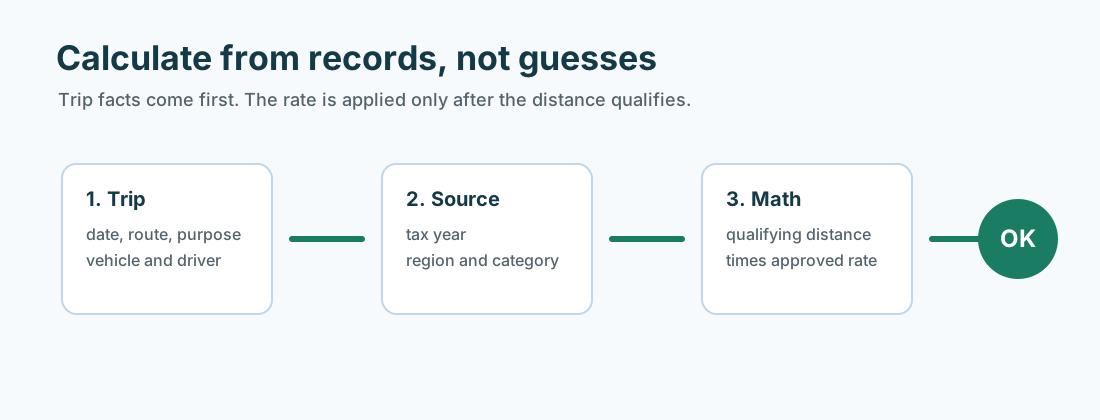
Quick answer
To claim Mileage Allowance Relief from HMRC:
- Confirm the journeys qualify as business travel, not ordinary commuting.
- Gather your mileage log and employer payment records for the tax year.
- Calculate the approved amount using HMRC’s pence-per-mile rates.
- Subtract the Mileage Allowance Payments your employer already paid.
- Claim through Self Assessment if you file a tax return, or use the GOV.UK job-expenses claim route or form P87 if you do not.
For the 2026/27 tax year, the employee approved rates are 45p per mile for the first 10,000 business miles in cars and vans, 25p after that, 24p for motorcycles, and 20p for bicycles. MAR is based on the unused approved amount, then your tax relief depends on the tax you paid and your tax rate.
Which employees can claim
MAR is an employee relief. You may have a claim if you used your own car, van, motorcycle, or bicycle for qualifying business journeys and your employer paid less than HMRC’s approved amount for that vehicle kind in the tax year.
This most often comes up when:
- your employer pays a lower mileage rate, such as 25p or 30p per mile for car business mileage
- your employer pays no mileage allowance for qualifying business journeys
- your employer pays a taxable car allowance, but you still use your own vehicle for business miles and the business-mile payments do not reach the approved amount
- your employer reimburses some business fuel or vehicle costs, but not enough to cover the approved mileage amount
You also need to have paid tax in the year you are claiming for. If you did not pay tax, there may be no tax relief for HMRC to give, even if the mileage shortfall is real.
Check the journeys before you calculate
Do this before touching the numbers. A correct calculation will still fail if the journeys do not qualify.
Business travel can include journeys between workplaces, trips to a client’s site, or travel to a temporary workplace where the facts support that treatment. Travel between home and a permanent workplace is usually ordinary commuting. HMRC’s ordinary commuting guidance treats that as non-deductible travel for most employees.
Keep private stops out of the claim. If a journey is mainly personal, a work errand on the way does not automatically turn the whole trip into business mileage. Keep your records specific enough to show why each journey was for work.
Records to prepare before claiming
HMRC can ask for journey-level evidence. A total such as “3,200 work miles” is not enough on its own.
Prepare a mileage log with:
- tax year
- date of each journey
- reason or business purpose
- start point and destination
- start and end postcodes where you are making a P87 vehicle claim
- vehicle used
- business miles
- employer Mileage Allowance Payments received for the same mileage
- separate records for each employment, if you are claiming for more than one job
For a postal P87 claim, vehicle evidence must include mileage logs showing the reason for every journey and the start and end postcodes. The P87 guidance also requires a separate mileage log for each employment if you claim for more than one job.
HMRC rates used for the claim
Use the approved mileage rates for the tax year you are claiming. For 2026/27, the employee rates are:
| Vehicle type | First 10,000 business miles in the tax year | Each business mile after 10,000 |
|---|---|---|
| Cars and vans | 45p | 25p |
| Motorcycles | 24p | 24p |
| Bicycles | 20p | 20p |
Cars and vans share one 10,000-mile threshold for this calculation. If you use more than one car or van for the same employment in the tax year, count those business miles together.
For more detail on the rates, vehicle groups, and self-employed flat rates, read Current HMRC Mileage Rates (UK). If you are claiming for an older tax year, check Historical HMRC Mileage Rates (UK) before calculating the approved amount.
Step 1: add up your business miles
Start with the mileage log, not your memory. Add qualifying business miles by tax year and vehicle kind.
For most employee MAR claims, you need separate totals for:
- cars and vans
- motorcycles
- bicycles
- each employment, where you had more than one job
Do not include commuting miles, private journeys, or self-employed business mileage in an employee MAR claim. If you have employment mileage and self-employed mileage in the same year, keep separate logs and separate calculations.
Step 2: work out the approved amount
Multiply the qualifying business miles by the approved rate for that vehicle kind.
Example for a car in 2026/27:
| Calculation | Amount |
|---|---|
| 4,500 business miles x 45p | £2,025 |
| Approved amount | £2,025 |
If your car or van business mileage goes over 10,000 miles in the tax year, split the calculation:
| Calculation | Amount |
|---|---|
| 10,000 miles x 45p | £4,500 |
| 2,000 miles x 25p | £500 |
| Approved amount for 12,000 business miles | £5,000 |
HMRC’s Employment Income Manual explains that MAR uses the same statutory mileage rates as the approved amount for Mileage Allowance Payments.
Step 3: subtract what your employer paid
Add up the Mileage Allowance Payments your employer paid for the same business miles. Then subtract those payments from the approved amount.
Example:
| Calculation | Amount |
|---|---|
| Approved amount for 4,500 car business miles | £2,025 |
| Employer paid 30p x 4,500 miles | £1,350 |
| Unused approved amount | £675 |
The claim is based on the £675 unused approved amount. If you pay Income Tax at 20%, the tax value would usually be £135, subject to your wider tax position and the tax you paid for that year.
If your employer paid nothing for those qualifying business miles, the unused approved amount is usually the full approved amount. If your employer paid the full approved amount, there is no MAR to claim for that vehicle kind and tax year. If your employer paid more than the approved amount, the excess is taxable as normal pay and does not create a MAR claim.
For a fuller explanation of the relief calculation, read Mileage Allowance Relief (UK). For the employer payment side, read Mileage Allowance for Employees (UK).
Step 4: choose P87 or Self Assessment
The route depends on whether you complete a Self Assessment tax return.
If you complete Self Assessment, claim employee job-expense tax relief through your tax return. The Self Assessment overview describes the system HMRC uses to collect Income Tax, with returns filled in after the tax year ends.
If you do not complete Self Assessment, you can use the GOV.UK job-expenses claim service where eligible, or claim by post using form P87. A postal P87 claim generally must:
- be within 4 years from the end of the tax year you are claiming for
- be £2,500 or less for each tax year
- relate to a year in which you paid tax
- use HMRC form P87
- include the required evidence
If the total expenses claim for a tax year is more than £2,500, use Self Assessment instead.
Step 5: submit the claim and keep the records
Before you submit, check that the claim matches the evidence:
- the tax year is correct
- business miles exclude ordinary commuting
- vehicle kinds and thresholds are separated correctly
- employer payments have been subtracted
- the claim route is right for your situation
- P87 evidence includes mileage logs with journey reasons and postcodes
Keep copies after you claim. If HMRC asks questions later, you will need the mileage log, employer payment details, and calculation that support the figure you claimed.
Self-employed mileage is a different claim
Do not use employee MAR for self-employed mileage. Sole traders and eligible partnerships usually look at simplified expenses or actual vehicle costs instead. Those routes sit in Self Assessment as business expense claims, not as relief for an employer’s Mileage Allowance Payment shortfall.
If you are both employed and self-employed, split the records. The same vehicle may appear in both parts of your working life, but the claim routes are different.
Company cars and fuel claims
MAR for your own vehicle is separate from company car fuel or electricity relief. If you use a company car for business trips and personally pay for fuel or electricity, the employee vehicle guidance may allow tax relief on unreimbursed business fuel or electricity costs.
Do not use the private-vehicle approved mileage rate to claim company car running costs. The evidence and calculation are different.
Car allowance and the 45p question
A taxable car allowance does not automatically stop a MAR claim. The practical question is whether the allowance or mileage payments count as reimbursement for the business miles and whether your employer’s payments reached the approved amount.
If the car allowance is taxed as pay and your employer pays less than the approved amount for qualifying business mileage, you may still need to calculate the unused approved amount. If your employer has already reimbursed the business mileage up to the approved amount, there is usually no MAR left to claim.
How MyCarTracks helps with mileage claim records
The hard part is usually the log, not the arithmetic. MyCarTracks can capture trips automatically, separate business and personal journeys, keep vehicle records, and export mileage reports for an employer review or HMRC claim calculation.
Use MyCarTracks automatic mileage tracking if you want the business-mile record built throughout the year instead of reconstructed when the claim is due.
Common claim mistakes
- claiming the full mileage shortfall instead of tax relief on the unused approved amount
- using 45p per mile for ordinary commuting
- forgetting to subtract employer Mileage Allowance Payments
- mixing employee MAR with self-employed vehicle expenses
- claiming fuel, electricity, MOTs, repairs, or vehicle tax separately after using the own-vehicle approved mileage rate
- using a single annual mileage estimate instead of journey records
- missing start and end postcodes for P87 vehicle evidence
- using Self Assessment and P87 for the same expense
- claiming passenger-payment shortfalls as MAR
Mileage Allowance Relief claim FAQ
How far back can I claim Mileage Allowance Relief?
You can claim for the current tax year and the 4 previous tax years if you are eligible. For postal P87 claims, the claim must generally be within 4 years from the end of the tax year you are claiming for.
Do I need receipts to claim mileage from HMRC?
You need mileage records rather than fuel receipts for the own-vehicle approved mileage rate. For P87 vehicle evidence, keep mileage logs showing the reason for every journey and the start and end postcodes.
Can I claim 45p per mile if my employer pays a car allowance?
Possibly, but only for the unused approved amount after employer payments are considered. A taxed car allowance does not by itself prove there is a claim. You still need qualifying business miles, a payment shortfall, tax paid in the year, and records.
Can I claim if my employer pays 30p per mile?
You may be able to claim MAR on the difference between the approved amount and the 30p-per-mile payment for qualifying business miles. For car or van business miles under 10,000 in 2026/27, that usually leaves a 15p-per-mile unused approved amount before your tax rate is applied.
Can I claim mileage for commuting?
Usually no. Travel between home and a permanent workplace is ordinary commuting. Travel to a temporary workplace or between workplaces may qualify where the facts support business travel.
Can I claim MAR for passenger payments?
No. Passenger payments are separate from your own vehicle mileage. The passenger payment rules do not give relief if an employer pays less than the passenger payment rate or pays nothing.
Can I claim through P87 if my expenses are over £2,500?
For postal P87 claims, the total expenses claim for each tax year must be £2,500 or less. If the amount is more than £2,500, you need to use Self Assessment.
What to read next
- Mileage Allowance Relief (UK)
- Mileage Allowance for Employees (UK)
- Current HMRC Mileage Rates (UK)
- Historical HMRC Mileage Rates (UK)
- HMRC Mileage Guide (UK)
Sources
- GOV.UK: Expenses and benefits - business travel mileage for employees’ own vehicles, rules for tax
- GOV.UK: Claim tax relief for your job expenses - vehicles you use for work
- GOV.UK: Claim tax relief for your job expenses by post using form P87
- HMRC Employment Income Manual EIM31330: Mileage Allowance Relief
- HMRC Employment Income Manual EIM32055: ordinary commuting
- GOV.UK: Self Assessment tax returns
- GOV.UK: Expenses and benefits - business travel mileage, passenger payments