The current HMRC mileage rates for the 2026/27 tax year are 45p per mile for the first 10,000 business miles in a car or van and 25p after that. Motorcycles are 24p per business mile, and bicycles are 20p per business mile. GOV.UK lists the same approved rates in the employee business travel mileage rules and in the HMRC travel mileage and fuel allowances table.
These rates are used for approved mileage allowance payments, usually shortened to MAPs, when an employee uses their own vehicle for business travel. They also feed into Mileage Allowance Relief (MAR) if an employer pays less than the approved amount. For self-employed drivers, GOV.UK uses similar flat rates for simplified vehicle expenses, but that is a business-expense method, not an employee reimbursement claim.
This article is educational and is not tax, payroll, legal, employment, or financial advice. HMRC treatment can change by tax year, vehicle type, employment status, payment type, and the facts of the journey. Check the official source or speak with a qualified adviser before relying on a calculation.
Quick answer
Use these HMRC mileage rates for UK business miles in 2026/27:
| Vehicle type | First 10,000 business miles in the tax year | Each business mile after 10,000 |
|---|---|---|
| Cars and vans | 45p | 25p |
| Motorcycles | 24p | 24p |
| Bicycles | 20p | 20p |
For employees, the table is the approved amount benchmark for MAPs and MAR. For self-employed simplified expenses, cars and goods vehicles use 45p for the first 10,000 business miles and 25p after that, while motorcycles use 24p per mile. Bicycles are not listed in GOV.UK’s simplified vehicle expenses table.
Current HMRC mileage rates for employees
For employees using their own vehicle, HMRC’s approved mileage allowance rates are:
| Vehicle | Approved mileage rate |
|---|---|
| Car or van, first 10,000 business miles in the tax year | 45p per mile |
| Car or van, each business mile after 10,000 | 25p per mile |
| Motorcycle | 24p per mile |
| Bicycle | 20p per mile |
The statutory mileage rates have applied from the 2011/12 tax year onward. They are used to work out the approved amount for MAPs and any MAR available to the employee. If you are checking business miles from before 2011/12, use Historical HMRC Mileage Rates (UK).
For MAP and MAR calculations, vehicles are grouped by kind. Cars and vans are one kind, motorcycles are another, and cycles are another. If an employee uses two cars in the same tax year, the business miles for those cars are combined for the 10,000-mile threshold. A motorcycle calculation stays separate from a car or van calculation.
How the 10,000-mile threshold works
The 10,000-mile threshold applies per tax year for cars and vans. It is not a monthly threshold, and it is not reset each time you change cars.
Example: you drive 12,000 business miles in your own car in 2026/27.
| Calculation step | Amount |
|---|---|
| 10,000 miles x 45p | £4,500 |
| 2,000 miles x 25p | £500 |
| Approved amount for the tax year | £5,000 |
If your employer pays exactly £5,000 as MAPs for those business miles, the payment is within the approved amount. If your employer pays less, you may have a MAR claim on the unused approved amount. If your employer pays more, the excess is taxable as normal pay.
What counts as business miles
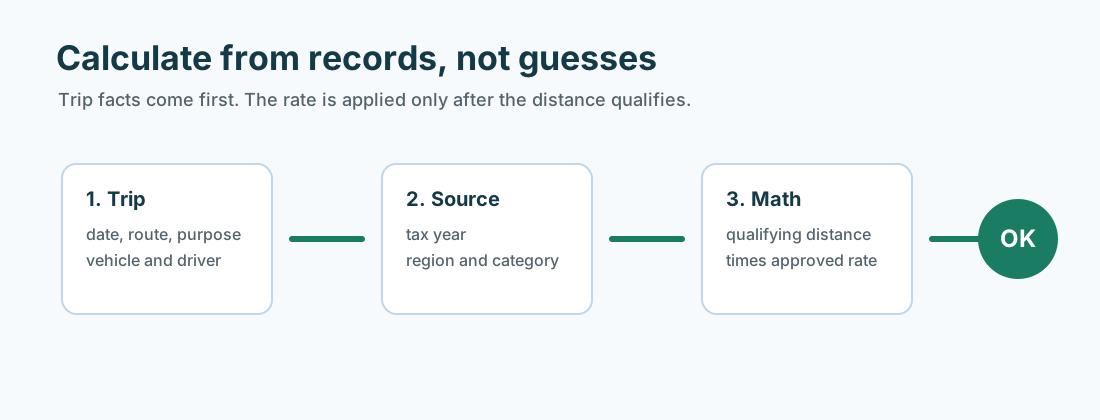
The rate only matters after the journey qualifies. Business miles usually include travel to a temporary workplace, travel between workplaces for the same employment, and journeys made to visit clients, customers, suppliers, patients, or job sites.
Ordinary commuting is different. Travel between home and a permanent workplace usually does not qualify for tax relief. A journey to a temporary workplace can qualify, but the facts still matter. Do not apply the 45p rate to every workday drive unless the journey is actually business travel.
For broader UK mileage rules, use the HMRC Mileage Guide (UK). For employee-specific reimbursement treatment, use Mileage Allowance for Employees (UK).
If your employer pays a different rate
HMRC’s approved mileage rates are tax benchmarks. They do not, by themselves, force every employer to pay 45p per mile. Your contract, employer policy, or sector rules may matter separately.
If your employer pays below the approved amount, there is normally nothing extra for the employer to report for income tax, but you may be able to claim Mileage Allowance Relief on the unused balance. The relief is on the difference between the approved amount and what your employer paid. It is not a direct reimbursement of the whole shortfall.
If your employer pays above the approved amount, the excess must be reported and taxed as normal pay. Employers also need to check National Insurance separately where the payment is relevant motoring expenditure.
National Insurance rates for motoring payments
National Insurance has its own calculation for relevant motoring expenditure, or RME. RME can include MAPs, payments made to someone else for the employee’s benefit, and other cash payments toward the employee’s use of their vehicle.
For National Insurance, the qualifying amount is calculated for the earnings period using these rates:
| Vehicle type | National Insurance qualifying amount rate |
|---|---|
| Cars and vans | 45p per business mile |
| Motorcycles | 24p per business mile |
| Bikes | 20p per business mile |
If RME is above the qualifying amount, the excess is added to earnings for Class 1 National Insurance. If it is below the qualifying amount, there is nothing to report and no National Insurance to pay on that RME shortfall. The spare qualifying amount cannot be used against other pay.
Passenger payment rate
The approved passenger payment rate is 5p per passenger per business mile for carrying fellow employees in a car or van on journeys that are also work journeys for those passengers.
Passenger payments are separate from the driver’s own mileage rate. There is no Mileage Allowance Relief if your employer pays less than 5p per passenger mile or pays nothing for passengers.
Self-employed simplified expenses rates
Self-employed sole traders and eligible partnerships may be able to use simplified expenses for vehicles instead of claiming actual vehicle costs. The current flat rates are:
| Vehicle type | Simplified expenses flat rate |
|---|---|
| Cars and goods vehicles, first 10,000 business miles | 45p per mile |
| Cars and goods vehicles, after 10,000 business miles | 25p per mile |
| Motorcycles | 24p per mile |
Simplified expenses are not available for every vehicle. You cannot use simplified expenses for a vehicle if you have already claimed capital allowances for it or included it as an expense when working out business profits. Once you use flat rates for a vehicle, you must keep using them for that vehicle while it remains in the business.
You can still claim other business travel costs, such as train journeys and parking, on top of simplified vehicle expenses where the rules allow. For the full self-employed workflow, use Self-Employed Mileage Allowance (UK).
What the rate covers
For employee tax relief on your own vehicle, the approved mileage rate covers the cost of owning and running the vehicle for work. Fuel, electricity, vehicle tax, MOTs, and repairs are not claimed separately when you use the approved mileage rate.
Some travel costs are handled separately from the mileage rate. Parking, tolls, congestion charges, public transport, hotels, and meals may need separate treatment under employer expense policy or general travel-expense rules. Fines and penalties should not be treated as normal reimbursable business mileage costs.
Records you need before using the rate
Keep records before you calculate the claim. Rebuilding the log months later is where mistakes usually enter the calculation. A useful UK mileage record should include:
- date of the journey
- start and end point
- business purpose or reason for the trip
- vehicle used
- miles driven
- whether the trip was business or personal
- employer mileage payment received, if any
- tax year and rate used for the calculation
For a postal P87 employee claim, GOV.UK asks for the reason for every journey and the start and end postcodes. Self-employed drivers need enough business records to support the expense method they use.
MyCarTracks workflow for HMRC mileage rates
MyCarTracks can help capture business trips, classify journeys, keep vehicle records, and export mileage reports for reimbursement, payroll review, or Self Assessment preparation. If you want the log built as you drive, use MyCarTracks automatic mileage tracking.
Common mistakes with HMRC mileage rates
- using 45p per mile for ordinary commuting
- treating the HMRC rate as a legal payment requirement rather than a tax benchmark
- forgetting that the car and van rate drops after 10,000 business miles in the tax year
- resetting the 10,000-mile threshold when the employee changes cars
- claiming fuel, MOTs, repairs, or vehicle tax separately after using the employee approved mileage rate
- treating passenger payments as if they can create MAR
- mixing employee MAP/MAR rules with self-employed simplified expenses
- ignoring National Insurance where regular motoring payments are made through payroll
FAQ
What are the HMRC mileage rates for 2026/27?
Cars and vans are 45p per mile for the first 10,000 business miles in the tax year and 25p per mile after that. Motorcycles are 24p per mile. Bicycles are 20p per mile.
Are the current HMRC mileage rates different from 2021?
No. The official GOV.UK table shows the approved mileage rates from the 2011/12 tax year to the present date. The same 45p, 25p, 24p, and 20p rates apply for 2026/27.
Can I claim 45p per mile if my employer pays 30p?
You may be able to claim Mileage Allowance Relief on the difference between the approved amount and what your employer paid, if the journeys qualify and you meet the employee tax-relief conditions. You do not receive the whole difference as cash from HMRC; the claim gives tax relief on the unused approved amount.
Can self-employed people use the HMRC mileage rate?
Self-employed sole traders and eligible partnerships can use simplified expenses for cars, goods vehicles, and motorcycles if they meet the conditions. This is separate from employee MAPs and MAR.
Is there a higher mileage rate for electric cars?
For employee MAP and MAR calculations, electric and hybrid cars and vans are included with cars and vans. That means the same 45p/25p rates apply. Electric bikes are treated as cycles if they meet the electrically assisted pedal cycle rules; otherwise, GOV.UK treats them like motorcycles for this purpose.
Does the HMRC mileage rate include fuel?
Yes, for employee claims using your own vehicle, the approved mileage rate covers the cost of owning and running the vehicle for work, including fuel or electricity. You cannot claim those running costs separately through the approved mileage rate route.
What to read next
- Historical HMRC Mileage Rates (UK)
- HMRC Mileage Guide (UK)
- Mileage Allowance for Employees (UK)
- Mileage Allowance Relief (UK)
- Self-Employed Mileage Allowance (UK)
Sources
- GOV.UK: Expenses and benefits - business travel mileage for employees’ own vehicles, rules for tax
- GOV.UK: Travel - mileage and fuel rates and allowances
- HMRC Employment Income Manual EIM31240: statutory mileage rates
- GOV.UK: Claim tax relief for your job expenses - vehicles you use for work
- GOV.UK: Expenses and benefits - business travel mileage, rules for National Insurance
- GOV.UK: Expenses and benefits - business travel mileage, passenger payments
- GOV.UK: Simplified expenses if you’re self-employed - vehicles