If people in your team drive to client visits, training days, care appointments, site checks, or business errands in vehicles the company does not provide, you may already have a grey fleet. The useful first step is to record who is driving, what they drive, and which work trips are being approved.
That can mean an employee’s own car, a personal lease, a cash-allowance vehicle, a van, a motorcycle, a scooter, a bicycle, or another third-party vehicle used for work. The practical issue is visibility: someone needs to know whether business-use insurance has been confirmed and how mileage will be recorded and reimbursed.
The Health and Safety Executive (HSE), the UK workplace health and safety regulator, says employers must manage health and safety risks for workers who drive or ride for work, and its guidance says this applies to both company and grey fleet vehicles. It also defines grey fleet vehicles as worker-owned vehicles used for business purposes, including vehicles used under cash allowance schemes.
This guide gives UK business owners, HR teams, finance teams, operations managers, office administrators, and fleet administrators a practical starting point for getting that process under control. It is educational only and is not legal, HSE, tax, payroll, insurance, employment, or data-protection advice.
Quick answer
A grey fleet is the group of vehicles used for work that your organisation does not own, lease, or directly provide. In the UK, that usually means employee-owned vehicles, personally leased vehicles, cash-allowance vehicles, employee-owned vans, motorcycles, scooters, bicycles, or third-party vehicles used for business journeys.
You manage a grey fleet by keeping a live list of drivers and vehicles, checking driving licence and vehicle information, asking for business-use insurance confirmation, setting a clear policy, assessing journey, driver, and vehicle risk, collecting accurate business-mileage records, and reviewing reimbursement before payment.
If you’re just starting
Start with a register, not a complex system. List every person who drives for work, the vehicle they use, who approves their journeys, what evidence you have for licence, MOT, vehicle tax, and business-use insurance, and how business mileage is submitted.
Then decide who owns the process. Finance may handle payments, HR may hold policy acknowledgements, managers may approve journeys, and operations may understand travel patterns. One person or team still needs accountability for the whole grey-fleet process.
What counts as a grey fleet in the UK?
A grey fleet is any non-company vehicle used for business travel. The simplest test is: if the vehicle is not owned or provided by your organisation, but it is being used for a work task, it belongs in the grey-fleet process.
Common grey-fleet vehicles include:
- employee-owned cars used for client visits, site trips, training, errands, or meetings
- personal lease vehicles used for work
- cars bought or leased by employees using a cash allowance
- employee-owned vans used for work tasks
- motorcycles, scooters, bicycles, electric bikes, hybrid cars, and electric cars used for business travel
- contractor, volunteer, client, or other third-party vehicles used for your organisation’s work
- occasional private vehicles used for one-off business journeys
Common grey-fleet journeys include:
- care or support workers travelling between home visits
- engineers, technicians, inspectors, or surveyors visiting sites
- salespeople and account managers visiting customers
- consultants travelling to client offices
- construction or property teams travelling between temporary work locations
- office staff making work errands or attending off-site training
- managers travelling between workplaces
Do not limit the process to people with “driver” in their job title. Occasional trips still create safety, insurance, mileage, and reimbursement questions.
Who is a grey-fleet driver?
A grey-fleet driver is anyone who uses a private or third-party vehicle for a work-related journey. That can include:
- employees taking a car allowance instead of a company car
- employees using their own car for meetings, training, errands, inspections, or site visits
- personally leased vehicle drivers
- contractors, freelancers, volunteers, and dependent contractors where they drive for your organisation’s work
- staff driving a client’s, friend’s, or other third-party vehicle for a business task
- workers using motorcycles, scooters, bikes, vans, hybrids, or electric vehicles for work travel
The HSE road-risk guidance also makes clear that work-related road risk can apply beyond standard employees, including some people engaged to work for you in the gig economy. Check the worker relationship, the journey, and the control you have over the work before assuming the process does not apply.
Grey fleet, company cars, commercial fleets, hire cars, and allowances
Ownership changes the control, tax, and recordkeeping model. It does not remove the need to manage work-related driving risk.
| Vehicle model | Who owns or controls the vehicle | Employer focus | Mileage and tax handoff |
|---|---|---|---|
| Grey fleet | Employee, worker, contractor, volunteer, or another third party | Approval, licence checks, MOT and tax checks, business-use insurance confirmation, work-related road risk, mileage records, reimbursement review | Approved Mileage Allowance Payments (AMAPs), Mileage Allowance Payments (MAPs), Mileage Allowance Relief (MAR), and payroll treatment may matter |
| Cash-allowance vehicle | Employee normally chooses or leases the vehicle, funded partly by cash pay | Same grey-fleet controls plus careful payroll and policy wording | A cash allowance is not automatically a tax-free mileage payment |
| Company car | Employer owns, leases, or provides the car | Full fleet controls, private-use policy, fuel records, company-car tax, maintenance, driver eligibility | Benefit-in-Kind (BiK), company-car fuel, and Advisory Fuel Rates (AFRs) may matter |
| Commercial fleet | Employer-owned or employer-leased vans, cars, specialist vehicles, or operational vehicles | Maintenance, scheduling, driver controls, incident reporting, fleet reporting | Business/private split and vehicle-benefit rules may still matter |
| Hire or rental vehicle | Rental provider owns the vehicle, employer or worker books it | Approved drivers, rental terms, fuel, damage, trip purpose, insurance, incident reporting | Usually handled through travel and expense controls |
Benefit-in-Kind (BiK) means tax on a non-cash employee benefit such as private use of a company car. Advisory Fuel Rates (AFRs) are HM Revenue and Customs (HMRC) rates used for company-car fuel reimbursement or private-fuel repayment. Do not use AFRs for employee-owned grey-fleet vehicles; GOV.UK says advisory fuel rates only apply to employees using a company car.
For the current employee-owned vehicle rates, use Current HMRC Mileage Rates (UK). Keep the company-car comparison separate until the dedicated grey-fleet company-car guide is ready.
General employer responsibilities
Grey fleet management starts with practical questions:
- Who drives for work?
- Which vehicle do they use?
- Is the driver licensed for that vehicle and role?
- Is the vehicle roadworthy and suitable for the work journey?
- Has the driver confirmed business-use insurance?
- Is the journey necessary, planned, and proportionate to the risk?
- How is mileage recorded and approved?
- What happens after an incident, near miss, licence change, insurance change, or vehicle change?
The HSE says driving-for-work risk assessments should look at the journey, the driver or rider, and the vehicle. That gives UK employers a useful framework: keep driver checks, vehicle checks, journey controls, and mileage records connected rather than scattered across inboxes.
Why grey fleets are common
Grey fleets often grow because they are flexible. A business may not need a dedicated company car for occasional client visits, hybrid work can make travel less predictable, and employees may prefer using a familiar vehicle.
They can also look cheaper at first. The employer avoids buying or leasing more vehicles, while employees claim business mileage or receive a car allowance. That does not make the arrangement admin-free. The work moves into policy, licence and vehicle checks, mileage logs, approval workflows, payroll review, and record retention.
Tax and company-car rules can also affect behaviour. Employees and employers may compare cash allowances, company cars, salary sacrifice cars, and mileage reimbursement differently depending on tax year, vehicle emissions, private use, role, and mileage. Keep those decisions separate from the basic grey-fleet control question: if the employee uses a private vehicle for work, the business still needs a clear process.
Driving patterns have changed too. Many teams travel fewer long-distance miles, but more people may make short, irregular trips between clients, sites, appointments, or offices. That is exactly where grey fleet can become invisible unless someone records who is driving and why.
What grey fleet management means
Grey fleet management is the set of checks, rules, records, and approvals that keeps work driving in private vehicles visible.
It usually covers:
- driver eligibility and licence checks
- vehicle suitability, MOT, vehicle tax, and roadworthiness checks
- business-use insurance confirmation
- journey planning, fatigue, distraction, mobile-phone, and incident expectations
- policy acknowledgement and driver declarations
- mileage logs showing date, route or locations, purpose, distance, vehicle, and driver
- reimbursement rules and approval workflows
- payroll, HMRC, and National Insurance handoffs where mileage is paid
- UK GDPR and privacy controls where location or employment data is collected
- periodic review as the team grows or work patterns change
HSE, HMRC, and mileage records baseline
For health and safety, start with HSE’s work-related road-risk guidance. It says employers must manage risks to workers who drive or ride for work, and that health and safety law applies to work activities on the road in the same way as it does on a fixed site.
For vehicle checks, GOV.UK provides services to check MOT status, check vehicle tax, and view or share driving licence information. The licence-sharing service covers licences issued in England, Wales, or Scotland and warns that getting someone else’s personal information without permission is a criminal offence, so build permission into the process. Northern Ireland licence checks use separate services.
For mileage payments, define the terms before using acronyms:
- Approved Mileage Allowance Payments (AMAPs) are HMRC’s tax-free mileage payment benchmark for employees using their own vehicle for business trips.
- Mileage Allowance Payments (MAPs) are payments an employer makes when an employee uses their own vehicle for business travel.
- Mileage Allowance Relief (MAR) is tax relief an employee may claim if their employer pays less than HMRC’s approved amount.
GOV.UK’s employee business travel mileage rules list the approved car and van rates as 45p per mile for the first 10,000 business miles in the tax year and 25p after that, plus 24p for motorcycles and 20p for bicycles. Those are tax benchmarks. They do not, by themselves, force every employer to reimburse at 45p per mile.
Records a grey-fleet process should keep
A useful grey-fleet file has two layers: driver and vehicle approval records, and trip-level mileage records.
Driver and vehicle records can include:
- driver name, role, manager, team, and approval status
- driving licence check date, vehicle category, restrictions, penalty points or disqualification result where relevant and lawfully handled
- vehicle registration, make, model, fuel type, and owner
- MOT status where required
- vehicle tax or SORN status
- business-use insurance confirmation and renewal date
- driver declaration or policy acknowledgement
- incidents, near misses, claims, licence changes, insurance changes, vehicle changes, and role changes
Trip and reimbursement records can include:
- trip date
- start and end location or route
- business purpose
- driver and vehicle
- business/private classification
- total business miles
- reimbursement rate or payment type
- manager approval status
- payroll or finance export reference
GOV.UK says employers must keep records of taxable expenses or benefits and reports made to HMRC, and that PAYE records generally need to be retained for three years after the relevant tax year ends. GOV.UK’s expenses and benefits recordkeeping guidance also gives travel expenses as an example where the employer should keep when and why the employee travelled and receipts where possible.
Who should own grey fleet management?
Grey fleet often falls between teams:
- finance reviews mileage claims, reimbursements, payroll exports, and exception payments
- HR or people teams manage policy acknowledgements and role eligibility
- operations knows which roles drive and when travel patterns change
- fleet, facilities, health and safety, or risk teams may own driver and vehicle checks
- line managers approve journeys and claims
- payroll or advisers review tax, National Insurance, and benefits treatment
Pick one accountable owner for the overall process, even if the tasks are shared. Without that owner, licence checks, business-use insurance, MOT dates, mileage approvals, and incident reports tend to drift into separate spreadsheets.
How the process changes as you grow
Grey fleet does not become risky at one magic number. The problem is letting an informal process grow beyond what one person can remember.
| Team size signal | What usually starts to break | Practical response |
|---|---|---|
| Around 10 drivers | Mileage claims arrive in different formats; licence, MOT, and insurance checks rely on memory | Name an owner, use one mileage-submission method, and write the basic policy down |
| Around 25 drivers | Manual approvals and document chasing slow finance and managers; rounded mileage becomes harder to spot | Standardise approvals, schedule recurring checks, and use consistent mileage records |
| Around 50+ drivers | Multiple teams use different habits; central oversight and audit trails are weak | Use role-based access, central reporting, repeatable controls, and clear escalation rules |
These are operational warning signs, not legal thresholds. A high-mileage field team may need structure sooner. A low-mileage office team may stay simple for longer, but it still needs clear evidence when private vehicles are approved for work.
How MyCarTracks fits a UK grey-fleet process
MyCarTracks can help with the mileage and reporting layer of grey-fleet management. It does not replace HSE advice, insurance checks, payroll review, tax advice, or UK GDPR review, but it can reduce the recordkeeping gaps that make those reviews harder.
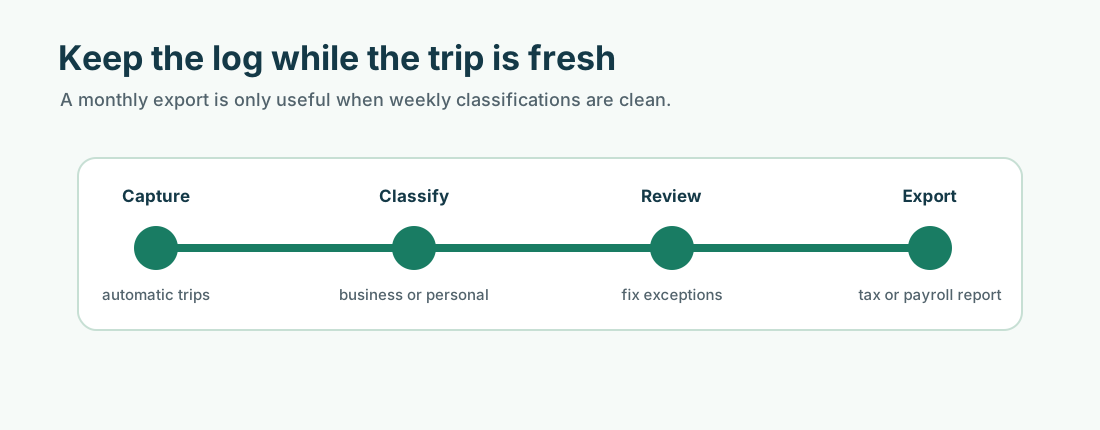
MyCarTracks automatic mileage tracking can capture trips, let drivers classify business and private travel, and export reports by date, vehicle, driver, purpose, and distance. For teams, MyCarTracks fleet tracking can help administrators review team activity, mileage reports, reimbursement records, and vehicle activity from one workflow.
That matters when finance or managers need evidence. Instead of approving rounded monthly totals, they can review submitted trip records with a consistent format.
Plain-English translation
- Grey fleet: private or third-party vehicles used for work.
- Business-use insurance: motor insurance wording that allows the type of work driving being approved. Do not assume ordinary private or commuting cover is enough.
- MOT: the UK roadworthiness test required for many vehicles once they reach the relevant age.
- AMAPs: HMRC’s approved mileage payment benchmark for employees using their own vehicle for business trips.
- MAPs: mileage payments from an employer to an employee for using their own vehicle for business travel.
- MAR: tax relief an employee may be able to claim if paid less than the approved amount.
- BiK: Benefit-in-Kind, tax on a non-cash employee benefit such as private use of a company car.
- UK GDPR: the UK data protection rules that affect how employers handle personal data, including employment and location data.
Grey fleet self-check
Use these questions before you approve more private vehicles for work:
- Do you know every person who drives a private or third-party vehicle for work?
- Do you know which vehicle each person uses?
- Have you checked or recorded the driver’s licence status with permission?
- Have you checked MOT and vehicle tax where relevant?
- Has the driver confirmed business-use insurance for the type of journey?
- Does your policy explain what counts as business travel and what counts as ordinary commuting or private travel?
- Do mileage records show date, location or route, purpose, miles, driver, and vehicle?
- Are reimbursement payments separated from car allowances, salary sacrifice cars, and company-car fuel payments?
- Do managers approve mileage claims consistently?
- Do drivers know how to report incidents, near misses, licence changes, vehicle changes, insurance changes, and health issues affecting driving?
- Are checks repeated, or do they happen only when someone joins?
- Can finance, HR, operations, or an adviser produce a clear file if HMRC, HSE, an insurer, or senior management asks?
If several answers are unclear, start with the register and policy. Then tighten mileage records and approval workflows.
Common grey fleet mistakes
- Assuming private vehicles are outside the employer’s work-related road-risk process.
- Treating a car allowance as proof that the vehicle is safe, insured, and suitable.
- Letting drivers estimate business miles at month end.
- Using AMAP rates as if they were a universal employment-law reimbursement requirement.
- Applying company-car advisory fuel rates to employee-owned vehicles.
- Keeping licence, MOT, insurance, mileage, and approval records in separate inboxes with no owner.
- Collecting location or employment data without thinking through UK GDPR, access, retention, and driver visibility.
- Reviewing the grey fleet only after a crash, claim dispute, HMRC query, or payroll problem.
FAQ
What does grey fleet mean?
Grey fleet means private or third-party vehicles used for work. In the UK, that often includes employee-owned cars, personal leases, cash-allowance vehicles, employee-owned vans, motorcycles, scooters, bicycles, and occasional private vehicles used for business journeys.
Is a grey fleet only employee-owned cars?
No. Employee-owned cars are the common example, but HSE grey-fleet wording also covers worker-owned vehicles used for business purposes and cash allowance vehicles. Your internal process may also need to cover contractors, volunteers, client vehicles, hire vehicles, and personal leases depending on the work.
Does commuting count as grey fleet business travel?
Normal commuting is generally not driving for work. HSE says commuting is not generally classified as driving for work, except where someone’s journey starts from home and they are travelling to a work location that is not their normal place of work. HMRC tax treatment also depends on whether a journey is ordinary commuting, private travel, or qualifying business travel.
What checks should UK employers make?
A practical baseline is a driver register, driving licence check with permission, MOT check where required, vehicle tax check, business-use insurance confirmation, vehicle suitability check, policy acknowledgement, and a mileage-record process. Higher-risk roles may need more detailed journey planning, training, and review.
Who manages a grey fleet?
The employer manages the process, but tasks often sit across finance, HR, operations, fleet, health and safety, payroll, and line managers. The important point is to name one accountable owner so checks, mileage approvals, incidents, and policy updates do not fall between teams.
Do employers have to pay 45p per mile?
HMRC’s 45p rate for the first 10,000 car or van business miles is an approved mileage allowance benchmark for tax. It is not, by itself, a rule that every employer must pay 45p per mile. Contracts, policies, employment terms, or sector arrangements may create separate payment obligations.
Where to go next
- Grey Fleet Policy Guide (UK)
- Grey Fleet Risk Assessment (UK)
- Grey Fleet vs Company Cars (UK)
- Grey Fleet HMRC Compliance (UK)
- Grey Fleet Mileage Tracking Software (UK)
- Current HMRC Mileage Rates (UK)
- Mileage Allowance for Employees (UK)
- Mileage Allowance Relief (UK)
- Car Allowance for Employees (UK)
- Salary Sacrifice Car Scheme (UK)
- What Is a Fleet Vehicle?
Sources
- HSE: Employers - driving and riding safely for work
- HSE: Driving and riding safely for work
- GOV.UK: Expenses and benefits: business travel mileage for employees’ own vehicles
- GOV.UK: Travel - mileage and fuel rates and allowances
- GOV.UK: PAYE and payroll for employers - keeping records
- GOV.UK: Expenses and benefits for employers - record keeping
- GOV.UK: Advisory fuel rates
- GOV.UK: Check the MOT status of a vehicle
- GOV.UK: Check if a vehicle is taxed
- GOV.UK: View or share your driving licence information
- ICO: Employment information