When only one or two people claim mileage, grey fleet rules often live in emails, manager habits, and “we’ll check it when needed” admin. That can work for a while, but it gets harder once more drivers, approvers, vehicles, and reimbursement claims are involved. A grey fleet policy can help turn those assumptions into a process people can follow.
The policy should say when private vehicles can be used for work, what evidence is needed before approval, how business miles are recorded, and who reviews claims. Gaps usually show up in practical ways: a mileage claim with no journey detail, no clear business-use insurance confirmation, or a manager unsure whether the trip should have been approved.
The Health and Safety Executive (HSE), the UK workplace health and safety regulator, says employers must manage health and safety risks for workers who drive or ride for work, including both company and grey fleet vehicles.
This guide is for UK employers, fleet administrators, HR teams, finance teams, operations managers, health and safety leads, and business owners who need a workable policy without creating unnecessary admin. It is educational only and is not legal, HSE, tax, payroll, employment, insurance, or data-protection advice.
Quick answer
A UK grey fleet policy should say who can drive a private vehicle for work, which vehicles are acceptable, what licence, MOT, vehicle tax, roadworthiness, and business-use insurance evidence is required, how journeys are approved, what mileage records employees must keep, how reimbursement is handled, how incidents are reported, who owns the process, and when checks are repeated.
If your business has five or more employees, HSE says you must write down your health and safety policy. Even below that threshold, a written grey fleet policy becomes useful as soon as private-vehicle work trips, mileage claims, or driver checks depend on memory.
Do you need a grey fleet policy?
Yes, if anyone uses their own vehicle for work and you need a repeatable process. The policy is not magic proof of compliance. It is the operating document that tells drivers and managers what needs to happen before, during, and after work journeys.
Use it to define:
- which work journeys are allowed in private vehicles
- who can approve a grey-fleet driver
- what licence, MOT, vehicle tax, and business-use insurance evidence is needed
- how business mileage is recorded and submitted
- when reimbursement is paid, held, rejected, or reviewed
- who owns recurring checks and exception decisions
- how incidents, near misses, licence changes, insurance changes, and vehicle changes are reported
The legal threshold: five or more employees
HSE’s health and safety policy guidance says every business must have a policy for managing health and safety. It also says employers with five or more employees must write the policy down and share it, and any changes, with employees.
That does not mean the law uses the phrase “grey fleet policy” as a required document name. It means work-related driving needs to be covered by your wider health and safety arrangements. For many organisations, a dedicated grey fleet policy or a clearly labelled section inside the health and safety policy is the cleanest way to explain who does what, when, and how.
The operational threshold: around 10 drivers
Even with fewer than five employees, a written policy can be worth having. Around 10 grey-fleet drivers, informal habits usually start to strain:
- one manager approves mileage differently from another
- document checks depend on calendar reminders or memory
- employees are not sure whether ordinary commuting can be claimed
- finance receives mileage claims without a trip purpose
- business-use insurance evidence is requested only after an incident
- nobody owns the end-to-end process
Ten drivers is not a legal threshold. It is a practical warning sign. If the same question is being answered differently across the business, write the rule down.
What a good grey fleet policy includes
A useful policy creates clarity across driver, vehicle, journey, mileage, reimbursement, data, and ownership rules.
| Area | What the policy should require |
|---|---|
| Driver eligibility | Valid driving licence for the vehicle and role, permission-based licence checks, declaration of restrictions or disqualifications, fitness to drive, safe-driving expectations |
| Vehicle approval | Vehicle registration, MOT where required, vehicle tax status, suitable condition, maintenance responsibility, no known safety defects |
| Insurance | Written confirmation that motor insurance covers the approved business use, plus a renewal or review date |
| Journey management | Rules for whether the trip is necessary, who approves it, fatigue and mobile-phone expectations, incident reporting, and higher-risk trip escalation |
| Mileage records | Trip date, business purpose, start and end location or route, miles, driver, vehicle, business/private classification, and approval status |
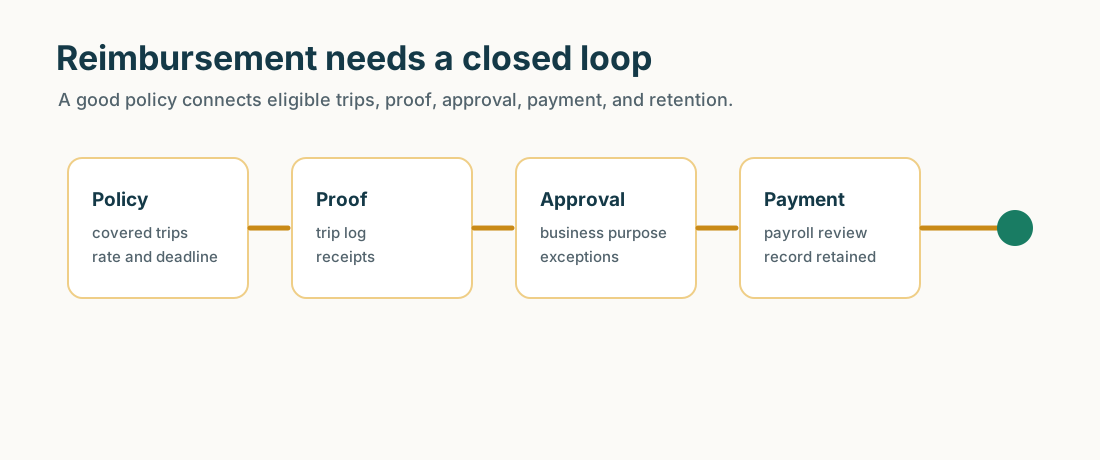
| Reimbursement | Approved rate or payment rule, claim frequency, evidence required before payment, exception handling, and payroll/HMRC review |
| Privacy and data | How location, driver, vehicle, licence, insurance, incident, and employment records are collected, accessed, retained, and reviewed |
| Ownership | Named accountable owner plus roles for HR, finance, operations, managers, payroll, fleet, and health and safety |
Driver eligibility
Set driver requirements before a private vehicle can be approved for work use.
At minimum, require:
- a current driving licence for the vehicle category and work role
- permission for licence checks and a process for Great Britain or Northern Ireland checks as appropriate
- prompt reporting of disqualification, suspension, restrictions, penalty points, or medical limits that affect work driving
- agreement to follow speed, seatbelt, mobile-phone, fatigue, drug, alcohol, and journey rules
- manager approval before the first work trip in the vehicle
The GOV.UK driving licence share service covers licences issued in England, Wales, and Scotland and uses a driver-generated check code. It also warns that obtaining someone else’s personal information without permission is a criminal offence, so do not build a licence-check process that bypasses driver permission.
Vehicle suitability and safety
The policy should explain what makes a private vehicle acceptable for work. “The employee owns a car” is not enough.
Your policy can require:
- current vehicle registration details
- a valid MOT where the vehicle requires one
- up-to-date vehicle tax or confirmation that the vehicle is not off the road
- vehicle condition suitable for the route, passengers, equipment, and work task
- tyres, brakes, lights, mirrors, seatbelts, and safety equipment in working order
- no known defects that make the vehicle unsafe for work use
- extra approval for long-distance, night, remote, bad-weather, client-transport, or equipment-carrying journeys
GOV.UK provides public services to check MOT status and check vehicle tax. Use those checks as evidence points, not as the whole policy.
Business-use insurance
Do not rely on the phrase “comprehensive insurance”. A private motor policy may cover social use, commuting, some business use, or no work use at all depending on the insurer and policy wording.
The policy should require drivers to:
- confirm the insurer allows the specific business use being approved
- provide a certificate, policy schedule, renewal notice, or written insurer confirmation where your process requires it
- report cancellation, refusal, restrictions, claims, or changes that affect work use
- update evidence before expiry
- stop using the vehicle for work if business-use cover is not current
The policy should also say whether mileage reimbursement is held until business-use insurance evidence is current. That is often the simplest enforcement point because it links the claim to the approval process.
Journey approval rules
A good policy helps employees pause before they drive.
Ask:
- Is the trip necessary, or would a call, video meeting, courier, public transport, hire car, pool car, or company vehicle be more suitable?
- Is the driver approved for this vehicle and trip type?
- Is there enough time to avoid rushing or fatigue?
- Does the trip involve bad weather, unfamiliar roads, remote areas, night driving, lone working, passengers, or equipment?
- Who should the driver contact if conditions change?
- What must be reported after an incident, near miss, defect, or claim?
HSE’s risk assessment guidance frames risk control as identifying what could cause harm, deciding how likely and serious the harm could be, and taking action to eliminate or control the risk. For grey fleet, keep that practical: journey, driver, vehicle, and admin controls should all be visible.
Mileage records and HMRC handoffs
Define mileage rules in plain English. A grey fleet policy should not make drivers guess what counts as business travel, what counts as ordinary commuting, or what evidence finance needs.
Mileage records should normally include:
- trip date
- business purpose
- start and end location or route
- total business miles
- driver and vehicle
- business/private classification
- manager approval
- reimbursement rate or payment type
Approved Mileage Allowance Payments (AMAPs) are HM Revenue and Customs (HMRC), the UK tax authority’s tax-free mileage payment benchmark for employees using their own vehicle for business trips. Mileage Allowance Payments (MAPs) are payments an employer makes when an employee uses their own vehicle for business travel. Mileage Allowance Relief (MAR) is tax relief an employee may claim if their employer pays less than HMRC’s approved amount.
GOV.UK’s employee business travel mileage rules list the approved car and van rates as 45p per mile for the first 10,000 business miles in the tax year and 25p after that, plus 24p for motorcycles and 20p for bicycles. Those are tax benchmarks, not a standalone rule that every employer must reimburse at 45p per mile.
For more detail, link the policy to Mileage Allowance for Employees (UK), Current HMRC Mileage Rates (UK), and Mileage Allowance Relief (UK).
Policy template outline
Use this structure as the starting point for your internal document:
- Purpose and scope
- Who the policy applies to
- What counts as a grey-fleet vehicle
- What counts as business travel and what is excluded
- Driver eligibility and licence checks
- Vehicle suitability, MOT, tax, maintenance, and defects
- Business-use insurance evidence
- Journey approval, fatigue, mobile-phone, and incident rules
- Mileage records, reimbursement, and HMRC handoffs
- Data protection, location data, access, and retention
- Roles and responsibilities
- What happens if documents expire or claims are incomplete
- Review schedule and version owner
Keep the template short enough to use. Put detailed claim forms, checklists, or software steps in appendices or internal process pages.
Implementation without admin overload
Creating the policy is the easy part. The harder part is making it normal.
Build it into routine workflows:
- include the policy in onboarding for roles that may drive
- require acknowledgement before first work use of a private vehicle
- keep the driver and vehicle register in one place
- use one mileage submission format across teams
- set renewal reminders for licence, insurance, MOT, and policy reviews
- require managers to reject or return incomplete mileage claims
- review exceptions instead of letting them become the new rule
If the process feels too heavy, remove duplicate steps before removing important controls. A single driver register, consistent mileage record, and clear owner can remove more admin than another spreadsheet.
How MyCarTracks supports the policy
Enforcement should be predictable, not theatrical. The policy should tell employees what happens when evidence is missing or a rule is ignored. Mileage tracking is one part of that enforcement because it gives managers and finance a consistent claim file to review.
Useful guardrails include:
- no work-use approval until driver and vehicle evidence is current
- no reimbursement until required mileage fields are complete
- no private vehicle use if business-use insurance evidence has expired
- manager review for unusual trips, repeated rounded mileage, or high-mileage claims
- escalation for incidents, near misses, licence changes, or insurance changes
- periodic checks instead of one-off onboarding checks
For mileage records, MyCarTracks automatic mileage tracking can capture trips, let drivers classify business and private travel, and export reports by date, driver, vehicle, purpose, and distance. For teams, MyCarTracks fleet tracking can help administrators review team reports, vehicle activity, and reimbursement records from one workflow.
Grey fleet policy checklist
| Question | Yes/No |
|---|---|
| Does the policy define which private and third-party vehicles are covered? | |
| Does it explain what counts as business travel and what is excluded? | |
| Does it name the owner of the grey-fleet process? | |
| Does it require licence checks with driver permission? | |
| Does it require MOT, vehicle tax, and suitability checks where relevant? | |
| Does it require business-use insurance evidence before work use? | |
| Does it explain journey approval and higher-risk journey escalation? | |
| Does it set safe-driving, fatigue, mobile-phone, and incident-reporting expectations? | |
| Does it list the mileage record fields needed before reimbursement? | |
| Does it separate mileage reimbursement, car allowance, company car, and salary sacrifice arrangements? | |
| Does it explain data access, retention, and privacy for driver and location records? | |
| Does it set review dates for the policy and driver/vehicle evidence? |
Common mistakes
| Mistake | Why it matters | Better approach |
|---|---|---|
| Relying only on self-declaration for insurance | Employees may misunderstand what their policy covers | Require business-use evidence or insurer confirmation before work use |
| No named process owner | Finance, HR, managers, and operations assume someone else owns the checks | Assign one accountable owner and list supporting roles |
| Reimbursing mileage without trip records | Creates HMRC, payroll, and approval exposure | Require trip date, purpose, route or location, miles, vehicle, driver, and approval |
| Treating ordinary commuting as business mileage | HMRC treatment and employment policy can differ from employee expectations | Define business travel, ordinary commuting, temporary workplaces, and exceptions |
| Keeping records in scattered inboxes | Expiry dates and exceptions are easy to miss | Keep a central driver/vehicle register and consistent mileage reports |
| Writing a policy but never reviewing it | Work patterns, roles, vehicles, and risks change | Review at least annually and after incidents, role changes, or process failures |
FAQ
What is a grey fleet policy?
A grey fleet policy is an internal employer policy for people who use private or third-party vehicles for work. It usually covers driver eligibility, vehicle checks, business-use insurance, journey rules, mileage records, reimbursement, incident reporting, privacy, and process ownership.
Does UK law require a grey fleet policy?
UK employers must manage health and safety risks, including work-related driving risks. HSE says every business must have a health and safety policy and employers with five or more employees must write it down. A dedicated grey fleet policy is usually the practical way to document how private-vehicle work trips are controlled, but the policy must be backed by actual checks and records.
What mileage evidence does HMRC expect?
When employees are paid for business miles, keep records that explain the journey and the payment. A practical mileage log includes the date, business purpose, start and end location or route, miles, driver, vehicle, and approval status.
Should a policy require business-use insurance?
Yes. The policy should require evidence that the driver’s motor insurance covers the type of business use being approved. Do not assume social, domestic, and commuting cover is enough.
Who should own the grey fleet policy?
One named owner should be accountable for the whole process. The work may be shared across HR, finance, operations, health and safety, fleet, payroll, and line managers, but the policy should make ownership explicit.
Where to go next
- What Is a Grey Fleet? (UK)
- Grey Fleet Risk Assessment (UK)
- Grey Fleet HMRC Compliance (UK)
- Grey Fleet Mileage Tracking Software (UK)
- Current HMRC Mileage Rates (UK)
- Mileage Allowance for Employees (UK)
- Car Allowance for Employees (UK)
- Salary Sacrifice Car Scheme (UK)
Sources
- HSE: Prepare a health and safety policy
- HSE: Employers - driving and riding safely for work
- HSE: Managing risks and risk assessment at work
- GOV.UK: View or share your driving licence information
- GOV.UK: Check the MOT status of a vehicle
- GOV.UK: Check if a vehicle is taxed
- GOV.UK: Expenses and benefits: business travel mileage for employees’ own vehicles
- GOV.UK: Expenses and benefits for employers - record keeping
- ICO: Employment information