Self-employed mileage allowance in the UK is not an employee reimbursement claim. Use this guide to choose the right tax record route for Self Assessment: simplified expenses using HMRC flat rates, or actual vehicle costs based on the business share of your costs.
The GOV.UK simplified expenses vehicle guidance lists flat rates of 45p per mile for the first 10,000 business miles in cars and goods vehicles, 25p after that, and 24p per mile for motorcycles. GOV.UK also explains that self-employed people can claim allowable car, van, and travel expenses such as fuel, repairs, insurance, parking, fares, hotels, and overnight meals where the cost is for business.
This article is educational and is not tax, legal, accounting, or financial advice. UK tax treatment can change by tax year, business structure, accounting method, vehicle type, and how the journey was made. Check GOV.UK or speak with a qualified adviser before filing.
Quick answer
If you are self-employed in the UK, you can usually handle business vehicle costs in one of two ways:
| Method | How it works | What you need to keep |
|---|---|---|
| Simplified expenses | Multiply your business miles by HMRC flat rates for cars, goods vehicles, or motorcycles. | A mileage record showing business miles for the tax year. |
| Actual vehicle costs | Add up allowable vehicle costs, then claim only the business-use share. | Mileage records, total mileage if there is private use, receipts, invoices, and expense records. |
The flat-rate method is simpler, but it is not always available. You cannot use simplified expenses for a vehicle if you have already claimed capital allowances for it or included it as an expense when working out business profits. Once you use flat rates for a vehicle, you must keep using that method for that vehicle while it remains in your business.
Self-employed mileage allowance rates
For simplified expenses, the current flat rates are:
| Vehicle type | Business miles in the tax year | Flat rate |
|---|---|---|
| Cars and goods vehicles | First 10,000 business miles | 45p per mile |
| Cars and goods vehicles | Each business mile after 10,000 | 25p per mile |
| Motorcycles | All business miles | 24p per mile |
Bicycles are not listed for self-employed simplified vehicle expenses. That is different from employee approved mileage allowance payments, where bicycles have their own approved rate.
Example: you drive 11,000 business miles in a van during the tax year and use simplified expenses. Your vehicle expense claim is:
| Calculation | Amount |
|---|---|
| 10,000 miles x 45p | £4,500 |
| 1,000 miles x 25p | £250 |
| Simplified vehicle expense | £4,750 |
You can still claim other allowable business travel costs on top of simplified vehicle expenses where the rules allow. Train journeys and parking are common examples of costs that can sit outside the vehicle flat rate.
For the broader rate table and employee MAP/MAR distinction, see Current HMRC Mileage Rates (UK). For older employee MAP or MAR files, use Historical HMRC Mileage Rates (UK) rather than treating this self-employed guide as a historical employee-rate page.
Who can use simplified expenses
Simplified expenses can be used by sole traders and business partnerships that have no companies as partners. They cannot be used by limited companies or partnerships involving a limited company.
You also need to check the vehicle history. You cannot use simplified expenses for a vehicle if either of these is true:
- you have claimed capital allowances for that vehicle
- you have included the vehicle as an expense when working out business profits
You do not have to use flat rates for every vehicle in the business. You might use simplified expenses for one vehicle and actual costs for another, if the rules allow. The lock-in applies vehicle by vehicle: once you use the flat rate for a vehicle, keep using it for that vehicle while you still use it for the business.
Trading allowance and vehicle expenses
The trading allowance is separate from mileage. It is a tax exemption of up to £1,000 a year for individuals with trading income, but if you use the allowance instead of deducting expenses, you cannot deduct other expenses or allowances for that income.
That means you should compare the options before you file. If your business mileage and other allowable expenses are higher than the trading allowance, claiming actual expenses or simplified expenses may give a better result. If your trading income is small, the allowance may still be simpler. The right answer depends on your numbers, not on the mileage rate alone.
Actual vehicle costs
Actual vehicle costs can fit better when the business share of your vehicle costs is higher than the flat-rate calculation, or when simplified expenses are not available for that vehicle.
For cars, vans, and business travel, GOV.UK lists allowable costs such as:
- vehicle insurance
- repairs and servicing
- fuel
- parking
- hire charges
- vehicle tax licence fees
- breakdown cover
- train, bus, tram, air, and taxi fares
- hotel rooms
- meals on overnight business trips
You cannot claim non-business driving or travel costs, fines or penalty charges, or travel between home and work.
If you use the same vehicle for business and private journeys, do not claim every cost. Keep total mileage and business mileage, then claim only the business-use share of the allowable vehicle costs. For example, if 60% of the vehicle’s mileage was for business, you would usually apply that percentage to the allowable vehicle costs before adding the amount to your business expenses.
Buying a vehicle for the business
Buying a vehicle is not the same as paying for fuel or servicing. If you use traditional accounting and buy a vehicle for your business, the purchase cost normally goes through capital allowances. If you use cash basis accounting and buy a car for your business, the car cost is claimed as a capital allowance as long as you are not using simplified expenses.
For other types of vehicle under cash basis, the cost may be handled as allowable expenses. The exact treatment can depend on the vehicle and accounting basis, so check the official guidance before filing a vehicle purchase.
What counts as business mileage
Business mileage is mileage for the work of your trade. Typical examples include trips to clients, customer sites, suppliers, temporary job sites, business errands, and work-related meetings away from your normal base.
Do not treat every trip connected to work as claimable. Non-business driving, fines, penalty charges, and travel between home and work should stay out of the claim.
The difficult cases are usually mixed-purpose journeys and regular travel to the same place. If a journey has both business and private parts, keep notes that explain the business reason and the distance you are claiming. If you repeatedly travel from home to the same work location, get advice before treating it as business mileage.
Records for self-employed mileage allowance
For simplified expenses, keep a mileage log showing the business miles you used in the calculation. A practical log should include:
- date of the trip
- start and end point
- business purpose
- vehicle used
- business miles
- notes for mixed or unusual journeys
For actual vehicle costs, keep the mileage log and the cost records. That usually means receipts, invoices, bank records, insurance documents, repair and servicing records, parking receipts, hire documents, and any other evidence behind the costs claimed.
If the vehicle has private use, keep enough total-mileage evidence to support the business-use percentage. Without that, the actual-cost method is hard to defend because you cannot show how much of the annual vehicle cost belonged to the business.
Self-employed records must usually be kept for at least 5 years after the 31 January Self Assessment submission deadline for the relevant tax year. You do not send the records with the tax return, but HMRC can ask to check them.
How to claim on Self Assessment
The claim goes into your business expenses on your Self Assessment tax return. The workflow depends on the method:
- For simplified expenses, total your business miles for the tax year.
- Apply the flat rate for the vehicle type and mileage band.
- Add any separate allowable travel costs, such as parking or train journeys, where they qualify.
- Include the expense amount with your business expenses on the return.
For actual vehicle costs:
- Add up the allowable vehicle and travel costs for the tax year.
- Work out the business-use percentage if the vehicle also had private use.
- Apply that percentage to the vehicle costs.
- Add separate allowable business travel costs where they are not already included.
- Keep the records with your tax-year file.
Use the GOV.UK simplified expenses checker if you want to compare simplified expenses with actual costs before filing.
Employees, limited companies, and Mileage Allowance Relief
This article is for self-employed sole traders and individual partners. Limited-company owners are not self-employed for this GOV.UK expense guide, even if they own the company and work alone.
If you operate through a limited company and use your own car for company business, the employee/director mileage rules may apply instead. The company may pay Mileage Allowance Payments for business journeys in your own vehicle, using the approved amount rules. See Mileage Allowance for Employees (UK) for that route.
Mileage Allowance Relief is also an employee concept. It can apply when an employee uses their own vehicle for qualifying business travel and receives less than the approved amount from the employer. It is not the same as a self-employed simplified expenses claim. See Mileage Allowance Relief (UK) if you are comparing employee relief with self-employed expenses.
If the company owns the car and private use is available, company car tax may apply. Private use, including commuting, can create a taxable company benefit. That belongs in company-car and Benefit-in-Kind planning, not a sole-trader mileage allowance calculation.
Company-car fuel is another separate route. HMRC’s advisory fuel rates only apply to employees using company cars, for example when an employer reimburses company-car business travel or asks an employee to repay private fuel.
MyCarTracks workflow for self-employed mileage records
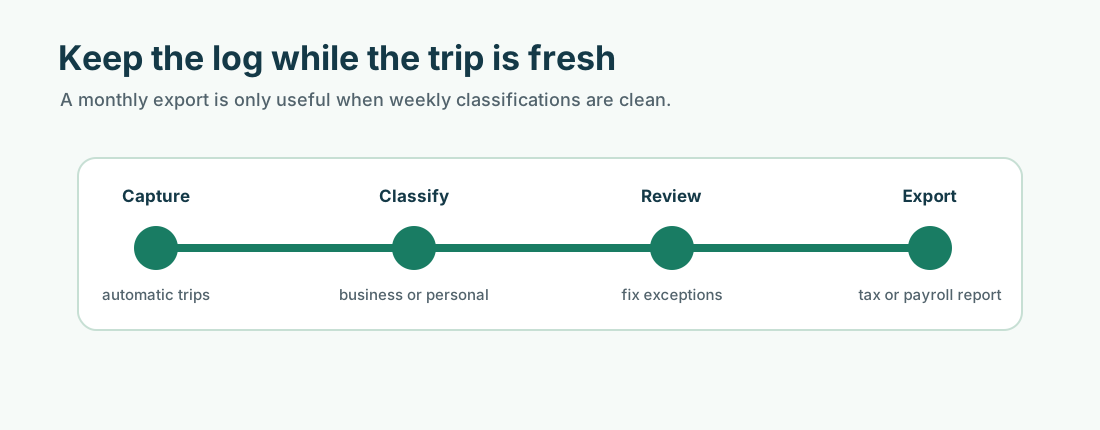
MyCarTracks can track trips automatically, help separate business and personal journeys, keep vehicle records, and export mileage reports for your Self Assessment file or accountant review. If you want the mileage log built while you drive, use MyCarTracks automatic mileage tracking.
Keep the app export with your receipts and Self Assessment records. The mileage log is most useful when it explains the claim before anyone has to reconstruct a route months later.
Common mistakes
- using simplified expenses after claiming capital allowances for the same vehicle
- switching from simplified expenses to actual costs for the same vehicle while it is still used in the business
- claiming the full cost of a vehicle that also has private use
- claiming travel between home and work without checking whether it qualifies
- forgetting that fines and penalty charges are not allowable travel expenses
- using the trading allowance and also deducting vehicle expenses
- treating a limited-company director’s mileage as a sole-trader expense claim
- keeping business mileage but no total mileage when using actual costs on a mixed-use vehicle
FAQ
Can self-employed people claim 45p per mile?
Self-employed sole traders and eligible partnerships can use simplified expenses for cars and goods vehicles at 45p per mile for the first 10,000 business miles in the tax year and 25p after that. Motorcycles use 24p per mile. The method has restrictions, so check vehicle history and business structure before using it.
Is the self-employed mileage allowance the same as Mileage Allowance Relief?
No. Self-employed simplified expenses are claimed as business expenses on Self Assessment. Mileage Allowance Relief is for employees who use their own vehicle for qualifying business travel and receive less than the approved amount from their employer.
What does the 45p rate cover for self-employed drivers?
For simplified expenses, the flat rate replaces the actual costs of buying and running the vehicle, such as insurance, repairs, servicing, and fuel. Parking and other qualifying travel costs can still be claimed separately where the rules allow.
Can I claim actual vehicle costs instead of mileage?
Yes, if the costs are allowable and you keep records. If the vehicle has private use, claim only the business-use share. You cannot use actual costs for a vehicle after choosing simplified expenses for that same vehicle while it remains in the business.
How long should I keep self-employed mileage records?
Self-employed records must usually be kept for at least 5 years after the 31 January submission deadline for the relevant tax year. Keep mileage logs, receipts, and calculation notes together.
Can I claim mileage if I use the trading allowance?
Not for the same trading income. If you use the trading allowance instead of deducting expenses, you cannot deduct other expenses or allowances for that income.
What to read next
- Current HMRC Mileage Rates (UK)
- Historical HMRC Mileage Rates (UK)
- HMRC Mileage Guide (UK)
- Mileage Allowance for Employees (UK)
- Mileage Allowance Relief (UK)
Sources
- GOV.UK: Simplified expenses if you’re self-employed - vehicles
- GOV.UK: Simplified expenses if you’re self-employed - overview
- GOV.UK: Expenses if you’re self-employed - overview
- GOV.UK: Expenses if you’re self-employed - car, van and travel expenses
- GOV.UK: Business records if you’re self-employed - what records to keep
- GOV.UK: Business records if you’re self-employed - how long to keep your records
- GOV.UK: Tax-free allowances on property and trading income
- GOV.UK: Claim capital allowances
- GOV.UK: Expenses and benefits - business travel mileage for employees’ own vehicles
- GOV.UK: Tax on company cars
- GOV.UK: Advisory fuel rates