Car expense reimbursement is not taxed the same way in every Australian payroll situation. The ATO allowances and reimbursements guidance separates allowances from reimbursements: an allowance is a separately identified payment, while a reimbursement pays back actual expenses already incurred.
That means the answer depends on whether you received a car allowance, a cents per kilometre car expense payment, an exact reimbursement, or a benefit connected with FBT. Check the income statement, payslip, reimbursement record, and employer policy before deciding whether the amount is assessable income or whether a deduction is still available.
This article is educational and is not tax, legal, payroll, employment, or financial advice. Australian PAYG withholding, income statement, deduction, reimbursement, allowance, and FBT rules can change. Check current ATO guidance and a qualified professional before relying on a tax position.
Quick answer
A car allowance is generally assessable income when it appears on your income statement or payment summary. An exact reimbursement can be different, especially if it is covered by FBT; in that case it is generally not assessable income to the employee, and the employee cannot claim a deduction for that expense. A cents per kilometre car expense payment may have special withholding treatment up to the approved rate and kilometre limit, but that is not the same as saying every payment is simply tax-free.
Car expense reimbursement starts with payment type
Use this table before deciding what goes in the tax return:
| Payment type | Usual tax question | Record to check |
|---|---|---|
| Car allowance | Is it shown as assessable income? | Income statement, payslip, allowance description, deduction records |
| Cents per kilometre car expense payment | Was it within the approved rate and kilometre limit for withholding? | Kilometres, rate, payment summary/income statement treatment, employer policy |
| Exact reimbursement | Did it repay a specific expense, and is FBT involved? | Receipt, claim form, payment record, FBT treatment |
| Company car or private-use vehicle benefit | Is there a car fringe benefit or exempt arrangement? | Employer FBT records, private-use records, logbook/odometer records |
The label on the payslip matters, but so does the substance. A regular car allowance is not the same as reimbursing a fuel receipt. A kilometre-based payment is not automatically the same as an exact reimbursement.
Car allowance tax treatment
A car allowance is commonly paid through payroll as a regular amount. The ATO employment allowances guidance generally requires employees to declare allowances shown on their income statement or payment summary.
If you receive a taxable car allowance, you may still be able to claim eligible work-related car expenses separately. The allowance itself does not become the deduction. You need to have personally incurred the expense, the trip must be work-related, and you need the records required for the method you use.
Cents per kilometre payment tax treatment
Some employers pay a set amount for each business kilometre. The ATO withholding table gives special treatment to cents per kilometre car expense payments up to the approved rate and kilometre limit, with different treatment for excess amounts.
For 2024-25 and 2025-26, the ATO cents per kilometre rate for car expense deduction calculations is 88 cents per kilometre. If an employer pays above the approved rate or beyond the kilometre limit, the excess can be treated differently for withholding.
Avoid the shortcut phrase “tax-free reimbursement” unless the payroll and reporting facts support it. No withholding, income statement reporting, assessability, and deduction entitlement are related questions, but they are not identical.
Exact reimbursement tax treatment
An exact reimbursement pays back a specific cost you already paid, such as fuel, parking, tolls, charging, repairs, or another approved expense. Keep the receipt and the payment record together.
If a reimbursement is covered by FBT, it is generally not assessable income to the employee, and the employee cannot claim a deduction for that expense. That is the cleanest double-claim rule: if you did not bear the final cost and it was not assessable to you, do not claim it again.
If the payment was treated as assessable income or had withholding applied, the deduction question still depends on the expense, the trip, the method, and the records. Do not decide from the word “reimbursement” alone.
Company cars and FBT
If an employer provides a car or makes it available for private use, fringe benefits tax may be relevant to the employer. The ATO taxable value of a car fringe benefit guidance covers statutory formula and operating cost methods.
For employees, the key point is practical: a company car arrangement is not the same as using your own car and being reimbursed. If you personally pay operating costs for someone else’s or a company vehicle, you may need actual receipts and employer payment records rather than a cents per kilometre own-car calculation.
EV and plug-in hybrid rules are conditional. Do not assume an electric car, salary-packaged car, or low-emission vehicle is automatically exempt from FBT.
Can you claim a deduction after reimbursement?
Use this checklist:
- Did you personally incur the expense?
- Was the trip work-related under ATO rules?
- Did your employer repay that exact expense?
- Was the payment included as assessable income or covered by FBT?
- Do you have the records required for cents per kilometre, logbook, or actual expense support?
If the employer fully reimbursed the exact expense and the reimbursement is not assessable income to you, do not claim the expense again. If the payment was an allowance or assessable income, you may still need to include the income and separately claim only the deduction you can prove.
How to know what happened in payroll
Check:
- income statement or payment summary labels
- payslip allowance or reimbursement lines
- PAYG withholding shown on the payment
- employer policy
- reimbursement claim form
- receipts or trip reports submitted
- whether the employer treated the payment as FBT-related
- year-end payroll notes from your employer or accountant
If the label is unclear, ask payroll what was reported. The tax-return answer often depends on how the payment was classified and reported.
Records to keep
Keep:
- trip dates and work purpose
- kilometres and vehicle used
- employer rate or amount paid
- receipts for exact expenses
- payslips and income statement
- reimbursement claim approvals
- logbook and odometer records where needed
- notes showing whether the amount was an allowance, reimbursement, or FBT-related benefit
The ATO expenses for a car you own or lease guidance requires work-related travel, unreimbursed expenses, and records for employee car expense deductions.
How MyCarTracks helps with reimbursement records
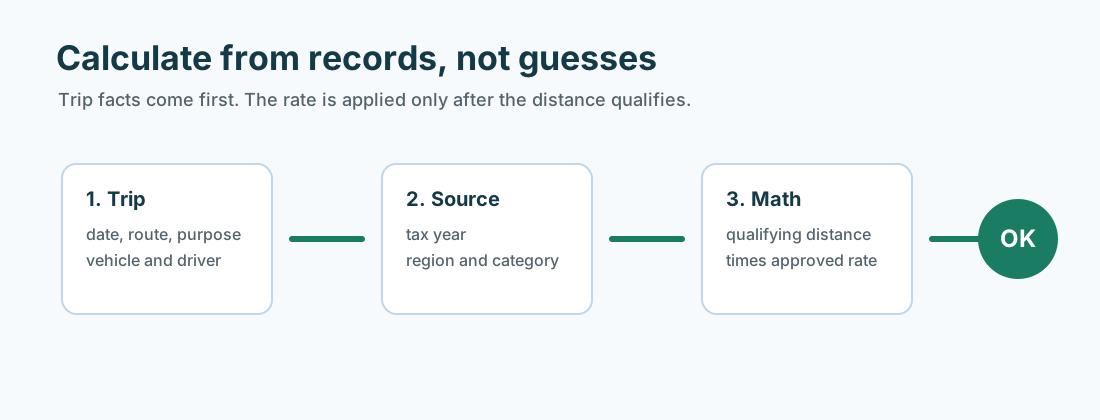
MyCarTracks automatic mileage tracking can capture trips, separate business and private kilometres, and export records by date, vehicle, driver, purpose, and distance. That makes it easier to match payroll reimbursement records with the trip evidence behind them.
For employers and teams, MyCarTracks fleet tracking can help managers review driver records before reimbursement, finance, payroll, FBT, or accountant review.
Common mistakes to avoid
- Calling a taxable allowance a reimbursement.
- Assuming a cents per kilometre payment is always tax-free.
- Claiming an expense that was fully reimbursed and not assessable to you.
- Ignoring income statement or payslip labels.
- Treating no withholding as the same thing as no tax-return consequences.
- Using own-car cents per kilometre treatment for a company car.
- Keeping receipts but no trip purpose or kilometre records.
- Mixing self-employed business kilometres with employee reimbursement records.
FAQ
Is a car allowance taxable income in Australia?
Usually yes, when it appears on your income statement or payment summary. You may still be able to claim eligible work-related car expenses separately if you personally incurred them and have records.
Is a cents per kilometre reimbursement taxable?
It depends on how the payment is handled. Cents per kilometre car expense payments can have special withholding treatment up to the approved rate and kilometre limit, but no withholding is not the same as a blanket tax-free rule.
Is an exact reimbursement taxable income?
An exact reimbursement can be treated differently from an allowance. If it is covered by FBT, it is generally not assessable income to you and you cannot claim the same expense as a deduction.
How do I know if tax was withheld?
Check your payslip, income statement, or payment summary. If the label is unclear, ask payroll how the amount was reported and whether it was treated as an allowance, reimbursement, or FBT-related payment.
Can I claim car expenses if I received a car allowance?
Possibly. The allowance may be assessable income, and any deduction is a separate question. You need a work-related trip, an expense you personally incurred, no blocked double claim, and the required records.
Can I claim car expenses if I was reimbursed?
Do not claim the same expense if your employer fully reimbursed it and the reimbursement was not assessable income to you. If the payment was assessable income or only partially reimbursed the cost, check the method and records before claiming anything.
Where to go next
- Mileage Reimbursement for Employees (Australia) for the broader employee view
- Mileage Reimbursement Rules for Employers (Australia) for employer policy and records
- How to Calculate Car Expense Reimbursement (Australia) for formulas and examples
- ATO Car Logbook Requirements (Australia) for trip evidence