Expense reimbursements help small businesses keep employees whole without turning every out-of-pocket cost into a dispute. The hard part is building a policy that is simple enough to use, strict enough to control spending, and documented well enough for payroll, accounting, and mileage tracking.
Start with a short written policy: who can spend, which costs qualify, what proof is required, who approves, when claims are due, and how payment is made. For federal tax treatment, IRS Publication 15 separates accountable-plan reimbursements from taxable nonaccountable payments, and MyCarTracks automatic mileage tracking can keep business-driving records ready before the monthly reimbursement review.
This article is educational and is not tax, legal, payroll, employment, or financial advice. Reimbursement obligations and tax treatment can change by tax year, state-specific rules, worker classification, employer policy, and federal tax treatment. Review official sources and a qualified professional before relying on a small-business reimbursement policy.
Quick answer
Small businesses should reimburse expenses through a simple written policy: define covered costs, set limits, require receipts or mileage logs, approve claims on a schedule, and keep the payment record with the accounting month. Mileage tracking should prove business distance and purpose, not just the amount paid.
What are reimbursable expenses?
Reimbursable expenses are business costs an employee pays out of pocket and submits back to the business for repayment. A bakery employee using a personal car for approved deliveries, a technician buying a part for a job, or a salesperson paying for parking at a client meeting may all have reimbursable expenses if the policy covers those costs.
For tax purposes, the expense still needs to be a real business expense. The IRS small-business guide explains that deductible business expenses generally must be ordinary and necessary, meaning common in the business and helpful or appropriate to the work. That standard appears in IRS Publication 334, and deeper expense categories are covered in IRS Publication 535.
Federal law does not create one universal reimbursement rule for every employee expense, but wage rules still matter. Employer-benefit expenses cannot reduce covered employees below required minimum wage or overtime compensation under the DOL wage-deduction guidance. State rules may add more specific reimbursement obligations, so small businesses should check the state where the employee works.
Common expense reimbursements for small businesses
The right expense list depends on the business. A mobile pet-care company, real estate office, bakery, cleaning service, and consulting firm will not reimburse the same things. Still, most small-business reimbursement policies need to address these categories.
Mileage
Mileage is one of the most common reimbursement categories because employees may use personal vehicles for client visits, deliveries, bank deposits, supply runs, inspections, events, service calls, or jobsite travel. The policy should define reimbursable business mileage and exclude ordinary commuting.
Employees should submit a mileage log with the date, destination or route, business purpose, miles, vehicle, and any parking or toll receipts. A fuel receipt alone is not enough for a cents-per-mile reimbursement because it does not prove business distance. For the federal recordkeeping standard, use IRS Publication 463 and the local checklist in IRS Mileage Log Requirements.
Travel expenses
Travel reimbursement may include airfare, lodging, rideshare, taxis, rental cars, meals, conference fees, parking, tolls, and other approved costs. Set limits before employees book travel. For meals and lodging benchmarks, many employers use the GSA per diem rate tool as a reference point even when they are not required to use federal per diem rates.
Home office expenses
Remote or hybrid employees may ask for reimbursement for monitors, software, phone service, internet, office supplies, or other home-office costs. The policy should define what is required for the job, what needs preapproval, whether the business buys equipment directly, and whether any stipend is taxable. For mileage questions tied to remote work, use How to Reimburse Mileage for Remote Workers.
Training and education
Conferences, trade shows, licensing exams, certification renewals, required courses, and continuing education may be reimbursable when they support the employee’s role. List which costs qualify, whether travel is covered, whether the employee needs preapproval, and what happens if a course is optional rather than required.
Do you need to reimburse every worker the same way?
Do not use the same policy language for employees, contractors, owners, and volunteers without review. Employee reimbursement rules are tied to wage, payroll, and state-law obligations. Independent contractors usually handle expenses under their contract and pricing terms, not the employee reimbursement policy.
If your small business uses contractors, spell out expense treatment in the contract: what is included in the contractor’s fee, what needs preapproval, what receipts are required, and whether mileage is billed separately. For employees, keep reimbursement claims tied to payroll and accounting records. For owners, keep the records needed for the business books and tax return rather than mixing them into employee reimbursements.
Are some expenses not reimbursable?
Yes. Some costs may feel work-adjacent but still be outside the policy or treated as personal. Common non-reimbursable or restricted categories include:
- ordinary commuting between home and a regular work location
- personal errands added to a business route
- upgrades beyond the approved travel class or lodging limit
- unapproved tools, equipment, or subscriptions
- fines, tickets, and penalties
- missing receipts where the policy requires proof
- expenses submitted after the deadline without an approved exception
The policy can still choose to pay some costs that are not tax-free reimbursements, but payroll treatment may change. That is why accountable-plan requirements, receipt rules, and return-of-excess rules should be written into the process before claims start.
MyCarTracks workflow for small-business mileage tracking
Small businesses do not need a complicated reimbursement department. They need a repeatable process.
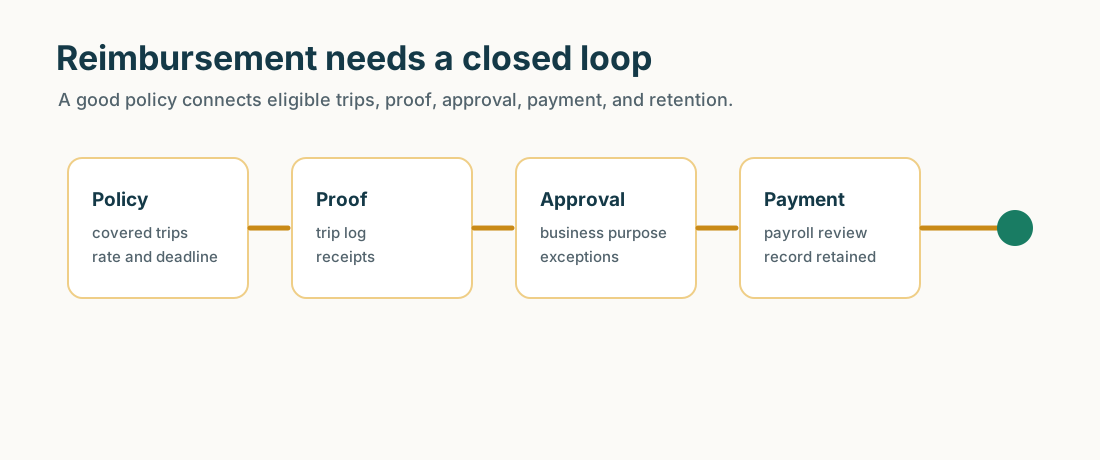
Create a clear policy. A one-page policy is better than a vague verbal promise. Include eligible expenses, spending limits, preapproval rules, documentation, submission deadlines, approval owner, payment timing, and exceptions.
Set spending limits. Limits keep reimbursement fair and predictable. Use the IRS standard mileage rate as the mileage benchmark, GSA per diem rates where travel limits are useful, and role-specific limits for tools, supplies, or training.
Use accountable-plan rules when you want tax-free treatment. Under IRS Publication 15, accountable-plan reimbursements require allowable business expenses, timely substantiation, and return of any excess. Payments that do not meet those rules are generally treated as wages.
Use technology where proof is hard. Mileage is hard to reconstruct after the fact. Receipt images, automatic mileage logs, approval statuses, and exports reduce month-end cleanup. If your team drives for work, MyCarTracks mileage reports can help group trips by employee, vehicle, project, and reimbursement period. For the broader app and reporting overview, see MyCarTracks.
Close reimbursements monthly. Collect claims, check missing fields, review exceptions, approve or deny, pay the claim, and attach records to the accounting month. Monthly close prevents reimbursement from becoming a year-end memory exercise.
Records to keep
Keep the policy version, employee or contractor name, expense date, vendor, amount, business purpose, receipt, mileage log where relevant, approval, payment record, account category, and exception note. For mileage, keep the trip date, destination or route, business purpose, miles, vehicle, rate, and calculation.
Approval workflow
Use the same monthly workflow every time: employee submits the claim, manager checks business purpose and policy fit, accounting verifies receipts and tax treatment, the business pays or denies the claim, and the final report is saved with the accounting period.
Common mistakes
- reimbursing mileage from fuel receipts instead of trip logs
- using a taxable stipend when the goal was accountable-plan treatment
- applying employee reimbursement rules to contractors without contract language
- leaving home-office, travel, and training expenses undefined
- approving late or missing receipts without an exception note
- forgetting state-specific reimbursement rules
- waiting until year-end to reconcile employee expense claims
State reimbursement checks
State rules can change the reimbursement answer. California requires employers to cover necessary expenditures under Labor Code section 2802. Illinois has a necessary-expenditure rule in section 9.5 of the Wage Payment and Collection Act. Massachusetts publishes employee-business-expense guidance on Massachusetts Employee Business Expenses. For other states, start with the DOL state labor office directory, then confirm the rule with state-specific counsel or payroll support.
If your business operates in more than one state, do not assume one reimbursement rule fits every employee. Add state riders to the policy and keep each claim tied to the employee’s work state and the policy version in effect when the expense was incurred.
FAQ
What should a small-business reimbursement policy include?
Include eligible expenses, excluded expenses, spending limits, preapproval rules, receipt requirements, mileage-log fields, submission deadlines, approver names, payment timing, tax treatment, and exception handling.
Is mileage reimbursable for small-business employees?
Often, yes, when employees use personal vehicles for approved business driving. The policy should define what qualifies, exclude ordinary commuting, require a mileage log, and state the reimbursement rate.
Can a small business use a stipend instead of reimbursing receipts?
It can, but the tax treatment may change. A stipend or allowance that does not meet accountable-plan rules is generally taxable wages. If the business wants tax-free reimbursement treatment, it needs substantiation and return-of-excess rules.
Do contractors have to follow the employee reimbursement policy?
Usually no. Contractors should have expense terms in their contract. If the business agrees to pay contractor mileage, travel, or supplies, the contract should explain rates, preapproval, receipts, and invoicing.
How often should reimbursements be paid?
Monthly works for many small businesses, but the schedule should be written into the policy. High-volume field teams may need reimbursement every pay period. Whatever the schedule, keep submission deadlines, approvals, and payment records together.
What to read next
- How to Create a Mileage Reimbursement Policy
- What Is Mileage Reimbursement?
- Mileage Reimbursement Rules for Employers
- How to Calculate Mileage Reimbursement
- Business Miles vs Commuting Miles
- Mileage Logbook Template and Examples
Sources
- IRS Publication 15, Employer’s Tax Guide
- IRS Publication 334, Tax Guide for Small Business
- IRS Publication 535, Business Expenses
- IRS Publication 463, Travel, Gift, and Car Expenses
- IRS 2026 standard mileage rate announcement
- DOL Fact Sheet #16, wage deductions
- GSA per diem rates
- California Labor Code section 2802
- Illinois Wage Payment and Collection Act section 9.5
- Massachusetts Employee Business Expenses
- DOL state labor office directory