Mileage tracking helps you compare a company car with a car allowance in a way finance, payroll, and drivers can actually use. The choice affects employee experience, brand control, insurance administration, payroll treatment, and the amount of time your team spends managing vehicles instead of the work those vehicles support.
A company car gives the business more control over the vehicle itself, while a car allowance gives the employee more control over what they drive. Those two models also create different tax and recordkeeping duties. The federal fringe-benefit rules for employer-provided vehicles sit in IRS Publication 15-B, and the 2026 maximum fair market value for employer-provided autos that can use the fleet-average or cents-per-mile valuation rules is $61,700 under Notice 2026-10.
If you need the trip record in place before you separate business use from personal use, MyCarTracks automatic mileage tracking can help you capture the mileage file while the route details are still easy to prove.
This article is educational and is not tax, legal, payroll, employment, or insurance advice. Vehicle-program treatment can change by tax year, state law, plan design, and the exact vehicle-use facts. Check the official source and a qualified professional before relying on a policy decision.
Quick answer
A company car gives the employer more control over vehicle standards, branding, and availability, but it adds acquisition, maintenance, personal-use, and liability work. A car allowance is easier to budget and easier for employees who want flexibility, but it is usually less precise and often creates a taxable-pay issue if the company does not tie the payment back to supported business use.
What are company cars?
A company car is a vehicle the employer owns or leases and makes available to an employee for work. In some businesses that vehicle is an everyday tool for service, delivery, or route-based roles. In others it is part of compensation for field leaders who represent the company regularly.
The company usually decides the vehicle class, replacement cycle, maintenance standard, and insurance setup. That control matters when the role depends on cargo space, equipment, or a predictable vehicle in front of customers.
Benefits of company cars for employees
For employees, the biggest benefit is cost relief. The business is usually handling the vehicle acquisition, most maintenance decisions, and a large share of the operating burden.
Company cars can also be more convenient for high-mileage roles. If the employer wants a certain class of vehicle on the road, the employee does not have to upgrade their own car just to fit the job.
Benefits of company cars for employers
For employers, the main advantages are control and consistency. You can choose the vehicle standard, keep branding and equipment uniform, and make sure the vehicle fits the work instead of hoping every employee’s personal car does.
Company cars also give the business a direct way to manage replacement timing, maintenance, and safety expectations. That can matter when the vehicle is part of the service promise, not just a way to get from one stop to the next.
Disadvantages of a company car
The downsides are usually cost and administration. The business is taking on lease or purchase costs, maintenance, insurance, downtime, and vehicle turnover. If the employee has personal use of the vehicle, that use has to be valued and handled correctly for payroll.
There is also a real operating burden. Someone has to manage repairs, accident follow-up, vehicle changes, and the recordkeeping needed to separate business use from commuting or personal use. For many businesses, that is the part that makes a company-car program feel heavier than it looked on paper.
What is car allowance?
A car allowance is cash paid to an employee instead of giving them a company vehicle. The allowance is usually fixed, often monthly, and the employee decides how to use it for the transportation side of the job.
That flexibility works well when employees already have suitable personal vehicles or when the business does not need tight control over vehicle type.
Benefits of car allowance for employees
The biggest benefit for employees is choice. They can decide whether to keep using their current vehicle, upgrade to something newer, lease a different vehicle, or apply the money across several transportation costs rather than being locked into one assigned car.
Allowance programs can also feel less intrusive. Employees are not always dealing with fleet rules, assigned-vehicle handoffs, or the expectation that a company asset needs to be stored, cleaned, or returned under a specific internal process.
Benefits of car allowance for employers
For employers, the appeal is usually simplicity. A flat allowance is easier to budget than a full fleet, and it avoids many of the repair, registration, replacement, and inventory tasks that come with employer-provided vehicles.
It can also help businesses avoid putting a depreciating vehicle asset on the operational side of the company when the role does not truly require that much control. If the real need is “help this employee cover work driving,” an allowance can be lighter than a company-car program.
Disadvantages of a car allowance
The main weakness is that a flat allowance may have only a loose connection to the actual work. One employee may drive very little and still receive the full payment, while another may use a much more expensive vehicle or cover a much larger territory without receiving enough support.
The other issue is tax treatment. A simple flat allowance is often handled as taxable wages unless the company runs it through a substantiated, accountable arrangement. That makes the program easy to issue, but not always efficient. Car Allowance vs Mileage Reimbursement goes deeper on that tradeoff.
Comparing car allowance and company cars
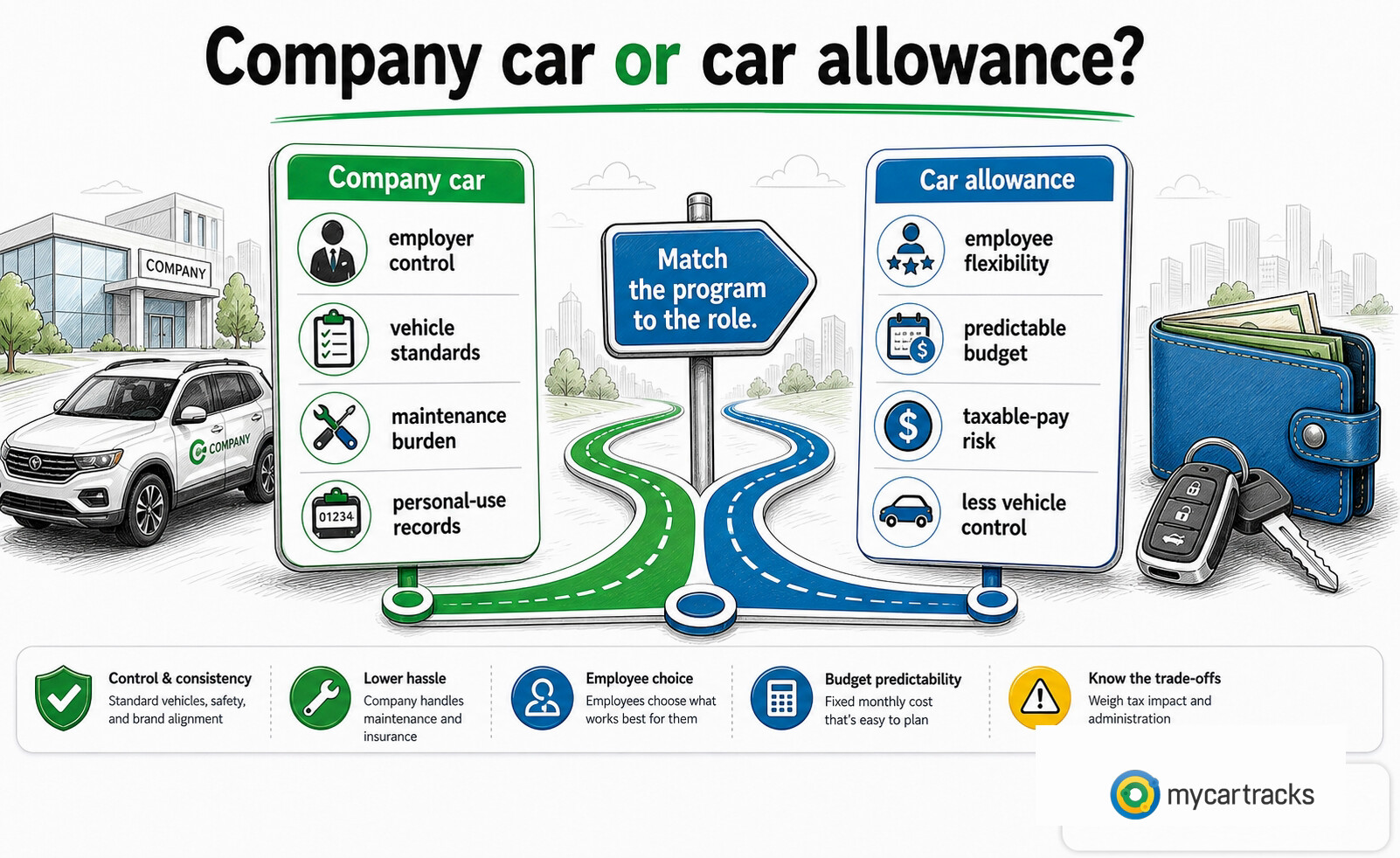
Financial implications
Company cars create more direct spending because the business carries the vehicle, insurance, maintenance, and replacement cycle. A car allowance moves much of that burden back to the employee, but a flat payment can quietly become expensive if it does not reflect how roles actually drive.
Personal use of a company car also creates payroll work. Publication 15-B explains that when an employee uses an employer-provided vehicle for personal use, that value must generally be included in wages or reimbursed by the employee.
Employers may value that use through the annual lease value rule, the cents-per-mile rule, or the commuting rule when the vehicle qualifies. If the vehicle was first made available in 2026, the fleet-average and cents-per-mile valuation rules only apply if the vehicle’s fair market value does not exceed $61,700 under Notice 2026-10.
Employee satisfaction
Some employees will prefer a company car because it removes the burden of maintaining a suitable vehicle for the job. Others will prefer an allowance because they want control over what they drive.
A technician who needs tools and storage may not value flexibility as much as reliability. A field manager who flies often may value flexibility more than an assigned vehicle.
Operational efficiency
Operationally, a company-car program only works well if the business is prepared to manage maintenance follow-up, accident handling, insurance coordination, and personal-use records.
A car allowance is lighter, but it does not remove the need for standards. The business still has to decide on minimum insurance and required vehicle classes.
The role of a mileage tracker app
Mileage tracking matters in both models. For company cars, it helps separate business use from other personal use. For car allowances, it helps the business check whether the allowance still matches the work or whether a mileage-based method would be cleaner.
If you want the record layer in one system, MyCarTracks automatic mileage tracking can help with trip capture. For broader reporting and admin workflows, use the MyCarTracks features overview.
Mileage tracking and records
Mileage tracking is usually what keeps this comparison honest after the policy goes live. A company car needs business-versus-personal-use records, and a car allowance needs enough trip data to show whether the payment still fits the role or whether the company should switch methods.
The best record includes the trip date, destination or route, business purpose, distance, vehicle, and any separately handled tolls or parking. If the proof is weak, IRS Mileage Log Requirements and Business Miles vs Commuting Miles are the best next reads.
Car allowance vs. company cars - which one to choose?
The better choice is the one that matches the job, not the one that sounds more generous in the abstract.
Which to choose for business
Choose a company car when the business truly needs control over vehicle class, branding, equipment, or readiness. That is common when vehicles are part of the service model itself, not just transportation support.
Choose a car allowance when the business mainly wants to support work driving without carrying a full vehicle asset and the roles do not require the same level of control. If neither option feels precise enough, the next comparison is often What Is Mileage Reimbursement? or FAVR Reimbursement Plans Explained.
Which to choose for employees
Employees who want fewer out-of-pocket surprises and less personal vehicle responsibility may prefer a company car. Employees who value vehicle choice and do not want their transportation tied to a company asset may prefer an allowance.
The best answer often depends on mileage, vehicle expectations, personal preference, and how much of the role’s vehicle burden the employer is willing to carry. If your real problem is setting fair reimbursement rather than assigning vehicles, Mileage Reimbursement Rules for Employers and How to Create a Mileage Reimbursement Policy are the next practical reads.
Common mistakes
- assuming a company car removes the need for mileage tracking
- using a car allowance without checking whether the amount still fits the territory or mileage pattern
- ignoring personal-use valuation rules on employer-provided vehicles
- letting branding or vehicle-class expectations stay informal instead of writing them into policy
- treating one employee preference as if it should decide the program for every role
FAQ
Is it better to get a company car or provide mileage reimbursement?
It depends on the role. A company car often makes more sense when the business needs control over the vehicle itself. Mileage reimbursement usually makes more sense when employees use personal vehicles and the company wants the payment to follow actual business driving instead of maintaining a fleet.
What is a good car allowance amount?
A good allowance should reflect the role’s expected business driving, vehicle expectations, territory, and the cost the company is trying to help cover. If the amount is just a round number that never changes, it will often be too high for some employees and too low for others.
What are the tax implications of a company car?
Business use of an employer-provided vehicle is generally not the same as personal use. Publication 15-B explains that personal use usually has to be valued and included in wages unless the employee reimburses the employer for that use. Employers may use the annual lease value rule, the cents-per-mile rule, or the commuting rule when the vehicle qualifies, and the 2026 fair market value cap for the fleet-average and cents-per-mile valuation rules is $61,700 under Notice 2026-10.
MyCarTracks workflow
MyCarTracks can support either model when the company needs a cleaner record:
- Capture trips by driver and vehicle.
- Separate business driving from commuting and personal use.
- Review unusual routes before payroll or reimbursement review.
- Export reports by employee, vehicle, territory, or period.
- Keep the supporting file attached to the policy in force at the time.
What to read next
- Car Allowance vs Mileage Reimbursement
- FAVR Reimbursement Plans Explained
- What Is a Fleet Vehicle?
- What Is Mileage Reimbursement?
- Mileage Reimbursement Rules for Employers
- Business Miles vs Commuting Miles